
Relief for Neck and Shoulder Pain: A Chiropractor's Guide to Better Sleep in Charlotte, NC

If you're waking up in Charlotte with a stiff neck or aching shoulders, the way you're sleeping is very likely the culprit. As a local chiropractor dedicated to helping our community find lasting relief, we know that the best positions for avoiding neck and shoulder pain are, without a doubt, on your back or your side.
Why? Because these positions allow your head, neck, and spine to rest in a neutral, properly supported line. The entire goal is to avoid any posture that twists or puts undue strain on the delicate structures in your neck, allowing your body to heal and recover overnight.
Why Your Sleep Position Is Fueling Your Pain
That morning stiffness or dull ache in your shoulder isn't just a bad way to start the day. It's a clear signal from your body that something is wrong. While it's easy to blame a stressful workday or an old injury, those eight hours you spend in bed can either be a time for healing or a period that actively makes your pain worse.
The connection between your sleeping habits and the pain you feel is direct and powerful. Many common sleep postures, which might feel comfortable at first, can force your spine out of its natural, healthy alignment. This kicks off a painful cycle where your body never truly gets the chance to rest and repair itself. Instead, your muscles and ligaments are strained all night long, leading to the inflammation and stiffness that greet you every morning.
The Hidden Stress of Poor Sleep Posture
Think of your spine as a carefully stacked column. All day long, gravity and your posture challenge its alignment. Nighttime should be its chance to decompress and recover. Unfortunately, for many people in Charlotte dealing with persistent neck and shoulder pain, the exact opposite is happening.
Did you know that researchers have identified poor sleeping positions as the primary cause behind 5% of chronic neck pain cases? While issues like injuries or poor daytime posture make up the rest, that 5% still represents millions of people suffering needlessly.
Stomach sleeping is a perfect example. To breathe, you have to twist your head nearly 90 degrees to one side. This extreme angle wrenches your cervical spine out of alignment, putting constant strain on your neck and shoulder muscles for hours on end.
The reality is, your posture at night can completely undo any progress you make during the day. It's a critical, yet often overlooked, piece of the wellness puzzle—especially for those of us with desk jobs or active lifestyles here in Charlotte.
From Bad Habits to Chronic Misalignment
Night after night, this strain does more than just cause temporary stiffness. It can lead to a persistent misalignment of the upper cervical spine, specifically the top two vertebrae: the atlas (C1) and the axis (C2). These bones are incredibly important, as they protect the brainstem and are the gateway for nerve communication to the rest of your body.
When these vertebrae are constantly pushed out of place, it can interfere with the central nervous system and trigger a cascade of problems:
- Chronic tension in the neck and shoulders
- Frequent tension headaches or even migraines
- Numbness or tingling that radiates into the arms and hands
- Poor sleep quality, leaving you feeling exhausted and sore
This is where the specialized upper cervical chiropractic care we provide at The Upper Cervical Spine Center becomes so crucial. We know your pain is real, and we understand that it's often tied directly to these correctable habits and the underlying misalignments they create. Many of these issues are also linked to daytime habits, which is why it's so important to learn how to fix forward head posture.
As a trusted chiropractor serving Charlotte, NC, we focus on identifying and addressing the root cause of your pain. Our goal is to guide you toward lasting relief so you can finally wake up feeling refreshed and ready for your day.
The Best Sleeping Positions for Spinal Health
If you're waking up with a sore neck or aching shoulders, the way you sleep might be the culprit. As a chiropractor in Charlotte, this is a problem we help patients solve every day. The good news is that a simple change in your sleeping position can make a world of difference.
The two positions we always recommend are sleeping on your back or on your side. Why? Because they make it much easier to maintain a neutral spine. Think of it as keeping your head, neck, and back in one straight, relaxed line. This alignment allows your muscles to truly rest and repair themselves overnight, which is exactly what they're supposed to do.
Let's break down how to perfect each of these positions.
Back Sleeping: The Gold Standard for Alignment
From a biomechanical standpoint, sleeping on your back is the undisputed champion for spinal health. It lets gravity do the work, keeping your body centered and preventing the awkward twists that cause you to wake up in pain. It also distributes your body weight evenly, which means less pressure on your joints.
Here's the interesting part: even though it's the best option, it's not very popular. Research shows that only about 8% of people are back sleepers. That's a shame, especially when you consider that nearly 35% of adults struggle with chronic shoulder pain. For many of them, simply learning to sleep on their back could bring significant relief. You can learn more about how sleep posture impacts shoulder health and get tips to make the switch.
If you're ready to give it a try, here’s how to set yourself up for success:
- Go for a Low-Profile Pillow: The pillow under your head should support the natural curve of your neck, not prop it up at an angle. A cervical pillow or a thinner memory foam one usually does the trick.
- Support Your Knees: This is a game-changer. Slide a larger pillow under your knees to maintain the natural curve of your lower back. You'll feel the tension in your lumbar spine and hips just melt away.
- Keep Your Arms Neutral: Let your arms rest comfortably by your sides or on your stomach. Try to avoid putting them up over your head, as this can put a lot of strain on your shoulder joints.
Side Sleeping: A Great Alternative (With the Right Support)
Side sleeping is by far the most common position—about four out of ten adults prefer it. While it can be a perfectly healthy way to sleep, it requires a bit more strategic support to prevent your shoulder from collapsing forward or your neck from bending at a weird angle.
Without the right pillow setup, side sleeping can easily compress the shoulder you're lying on and misalign your neck, leading to that all-too-familiar morning stiffness. The key is to create a perfectly straight line from your head all the way down to your pelvis.
The diagram below shows exactly what happens when your body isn't supported correctly.
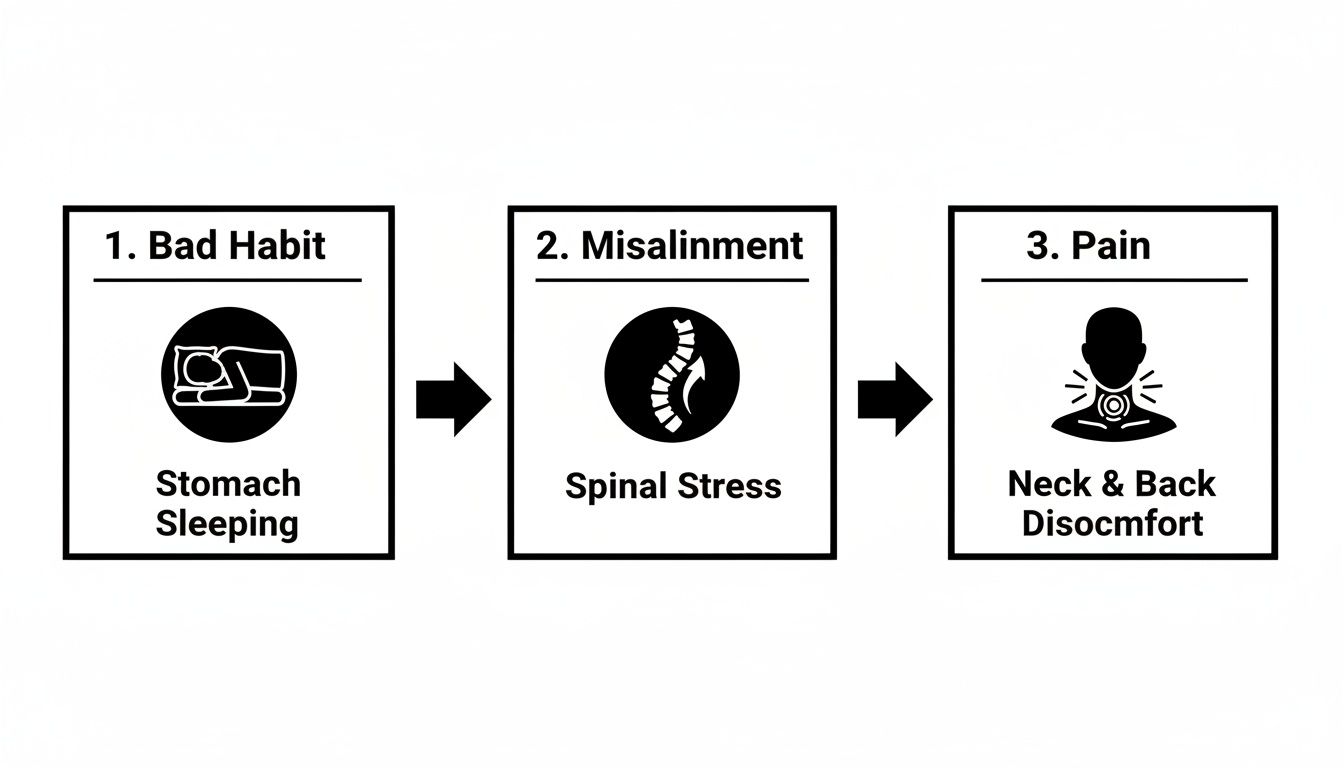
This chain reaction—from poor posture to spinal misalignment to chronic pain—is something we see daily in our Charlotte chiropractic office.
To make side sleeping work for you, not against you, follow these tips:
- Get the Pillow Height Just Right: Your pillow’s only job here is to fill the space between your ear and the mattress, keeping your neck straight. Side sleepers almost always need a thicker, firmer pillow than back sleepers.
- Hug a Pillow: Seriously. Placing a body pillow (or any spare pillow) in front of you gives your top arm a place to rest. This small trick stops your shoulder from rolling forward and straining your upper back.
- Put a Pillow Between Your Knees: A small pillow wedged between your knees will keep your top leg from sliding down. This helps prevent your pelvis and lower back from twisting out of alignment during the night.
To make it easier to see the differences, here's a quick comparison of the two best positions.
Comparing Recommended Sleeping Positions
Ultimately, the best position is the one that allows your body to rest in a supported, neutral alignment.
Expert Takeaway: "The goal in any position is balance. Your body needs support to maintain its natural curves. For side sleepers, this means actively using pillows to prevent collapse and rotation, ensuring your spine stays straight all night."
By making these conscious adjustments to your sleep setup, you give your body the supportive environment it needs to heal. If you've tried these tips and still can't shake that neck or shoulder pain, it might point to a deeper structural issue. That's where we come in. At The Upper Cervical Spine Center in Charlotte, we can help identify and address the root cause of your discomfort.
The One Sleep Position You Absolutely Must Avoid
We've covered the best ways to set yourself up for a pain-free night, but it's just as crucial to talk about what not to do. When it comes to neck and shoulder pain, there's one position that’s a guaranteed troublemaker: stomach sleeping.
If you're waking up day after day with a stiff neck, nagging headaches, or sore shoulders, this habit is almost certainly pouring fuel on the fire. In our Charlotte clinic, helping patients break the stomach-sleeping cycle is often the first and most impactful step toward real relief.

Why Stomach Sleeping Is a Biomechanical Nightmare
The core issue here is pure anatomy. To breathe while on your stomach, you have no choice but to crank your head to one side. This forces your neck into a nearly 90-degree rotation that you hold for hours.
Think about it: would you sit at your desk with your head twisted like that all day? Of course not. You'd be in agony. Yet, countless people put their neck through this exact ordeal every single night.
This extreme, prolonged twist puts immense stress on the delicate joints of your cervical spine, particularly the atlas (C1) vertebra. The atlas is the very top bone in your neck; it’s responsible for holding up your head and allowing you to turn it.
When you lock it into this awkward position all night, you're constantly straining the surrounding muscles, ligaments, and nerves. This is a direct recipe for problems we see every day, like:
- Waking Up Stiff: The muscles in your neck and upper back are stuck in a tight, contracted state, which stops them from ever truly relaxing and repairing overnight.
- Tension Headaches: The suboccipital muscles at the base of your skull get overworked, triggering those familiar headaches that start in your neck and creep up behind your eyes.
- Nerve Irritation: The unnatural twist can pinch the nerves that exit your spinal column, causing that awful tingling, numbness, or weakness down your arms and into your hands.
The research backs this up completely. Chronic pain is incredibly common, with studies showing 33.9% of workers suffer from neck pain and 34.7% from shoulder pain. Poor sleep posture is a massive contributor, and stomach sleeping is a prime offender that directly mangles your spinal alignment. If you're interested, you can read more about the study on sleep and musculoskeletal pain and see the data for yourself.
At The Upper Cervical Spine Center, we regularly trace a patient's chronic atlas misalignment directly back to a long-term stomach sleeping habit. This isn't just a minor issue; it's a direct cause of structural problems that need professional intervention to correct.
The Damage Doesn't Stop at Your Neck
Stomach sleeping is a full-body problem. The strain it creates travels down your entire spine.
When you lie on your stomach, your hips and midsection tend to sink into the mattress, especially if it’s even a little bit soft. This creates an exaggerated, unnatural arch in your lower back—a position called hyperextension. This puts a ton of pressure on your lumbar vertebrae and is a common cause of persistent low back pain.
Your spine is one interconnected system. Stress at one end will inevitably cause problems at the other. By forcing your body into a "U" shape, stomach sleeping creates a posture it was never meant to hold for eight hours straight. It's no wonder so many stomach sleepers also struggle with sciatica, hip pain, and general lumbar soreness.
For our patients in Charlotte, understanding these biomechanics is the lightbulb moment that fuels the desire to change. The motivation comes when you realize this "comfortable" habit is actively preventing your body from healing. Our specialty is correcting the misalignments that result from this, but the first step in prevention starts with how you position yourself tonight.
Choosing the Right Pillow and Mattress
Getting your sleeping position right is a massive step towards waking up pain-free, but it's only half the story. Your mattress and pillow are the tools that actually make proper alignment possible. We often tell our patients in Charlotte to think of them as an investment in their spinal health—they provide the foundational support your body needs to truly rest and heal overnight.
Choosing the right gear goes way beyond just picking what feels softest in the store. It's about a thoughtful approach based on your specific sleeping style. At The Upper Cervical Spine Center, we see these choices as an active part of recovery, reinforcing the proactive, health-forward philosophy we champion for our community.

Pillow Selection for Back Sleepers
If you're a back sleeper, your main goal is to support the natural curve of your neck (your cervical spine) without cranking your head forward. A pillow that’s too high will do just that, creating the same kind of strain you get from looking down at your phone for hours.
You need a pillow that cradles your neck but lets your head rest in a neutral, level position. Here’s what to look for:
- Low to Medium Loft: "Loft" is just a fancy word for pillow height. Back sleepers almost always need a thinner pillow to keep the spine happy and aligned.
- Cervical or Contour Pillows: These are a game-changer. They’re specifically shaped with a built-in curve to support the neck and a lower, flatter area where your head rests. This design is fantastic for maintaining proper posture.
- Memory Foam: We often recommend memory foam because it conforms to your unique shape, giving you customized support that doesn’t just flatten out by 3 a.m.
A good pillow can make a world of difference, especially if you also deal with headaches. You can learn more about that connection in our guide on finding the best pillow for headaches.
Pillow Selection for Side Sleepers
Side sleepers face a completely different challenge: you have to bridge that big gap between your ear and the outside of your shoulder. If your pillow is too thin, your head will sag downwards, straining your neck all night. Too thick, and it gets pushed upwards, creating just as much of a problem.
The perfect pillow for a side sleeper keeps the head, neck, and spine in one perfectly straight line.
Your pillow's job is to fill the exact space created by your shoulder's width. A firmer, higher-loft pillow is almost always necessary to prevent the head from tilting and ensure your neck muscles can fully relax.
To find the right fit, think about these points:
- Find Your Loft: A simple trick is to measure the distance from your ear to the edge of your shoulder. Look for a pillow with a loft that matches that measurement.
- Choose Firmer Support: A soft, fluffy pillow might feel nice at first, but it will likely compress too much under the weight of your head, failing to provide the support you need. Opt for firm memory foam, latex, or another dense material that holds its shape.
The Importance of a Supportive Mattress
Your mattress is the foundation for your entire body. If it’s too soft, your hips and shoulders will sink in too deeply, forcing your spine into an unnatural hammock-like curve. On the flip side, a mattress that’s rock-hard won’t have any give, creating painful pressure points and failing to support your body's natural shape.
For both back and side sleepers, a medium-firm mattress is usually the sweet spot. It offers enough support to keep the spine aligned while providing just enough cushion to relieve pressure on your joints, especially the hips and shoulders. Finding the best mattress for side sleepers can be particularly crucial for alleviating shoulder pain.
By pairing the right sleeping position with the right equipment, you create an ideal environment for truly restorative sleep. But if you've made these changes and still struggle with pain, that’s a strong sign that an underlying spinal misalignment needs to be addressed by a specialist.
How Upper Cervical Chiropractic Care in Charlotte Ends Sleep-Related Pain
You’ve done everything right. You bought the expensive ergonomic pillow, you've been practicing sleeping on your back, and you even put another pillow between your knees. So why do you still wake up with that familiar, nagging ache in your neck and shoulders?
When you’ve tried all the common-sense solutions and the pain persists, it’s a strong signal that the problem runs deeper than your sleep habits.
Years of awkward sleeping postures—especially stomach sleeping—can do a lot more than just strain your muscles overnight. Over time, this prolonged stress can contribute to a stubborn misalignment of your atlas vertebra. This is the very top bone in your spine, and it’s responsible for supporting the entire weight of your head. As you can imagine, its position is incredibly important.
When the atlas gets pushed out of its proper alignment, it can irritate and disrupt the central nervous system. The brainstem, which passes right through the center of the atlas, is essentially the main communication highway for your entire body. A misalignment creates a "traffic jam" on this highway, interfering with the critical nerve signals that control everything from your muscle tension to your ability to get restful sleep.
The Misalignment and Its Ripple Effect
This disruption is often the true source of many chronic issues we see in our patients here in Charlotte. When the head isn't sitting correctly on the spine, the body instinctively tries to compensate. It forces the muscles in your neck and shoulders to constantly tighten up just to keep your head level.
This constant state of tension is what leads to symptoms that just won't seem to go away, no matter what you try at home:
- Chronic Neck and Shoulder Pain: Your muscles are always on high alert, which leads to inflammation, stiffness, and persistent pain.
- Persistent Headaches: That constant tension at the base of the skull is a primary trigger for tension headaches and can even contribute to debilitating migraines.
- Poor Sleep Quality: An agitated nervous system makes it incredibly difficult to fall asleep and stay asleep, leaving you feeling exhausted even after a full 8 hours in bed.
For many of our patients, this is the missing piece of the puzzle. They realize the problem isn't just a "sore muscle"—it's a foundational structural issue at the very top of their spine that's keeping their body in a constant state of stress.
Here at The Upper Cervical Spine Center, we address this problem at its source. We don't just chase symptoms with temporary fixes. Our entire focus is on correcting the underlying cause with a precise, gentle, and non-invasive approach that restores proper communication within your nervous system.
The Upper Cervical Solution: Precise and Gentle Care
Our method is very different from what you might expect from general chiropractic care. We always start with advanced 3D imaging to get a crystal-clear, detailed picture of your upper cervical spine. This allows us to see the exact angle and direction of the atlas misalignment, measured down to the millimeter. There is absolutely no guesswork.
Using this precise diagnostic imaging, we create a correction plan that is completely customized to your unique anatomy. The adjustment itself is incredibly gentle. You won’t experience any of the twisting, popping, or cracking often associated with neck adjustments. Our goal is simply to guide the atlas back to its natural position, which immediately takes pressure off the brainstem and allows your body to do what it’s designed to do: heal.
Once the atlas is back in proper alignment, the healing process can truly begin. Our patients in Charlotte frequently tell us they experience:
- Dramatically Improved Sleep: With the nervous system finally calm, the body can achieve the deep, restorative sleep it needs.
- Increased Energy: Waking up refreshed and pain-free means having more energy and focus to get through your day.
- Real, Lasting Relief: By correcting the root cause, we help your body break the cycle of chronic pain for good.
If you’ve tried changing every pillow and position you can think of and are still struggling, it’s time to look deeper. The definitive solution might not be a new mattress, but a precise correction that restores your body's innate ability to function and heal. We offer a path to wellness that is free from drugs and surgery—it’s about getting back to living your life without being held back by pain.
Your Top Questions About Sleep and Neck Pain, Answered
Making changes to how you sleep is a great start, but it often brings up more questions. It's one thing to know what to do, but another thing entirely to put it into practice. Here in our Charlotte practice, we hear a lot of the same questions from people who are trying their best but are hitting a few snags.
Let's clear up some of that confusion. Our goal here is to give you the confidence to take control of your spinal health and get the restful, pain-free sleep you deserve.
How Long Does It Take to Get Used to a New Sleeping Position?
Honestly, it varies. If you're trying to shift from being a stomach sleeper to a side sleeper, you’re fighting years of habit. It could take just a few nights, or it might take a few weeks. The key is to be patient and consistent.
A great trick is to use pillows as a physical barricade to keep you from rolling back into your old position. For new side sleepers, we often recommend hugging a body pillow. It provides support in the front and makes the position feel much more stable and natural, which can make all the difference.
If you've stuck with it for several weeks and the pain is still there—or maybe even getting worse—that’s a huge clue. It often points to an underlying spinal misalignment that needs a professional look. This is where a neck pain chiropractor in Charlotte can address the real root of the problem.
Is It Bad to Sleep with My Arm Under My Pillow?
Yes, this is one habit we strongly encourage patients to break. It's incredibly common, especially for side sleepers, but it can cause some serious shoulder and neck issues down the road.
When you tuck your arm under your pillow, you can compress the bundle of nerves running through your shoulder and armpit. This is what causes brachial plexus impingement, which is just a technical way of saying you're pinching the nerves that lead to your arm. That's where the pins-and-needles, numbness, or even sharp, radiating pain comes from. It also hikes your shoulder up, creating constant tension in your neck. A better bet is to rest your arm on a body pillow or just let it relax by your side.
Can Upper Cervical Care Really Help with Pain from Sleeping Wrong?
Without a doubt. Changing your sleep posture is fantastic for managing the daily strain, but if you have chronic pain, it's often a sign of a deeper structural problem. All those years of sleeping in a less-than-ideal position can easily cause or worsen a misalignment of the atlas—the C1 vertebra—at the very top of your spine.
When this tiny bone is out of place, it disrupts the communication between your brain and your body. This leads to a frustrating cycle of muscle tension and inflammation that just won't quit. Here at The Upper Cervical Spine Center in Charlotte, we use precise diagnostics and gentle corrections to get to that root cause. By restoring proper alignment, we allow your nervous system to work as it should, giving your body a chance to finally heal itself. That’s how you get lasting relief that changing your pillows alone can't provide.
At The Upper Cervical Spine Center, we're committed to helping you find the true source of your pain and giving you a clear path to feeling better. If you're done with waking up sore and you're ready for a solution that lasts, we're here to help our Charlotte community live pain-free.
Schedule your complimentary clarity call with our Charlotte team today!
Address
2550 W Arrowood Rd
Suite 104
Charlotte, North Carolina, 28273
United States
Hours
Monday-Friday:
9AM-12PM
&
2PM-6PM
We Align the Head and Neck So That the Nerves Can Send Brain Healing Messages to Affected Parts Of Your Body.
It's a Natural Self Healing.
