
Finding the Best Pillow for Headaches in Charlotte

Waking up with a throbbing head is a miserable way to start the day here in Charlotte. If you're constantly fighting morning headaches, the solution might be simpler than you think. For many people, the best pillow for headaches is one that properly supports the natural curve of your neck, keeping your spine aligned all night. A well-chosen cervical or memory foam pillow can prevent the muscle strain that leads to tension and neck-related headaches, but sometimes, the problem runs deeper.
At The Upper Cervical Spine Center, our Charlotte chiropractors help patients find the root cause of their chronic pain. While the right pillow is a critical tool for spinal health, it's often part of a larger solution for lasting headache relief.
Is Your Pillow Causing Your Morning Headaches?
If you wake up with a nagging headache, the culprit might be the very thing you rest your head on. Your pillow has one critical job: to maintain the delicate alignment of your head, neck, and spine. If it's too high, too low, or has lost its shape, it forces your neck into an awkward angle for hours. This sustained poor posture puts tremendous strain on the muscles and ligaments of your cervical spine, often leading to chronic morning pain.
This is a common complaint we hear from new patients at our Charlotte chiropractic clinic. They've tried everything, not realizing their pillow is actively working against them night after night.
The Connection Between Neck Strain and Headaches
This constant muscle tension doesn't just stay in your neck. The pain often radiates upward, triggering what are known as cervicogenic headaches—headaches that originate from a problem in the cervical spine. You can learn more about how neck pain can be the root cause of your headaches in our detailed article.
As a leading chiropractor in Charlotte, NC, we see a direct link between chronic headaches and poor sleeping posture, which is often worsened by an underlying spinal misalignment. The strain from a bad pillow accumulates night after night, compromising your spinal health and locking you into a cycle of pain that can be hard to break without professional help.
A pillow should cradle your head and neck, not crane it. The goal is to achieve a "neutral spine," where your head isn't tilted up, down, or to the side, but rests in a straight, natural line with the rest of your body.
You don’t have to accept daily headaches as your new normal. Understanding the role your pillow plays is a huge first step toward relief. Making this one simple, informed change can dramatically reduce morning pain. Our team is here to provide the expert chiropractic care you need to get to the true source of your pain.
How Poor Sleep Posture Triggers Chronic Headaches
Think of your neck, or your cervical spine, as a delicate bridge connecting your head to the rest of your body. This bridge, made up of seven small vertebrae, is a crucial pathway for your nervous system. When your pillow isn't doing its job, it forces this bridge into an awkward, kinked position for hours on end.
This constant misalignment puts a ton of strain on your neck muscles, leading to irritation, tension, and even pinching off blood flow to your head. It’s no surprise that this is a direct recipe for those dull, persistent headaches that greet you in the morning. Understanding this connection is the first step toward choosing a pillow that helps, not hurts, and seeking care from a neck pain chiropractor when needed.
This chart breaks down the common culprits behind morning headaches, showing how your pillow, neck strain, and sleep quality are all tangled together.
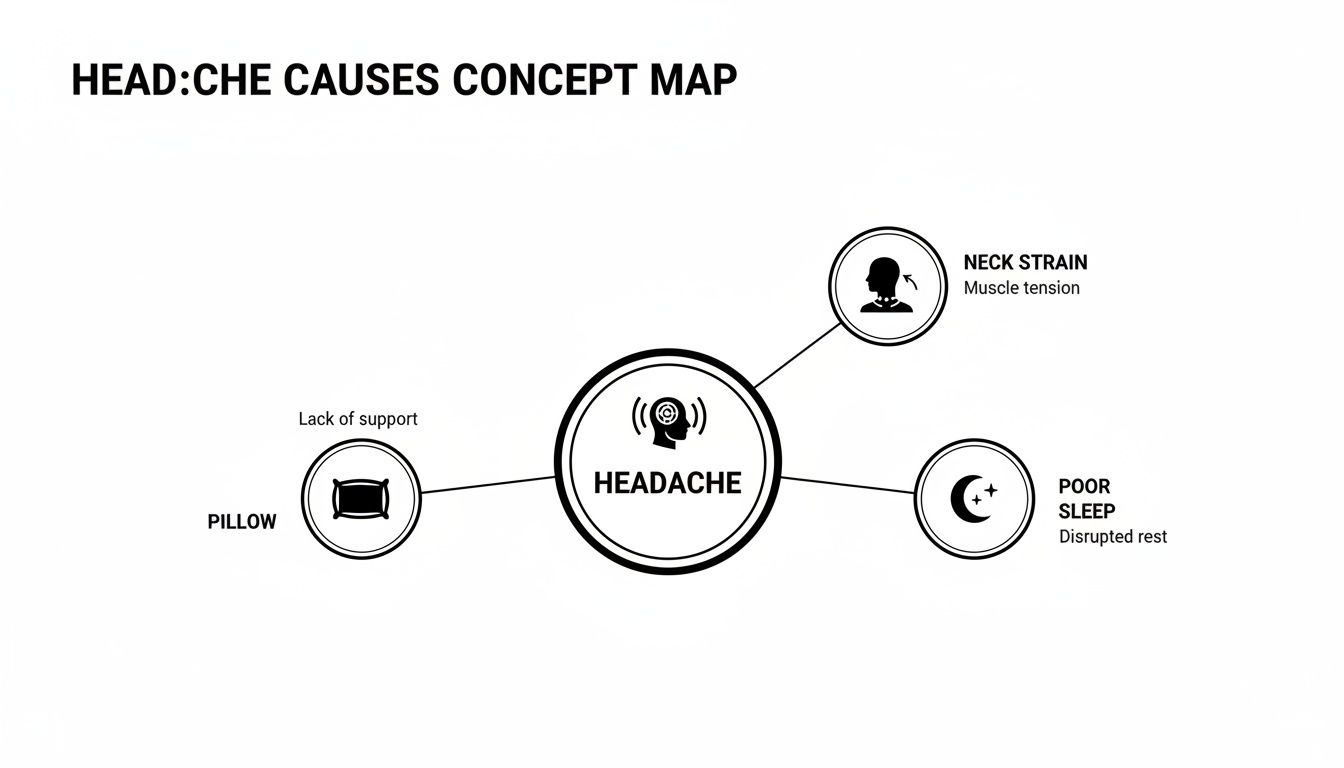
As you can see, a bad pillow is often the root of the problem. It directly causes neck strain and disrupts sleep, creating a frustrating cycle of chronic pain.
Your Sleeping Position and Spinal Health
How you sleep has a huge impact on the amount of stress your neck endures every night. Each position demands a different kind of support to keep your spine "neutral"—that sweet spot where your head, neck, and shoulders are perfectly aligned.
- Back Sleepers: Sleeping on your back is usually the best-case scenario for spinal alignment. But a pillow that’s too high will crank your head forward, while one that's too flat will let it drop back. Both throw the natural curve of your neck out of whack.
- Side Sleepers: This is how most of us sleep. The biggest challenge here is bridging the wide gap between your head and the mattress. Your pillow has to fill that space completely to stop your head from drooping and causing a nasty sideways strain on your neck.
- Stomach Sleepers: From a spine-health perspective, this is the worst position. It forces you to wrench your head to one side for hours, compressing the vertebrae and straining ligaments. This can trigger a specific kind of headache called a cervicogenic headache, which starts in the neck. You can learn more about what is cervicogenic headache in our detailed guide.
The Science Behind Pillow Support and Headaches
The link between poor neck alignment and morning headaches isn't just a hunch; it's well-established. And with more people experiencing issues like "tech neck" from looking down at screens all day, the need for proper support during sleep has never been more critical.
A pillow’s purpose isn't just to be soft. It has a mechanical job to do: keep your spine in a neutral position. When it fails, the muscles in your neck and upper back have to work all night to compensate, leading to fatigue, inflammation, and pain.
This growing awareness is why the market for cervical pillows is booming. It's expected to grow from $5.37 billion in 2026 to $7.02 billion by 2031.
A bad pillow doesn't just cause pain; it ruins your sleep quality, locking you into a vicious cycle. And often, the problem isn't just headaches. Finding the right pillow is also key to choosing the best pillows for neck pain, since the two issues are so closely related. By tackling the root cause—misalignment—you can finally break that cycle of morning pain and start getting the deep, restorative sleep you need.
How to Choose the Right Pillow for Headache Relief
Now that we've connected the dots between your pillow and those morning headaches, let's get practical. Finding the right pillow isn't about buying the most expensive one or grabbing whatever is on sale. It's about a personalized fit—matching the pillow's features to your unique body and sleep style.
Think of it like being fitted for the perfect pair of running shoes. What works for a marathoner is all wrong for a sprinter. Our goal is to give you the knowledge to make a therapeutic choice for your neck, not just a comfortable one.
Demystifying Pillow Loft and Firmness
You're going to see two words pop up everywhere: loft and firmness. Getting these two factors right is the secret to keeping your spine in a neutral, happy alignment all night long.
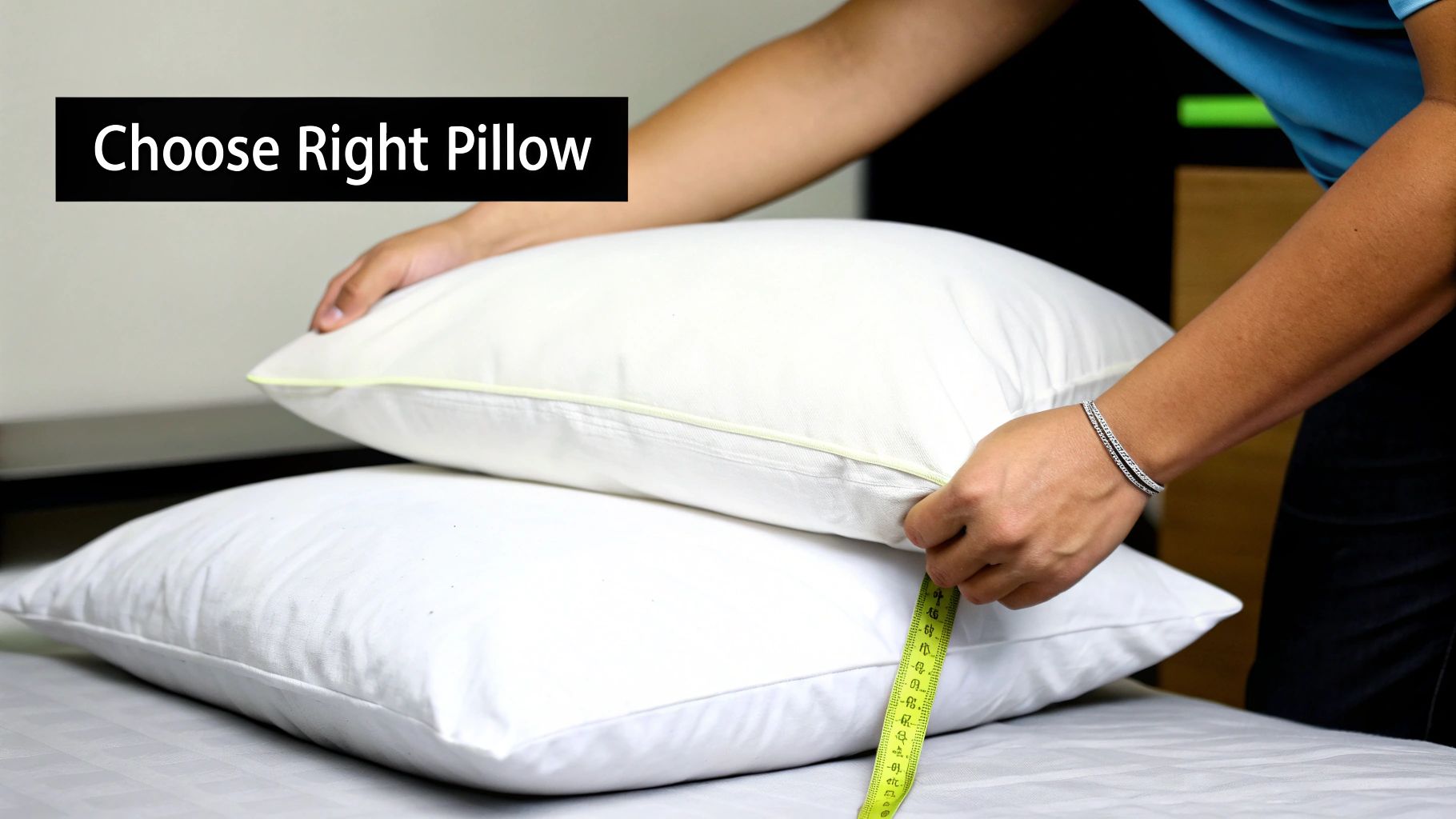
Loft (Pillow Height): This is simply how thick or tall the pillow is. The right loft perfectly fills the gap between your head and the mattress, so your neck stays in a straight line with the rest of your spine. Too high or too low, and you're forcing your neck into a stressful angle for hours.
Firmness (Support Level): This describes how much your head sinks when you lie down. A pillow that's too soft lets your head droop, undoing all the benefits of the right loft. But one that's too firm can feel like you're sleeping on a brick, creating new pressure points. The sweet spot is a firmness that cradles your head and neck, offering consistent support without pushing back.
For side sleepers, this is especially critical. The space between your ear and the mattress is much larger, making proper support essential. It’s worth digging into the specifics of finding your perfect pillow for side sleeping to avoid waking up with that all-too-familiar ache.
Choosing the Right Materials for Support
The stuff inside your pillow matters—a lot. For anyone battling headaches, we need materials that prioritize contouring and support over just being fluffy.
Memory Foam: This is often the MVP for headache sufferers. It molds to the exact shape of your head and neck, which helps distribute weight evenly and melt away pressure points. That adaptive support is what allows tense neck muscles to finally relax.
Latex: If you want support with a little more bounce, natural latex is a fantastic option. It’s responsive and durable, plus it’s naturally hypoallergenic and sleeps cooler than many memory foams.
Adjustable Fills (Shredded Foam, Buckwheat Hulls): These are brilliant because they put you in control. You can add or remove the filling to dial in the perfect loft and firmness for your body. That ability to customize is a game-changer.
The demand for pillows that actually do something is skyrocketing, with the cervical pillow market growing by over 12% each year. But quality is everything. Research shows that a higher-density memory foam (around 5.0 lb/ft³) can provide therapeutic support for up to three years, while cheaper, standard-density foams often lose their shape and support in less than one.
A pillow’s job is therapeutic. Its primary function is to hold your cervical spine in a neutral, relaxed position for eight hours. When you prioritize support over softness, you are investing in pain-free mornings.
The table below breaks down these key features to help you see what truly matters for your neck health.
Pillow Features for Headache Prevention
Choosing a pillow with these features in mind gives you the best shot at finding one that actively works to prevent headaches rather than cause them.
Your Practical Pillow Buying Checklist
Ready to shop? Don't get overwhelmed. Use this simple checklist to stay focused on what will actually help your headaches.
Assess Your Primary Sleep Position: Are you mostly on your side, back, or a bit of both? This is the first and most important question, as it dictates the loft you need.
Match Loft to Your Body Frame: A side sleeper with broad shoulders needs a much higher loft than someone with a petite frame. Back sleepers typically need a medium loft to support the neck without pushing the head forward.
Prioritize Contouring and Support: Look specifically for materials like memory foam or latex that will cradle the natural curve of your neck.
Consider an Adjustable Pillow: If you’re on the fence or have struggled to find the right fit in the past, an adjustable pillow is a safe bet. It offers the flexibility to get it just right.
Check the Return Policy: A good pillow is an investment in your health. Make sure the company offers at least a 30-night trial so you have time to see if it’s truly making a difference for your headaches.
Following these steps will help you confidently pick a pillow that works with your body, not against it. For many of our patients here in Charlotte, this simple change is the most effective first step they take toward ending the cycle of morning headaches.
Top Pillow Designs That Prevent Headaches
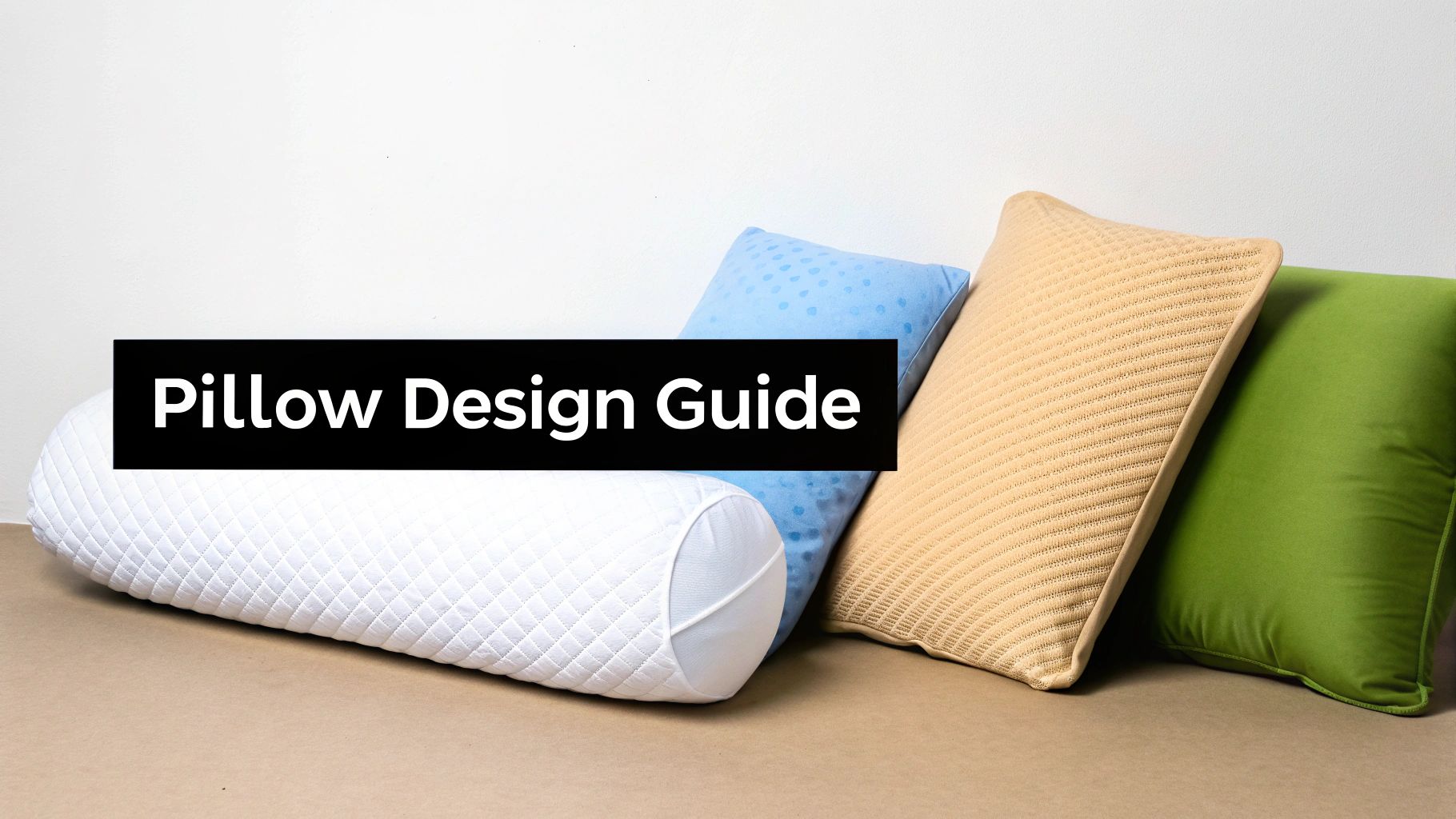
Knowing which features to look for is one thing, but seeing how they all come together in a real pillow is another. Let's walk through four of the most effective pillow designs out there for preventing headaches. Each one takes a slightly different approach to supporting your neck, but the goal is the same: to stop the muscle strain that so often triggers that morning ache.
Think of this as a non-branded guide to help you find a category of pillow that’s genuinely right for you.
Contour Memory Foam Pillows
This is probably the design that comes to mind when you think of a "therapeutic" pillow. Contour pillows have that unmistakable wave-like shape, with two raised edges and a valley in the middle. It’s not just for looks—that shape is specifically engineered to cradle the natural curve of your neck.
For back sleepers, you place the higher curve under your neck, letting your head rest in the lower central dip. This maintains the gentle, healthy forward curve of your spine (the cervical lordosis) and stops your chin from being pushed toward your chest.
Side sleepers can get great results, too. Just turn the pillow around and use the higher loft to perfectly fill the space between your ear and the tip of your shoulder. This keeps your head, neck, and spine in one straight, happy line.
Why It Works: A contour pillow fills the empty space under your neck, which means your neck muscles can finally stop working and just relax. When they are properly supported all night, the odds of waking up with a tension or cervicogenic headache drop dramatically.
Cervical Roll Pillows
Don’t let the simplicity fool you. A cervical roll (or neck roll) is a cylindrical pillow that provides incredibly targeted support right where you need it. You can use one on its own or, a popular trick, slide it inside the pillowcase of a flatter pillow to create your own supportive ridge.
If you’re a back sleeper, placing the roll directly under the arch of your neck gives firm, focused support. It lifts your neck just enough to encourage proper alignment, and it can feel amazing if you struggle with "tech neck" from looking down at screens all day.
While it’s not usually the best standalone option for side sleeping, a smaller roll can be a great supplement if your main pillow just isn't cutting it. Its biggest strength is its direct, no-nonsense approach to fixing your neck posture while you sleep.
Adjustable Fill Pillows
Here’s the thing about pillows: there is no "one size fits all." An adjustable-fill pillow tackles this problem head-on by putting you in the driver's seat. These pillows are filled with materials like shredded memory foam, latex, or even buckwheat hulls and have a zippered opening.
They usually come overstuffed, and you simply add or remove the filling until you get the perfect loft and firmness for your unique body.
This level of customization makes them a fantastic choice for literally any sleeper:
- Side Sleepers: Keep it packed full to create a thick, firm pillow that perfectly bridges the shoulder-to-ear gap.
- Back Sleepers: Remove some filling for a medium-loft feel that supports the neck without pushing the head up.
- Stomach Sleepers: Take out almost all the filling to get an ultra-thin pillow that keeps your neck from twisting at an awkward angle.
The ability to fine-tune the pillow means it's a great long-term investment. If your needs change, you can just adjust the filling instead of buying a whole new pillow.
Water-Based Pillows
Water-based pillows offer a totally unique type of responsive support. The design usually features a soft top layer (like polyester fiber or memory foam) for comfort and a sealed, insulated water pouch at the base. You control the firmness and height by adding or removing water.
The real magic here is how the pillow adapts. As you shift in your sleep, the water underneath moves with you, constantly filling the gap beneath your neck. This fluid movement provides consistent, gentle support in any position and prevents pressure points from forming.
Research has actually shown that water-based pillows can reduce morning pain and improve overall sleep quality. They’re an incredible solution for combination sleepers who toss and turn, because the pillow just adjusts in real-time.
When Your Pillow Isn't Enough: Lasting Headache Relief in Charlotte
Choosing a better pillow is a fantastic first step and often brings welcome relief. But what happens when you've tried the right pillows and still wake up with that nagging pain? If a new, supportive pillow helps but doesn't solve the problem, it's a strong clue that the issue runs deeper than simple muscle strain from a bad night's sleep.
Persistent morning headaches often point to an underlying structural problem in your upper cervical spine—the delicate area where your skull rests on your neck. The top bone, called the C1 or atlas, is responsible for supporting your entire head. When this bone is misaligned, a good pillow can only do so much.
The Atlas Misalignment: The Root Cause a Pillow Can't Fix
Even a slight misalignment of the atlas—caused by an old car accident, a fall, or even years of poor posture—can trigger a cascade of problems. A misaligned atlas can put pressure on the brainstem, interfering with nerve signals between your brain and body. It can also disrupt proper blood flow to and from your head.
This is often the hidden cause of chronic issues that the most ergonomic pillow in the world simply can't fix, including:
- Persistent tension headaches that feel like a tight, squeezing band.
- Cervicogenic headaches that start in the neck and creep up into your skull.
- Migraines, complete with their debilitating nausea and light sensitivity.
- General neck stiffness and a frustrating loss of mobility.
A supportive pillow can help accommodate your neck's structure, but it can't correct a foundational misalignment that has been present for months or even years.
How Our Charlotte Chiropractor Can Help
This is where the specialized upper cervical care at The Upper Cervical Spine Center in Charlotte makes a difference. We focus on detecting and correcting these tiny but powerful misalignments of the atlas vertebra. Our approach is gentle and precise, unlike the general twisting or cracking you might associate with other forms of chiropractic.
We use advanced diagnostic imaging to map out the precise angle and degree of the misalignment. Then, we make a gentle and exact correction to guide the vertebra back to its proper place. There is absolutely no twisting, popping, or cracking involved.
This gentle care takes pressure off your nervous system, restores normal blood flow, and allows your body's natural healing process to take over. For so many of our patients in the Charlotte, NC area, this is the missing piece of the puzzle that finally unlocks lasting headache and migraine relief.
The market for supportive pillows is booming, and that's great news. The global pillow market was valued at $9.7 billion in 2026 and is projected to reach $12.7 billion by 2030. This growth means people in Charlotte, Wilmington, and Nashville can find clinical-grade pillows more easily than ever. But these are just tools, and tools can only go so far. Learn more about the pillow market’s growth and trends.
If you’ve invested in a quality pillow but your headaches persist, it’s time to look at the root cause. A visit to a chiropractor near you who specializes in the upper cervical spine could be your next step toward finally waking up pain-free.
Your Questions About Pillows and Headaches, Answered
Choosing the right pillow can feel overwhelming, and it's natural to have questions. To help you find real relief and feel confident about your choice, here are the answers to some of the most common questions we hear from patients in our Charlotte clinic.
How Long Does It Take for a New Pillow to Help Headaches?
This is a great question. While some people feel a difference after just one night, it’s more realistic to expect an adjustment period. Think of it as retraining your body.
Your neck muscles have likely gotten used to being in a strained, unhealthy position night after night. A new, properly supportive pillow forces them into a healthier alignment. You might even feel a little temporary soreness as your body adapts to this new posture—that's completely normal. Give it at least 30 nights to see how your body responds before making a final judgment.
Can a Pillow Actually Cause Migraines?
It absolutely can be a trigger. While we often connect bad pillows directly to tension or cervicogenic headaches, the ripple effects can certainly contribute to migraines.
Poor neck alignment creates constant stress on the upper cervical spine. This area is a critical hub for nerves and blood vessels that lead to your head. When it's irritated, it can easily trigger a migraine attack in someone who is already susceptible. For many of our patients, a bad pillow doesn't just trigger migraines—it makes them more frequent and severe. The right pillow helps stabilize the neck, which can quiet down a major source of irritation.
What Is the Best Pillow Material for Headache Sufferers?
There's no single "best" material for everyone, but a few stand out for the specific kind of support headache sufferers need.
- Memory Foam: This is often my go-to recommendation. It excels at contouring to your unique shape, which helps distribute pressure evenly and lets those tight neck muscles finally relax.
- Latex: A fantastic alternative to memory foam, especially if you sleep hot. Latex is just as supportive but has a bit more bounce and is naturally more breathable.
- Adjustable Fills (like shredded foam or buckwheat): I love these because they put you in control. You can add or remove the filling to dial in the perfect height and firmness for your specific body type, which takes a lot of the guesswork out of finding the right fit.
Ultimately, the goal is to find a material that holds its shape and keeps your neck’s natural curve supported all night long.
How Often Should I Replace My Pillow?
Even the best pillow for headaches has an expiration date. Over time, all materials break down, lose their supportive structure, and become a haven for allergens. A pillow that's gone flat, lumpy, or hard is no longer doing its job—in fact, it's actively working against you.
Here's a good rule of thumb for replacement:
- Memory Foam & Latex: Every 2-3 years.
- Polyester/Down Alternative: Every 1-2 years.
Not sure if it's time? Try the fold test. Fold your pillow in half. If it doesn't spring right back to its original shape, it's time to let it go. A new pillow every couple of years is a small investment for the huge payoff of restorative sleep.
Is It Okay to Use Two Pillows to Stop Headaches?
Stacking pillows is almost always a bad idea for your neck. This habit usually props your head up way too high, forcing your neck into a sharp forward bend that puts immense strain on your cervical spine.
This is the exact posture that causes the tension and cervicogenic headaches you're trying to fix.
The solution isn't to stack two bad pillows. It's to find one single, great pillow with the correct loft (height) and firmness to hold your spine in a neutral line. The goal is alignment, not just elevation.
If you feel the need to use two pillows, it's a huge red flag that your current one isn't giving you the support you need.
When Should I See a Chiropractor in Charlotte for My Headaches?
A supportive pillow is a crucial tool, but it can't fix an underlying structural problem. It's meant to support a healthy spine, not correct a misaligned one. It might be time to schedule an evaluation at our Charlotte office if:
- You've diligently tried a new, high-quality pillow for a month or more with little to no improvement.
- Your morning headaches aren't going away, or they're getting worse.
- You're also dealing with neck stiffness, dizziness, or pain that radiates into your shoulders.
- You have a history of head or neck trauma—even a minor car accident or fall from years ago.
These are all signs that the root of the problem may be a misalignment in your upper cervical spine. A pillow alone can't fix that, but our gentle, precise approach can.
If you're tired of waking up in pain and ready to address the root cause of your headaches, the team at The Upper Cervical Spine Center is here to help. We are a trusted chiropractor serving patients in Charlotte, NC, and the surrounding areas. We invite you to schedule a consultation to see if our specialized care is the right fit for you and to finally find lasting relief.
Address
2550 W Arrowood Rd
Suite 104
Charlotte, North Carolina, 28273
United States
Hours
Monday-Friday:
9AM-12PM
&
2PM-6PM
We Align the Head and Neck So That the Nerves Can Send Brain Healing Messages to Affected Parts Of Your Body.
It's a Natural Self Healing.
