
How to Fix Forward Head Posture: A Guide from Your Charlotte Chiropractor

If you're in Charlotte, NC, struggling with nagging neck pain, persistent headaches, or that constant stiffness in your upper back and shoulders, the culprit might be something you haven’t considered: forward head posture. Often called "tech neck," this common condition is more than just a bad habit. Fixing it involves a targeted approach of strengthening weak back muscles, stretching tight chest muscles, and making key lifestyle changes.
For many, however, the root cause is a structural issue in the upper neck that requires professional care. At The Upper Cervical Spine Center, we help patients across Charlotte find lasting relief by addressing the underlying misalignment that causes this painful condition.
What Is Forward Head Posture?
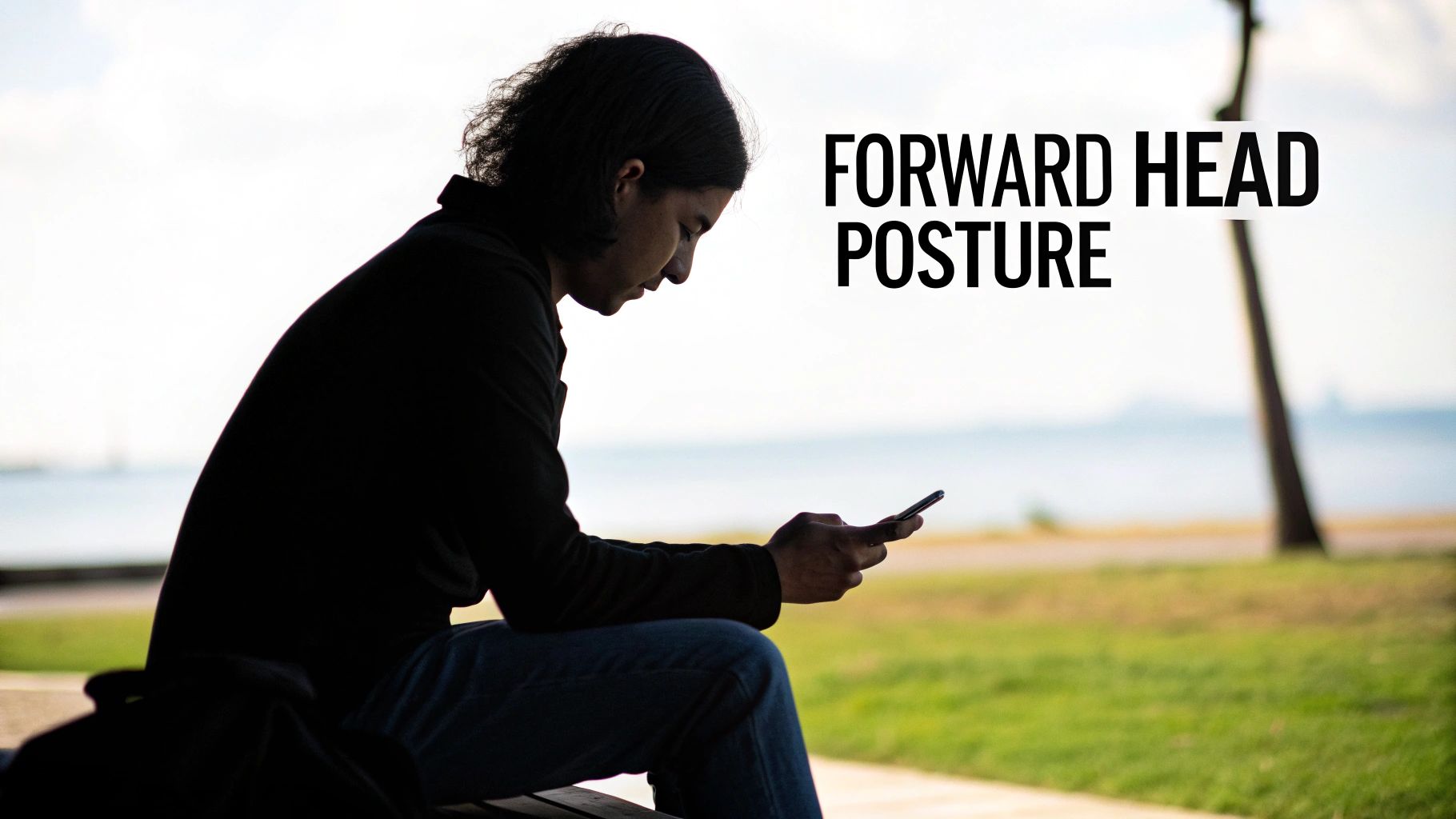
Simply put, forward head posture occurs when your head shifts forward, out of alignment with your shoulders and spine. In a healthy posture, your ears should be directly above the midpoint of your shoulders. When you have forward head posture, your ears drift noticeably in front of that line.
This isn't just a cosmetic issue. It’s a structural problem that places enormous strain on the muscles, ligaments, and discs of your neck and upper back. For every inch your head moves forward, it adds about 10 extra pounds of weight for your neck and spine to support. This constant pressure is often the trigger for chronic pain and dysfunction.
How Our Modern Habits Contribute to Neck Pain
Here in Charlotte, just like everywhere else, our daily routines are a primary driver of forward head posture. Think about how many hours you spend looking down at a phone, hunched over a laptop, or slouched on the couch. These prolonged positions place your neck under constant strain.
This postural breakdown is incredibly common, affecting over 75% of young adults. This spike is directly linked to increased device use. In fact, research shows that nearly 78% of people hold their neck in a forward-jutting position at some point during the day, heaping stress on the cervical spine. You can review the full research on lifestyle-driven posture issues to see the data.
Over time, this constant strain creates significant muscle imbalances:
- Tightened Muscles: The muscles in the front of your neck and across your chest become short and tight.
- Weakened Muscles: The muscles in your upper back and the back of your neck become overstretched and weak, losing the strength needed to hold your head in proper alignment.
This imbalance locks poor posture into place, making it feel "normal" even as it causes damage. The result? Chronic neck pain, tension headaches originating from the base of the skull, shoulder knots, and even reduced lung capacity.
At The Upper Cervical Spine Center, we see patients from all over the Charlotte area experiencing these exact symptoms. They often arrive frustrated after trying other treatments, not realizing the root cause is a structural problem that needs a precise, targeted chiropractic approach.
How to Check for Forward Head Posture at Home
Do you suspect your nagging neck pain or tension headaches are tied to your posture? There's a simple way to check your alignment right now using just a wall. This quick "wall test" provides a clear snapshot of your spinal alignment and is the first step toward understanding the root of your discomfort.
The Two-Minute Wall Test
Find a flat wall and stand with your heels about six inches away from it.
Now, lean back until your tailbone and shoulder blades are resting flat against the wall. Without forcing it, let your body settle. The key question is: Where is your head?
Ideally, the back of your head should touch the wall without effort. You shouldn't have to tilt your chin up or feel strain in your neck. If there's a gap between your head and the wall, that’s a classic sign of forward head posture. The larger the gap, the more your head has drifted from its proper center of gravity.
This is often an eye-opening moment for our new patients in Charlotte. They are frequently surprised by how much they have to strain to get their head to the wall, which highlights how tight and overworked their neck muscles have become.
Do Your Symptoms Match This List?
This self-check helps connect your physical alignment to the symptoms you feel every day. When your head juts forward, your body must compensate, creating a ripple effect of strain that can lead to various painful conditions.
Here’s a quick guide to common symptoms associated with forward head posture.
Common Symptoms of Forward Head Posture
If you performed the wall test and recognized your symptoms on this list, your body is sending a clear signal. This is more than a cosmetic issue; it’s about the underlying structural stress causing your pain. For many in our community, this simple self-check is the first step toward finding a local neck pain chiropractor who understands spinal biomechanics.
Corrective Exercises You Can Start Today
While we always recommend a professional evaluation to address the root cause of spinal issues, you can begin retraining your muscles and finding some relief with targeted exercises. The strategy is to tackle the problem from two angles: stretching the tight muscles pulling you forward and strengthening the weak muscles that should be holding you upright.
A quick way to see where you stand is the wall test. It gives you immediate feedback on your alignment.
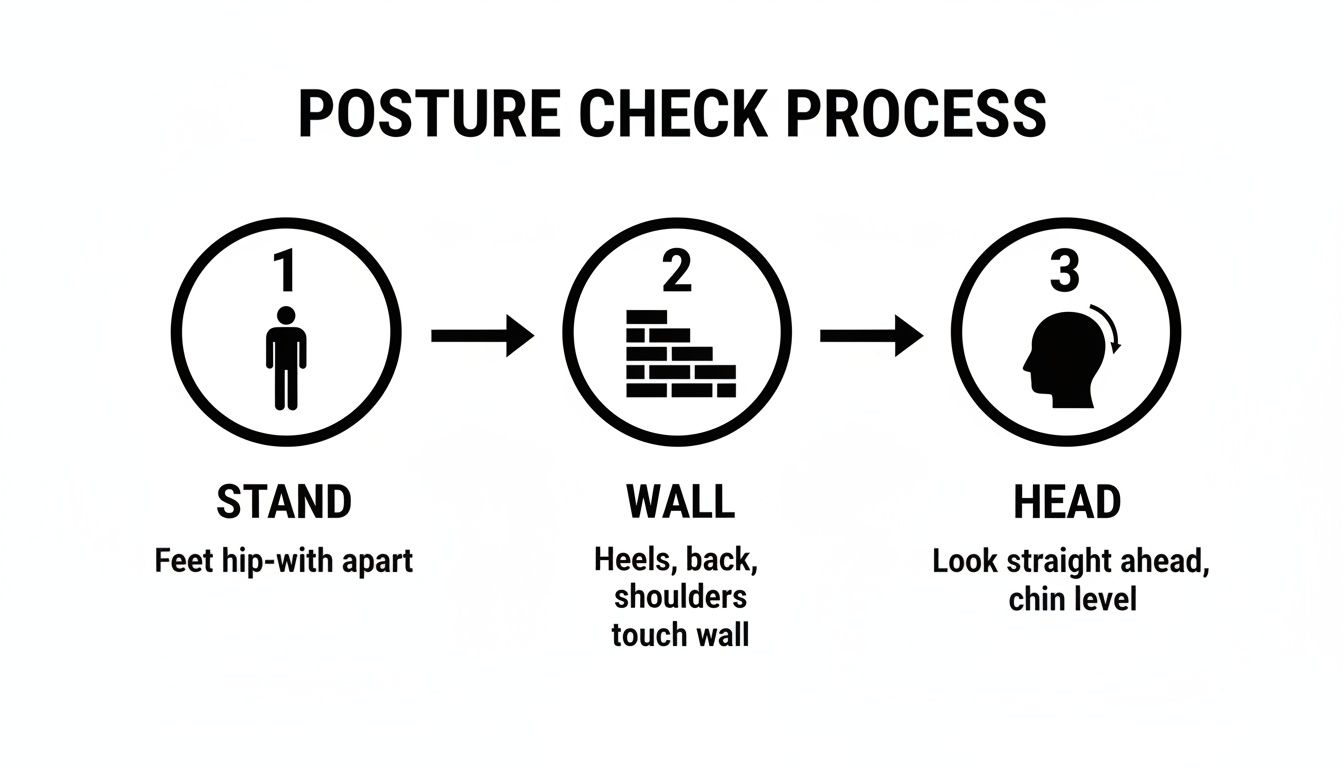
This simple visual shows you exactly what to look for. If your head is floating an inch or more off the wall when your back is flat against it, that's a clear sign your posture needs some attention.
Stretches to Release Tight Muscles
Before building strength, we must release the tension pulling your body forward. The primary culprits are usually your pectoral (chest) muscles and the small suboccipital muscles at the base of your skull, which become tight from hunching over screens.
The Doorway Pectoral Stretch
This classic stretch is effective for opening up a tight chest.
- Stand in an open doorway and place your forearms on the frame, with your elbows bent at a 90-degree angle and slightly below shoulder height.
- Step forward with one foot, keeping your back straight.
- Gently lean into the doorway until you feel a comfortable stretch across your chest.
- Hold for 20-30 seconds while breathing deeply.
- Repeat 2-3 times. We recommend our patients do this stretch each time they get up from their desk.
A Quick Tip from Our Charlotte Chiropractors: Be mindful not to let your head jut forward during this stretch, as it negates the benefit. Keep your chin slightly tucked to maintain a neutral neck and isolate the stretch in your chest muscles.
Chin Tucks
This exercise gently reactivates the deep neck flexor muscles at the front of your neck while releasing the tight muscles at the base of your skull.
- Sit or stand tall, looking straight ahead.
- Gently glide your chin straight back, as if making a double chin, without tilting your head down.
- You should feel a light stretch at the back of your neck.
- Hold for 5 seconds, then relax.
- Aim for 10 repetitions. This can be done anywhere—at your desk, in your car, or at home.
Strengthening Exercises for Better Support
Now that we've released tension in the front, it's time to build a stronger foundation in the back. Your upper back muscles act as anchors, pulling your shoulders back and creating a stable platform for your head and neck.
Scapular Squeezes (Shoulder Blade Squeezes)
This foundational exercise activates the key postural muscles between your shoulder blades (rhomboids and middle trapezius).
- Sit or stand with your arms hanging comfortably at your sides.
- Gently squeeze your shoulder blades together, imagining you are trying to hold a pencil between them.
- Avoid shrugging your shoulders up toward your ears; the motion should be backward and down.
- Hold the squeeze for 5-10 seconds, then slowly release.
- Perform 2-3 sets of 10-12 repetitions.
Strengthening the muscles that support your spine is essential for pulling your head and shoulders back into proper alignment. For a more comprehensive routine, you can explore a variety of back strengthening exercises to complement these basics.
Wall Angels
This challenging exercise is incredibly effective for improving shoulder mobility and activating all the right postural muscles simultaneously.
- Stand with your back flat against a wall, feet about six inches out. Your head, mid-back, and tailbone should all touch the wall.
- Bend your elbows to 90 degrees and raise your arms out to the side, like a field goal post. Keep your wrists and the backs of your hands touching the wall.
- Slowly slide your arms up the wall as high as you can without letting your lower back arch or your hands lift off.
- Slide back down to the starting position.
- Start with 1-2 sets of 8-10 repetitions.
Here in our Charlotte clinic, we always advise patients to start slowly. If you're dealing with chronic neck pain, consistent and gentle effort is far more effective than pushing too hard, too soon. For more ideas, explore other helpful neck pain stretches that complement this program.
Ergonomic and Lifestyle Habits for Lasting Change
Exercises are crucial, but they won't lead to lasting improvement if you spend the rest of your day reinforcing the habits that caused the problem. Lasting change comes from reshaping your environment and daily routines to support a healthy posture.
Think of it this way: if your posture is a sinking boat, corrective exercises are like bailing water. If you don't plug the leaks—your poor ergonomics and unconscious habits—you'll be bailing forever. These small, consistent adjustments are how you plug those leaks for good.
Audit Your Daily Screen Time
Our biggest postural challenges often arise at our desks, on our phones, and in our cars. These are the places where we spend hours in fixed positions, often unaware of how far our heads have drifted forward. A few key adjustments can make a significant difference.
Your Workstation Setup
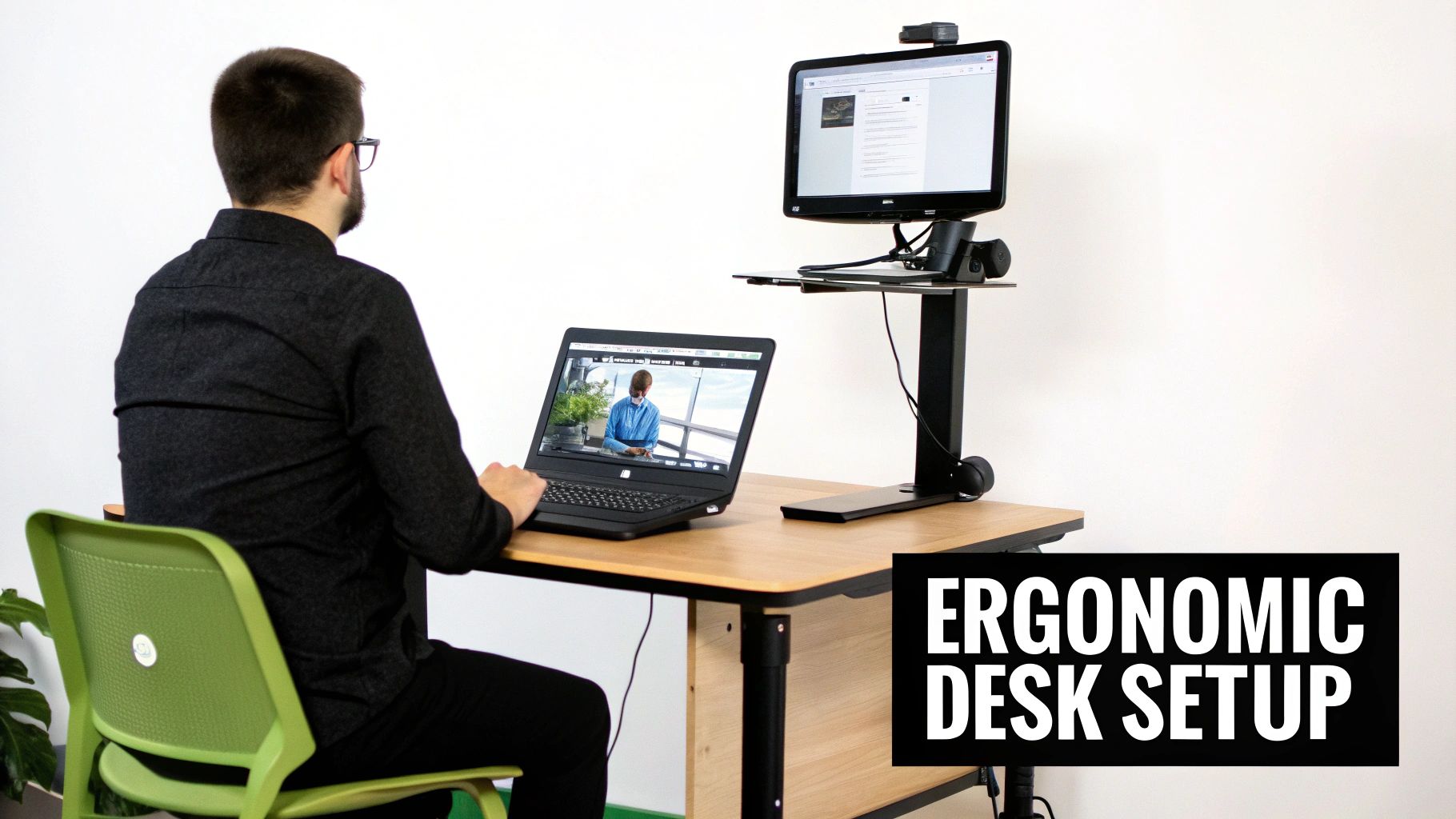
Your desk should support good posture, not work against it. The goal is to bring your work up to you, so you don't have to hunch down to it.
- Monitor Height: Position the top of your screen at or just below eye level. If you use a laptop, an external monitor or a laptop stand is essential to prevent constant downward gazing.
- Chair Support: Sit all the way back in your chair to support your lower back. Your feet should be flat on the floor, with your knees at a comfortable 90-degree angle.
- Arm Position: Adjust your armrests so your shoulders can relax completely. Aim for a 90-degree bend at the elbows, keeping them close to your body.
For a deeper dive into choosing the right equipment, review these helpful tips for proper posture in the office.
Smarter Smartphone Use
To combat "text neck," make a conscious effort to lift your phone to eye level instead of dropping your chin to your chest. This single habit can save your neck from hours of strain each day.
A simple rule we share with our Charlotte patients is the "20-20-20 rule." Every 20 minutes, look at something 20 feet away for at least 20 seconds. This not only rests your eyes but also serves as a built-in reminder to reset your posture.
Beyond the Desk: Your Car and Your Couch
Poor posture habits can also sneak in while driving and relaxing, undoing your hard work.
Driving Posture
Adjust your car seat to be more upright. Your headrest should be positioned so the middle of it is level with your ears, and the back of your head should be lightly touching it.
Relaxing with Awareness
When relaxing on the couch, avoid sinking into a C-shaped slump. Use pillows to support your lower back and neck, keeping your spine in a more neutral position, especially when reading or using a tablet.
Sleep Your Way to Better Alignment
You spend roughly a third of your life sleeping, making your bed a powerful place to either support or strain your neck. Proper sleep ergonomics can reinforce the progress you make during the day.
The best sleeping positions for neck health are on your back or your side. Stomach sleeping is the worst offender, as it forces your head to be turned to one side for hours, twisting your cervical spine. Find a pillow that fills the space between your head and the mattress, keeping your neck aligned with the rest of your spine.
Why Upper Cervical Chiropractic Care Is a Different Approach
Have you tried exercises and ergonomic adjustments, only to find the neck pain, headaches, and forward head posture always return? When this happens, it's often a sign that the problem is rooted in a deeper structural issue at the very top of your spine.
This is where the specialized focus of upper cervical chiropractic care becomes a game-changer for our patients here in Charlotte, NC. Unlike general chiropractic that may involve twisting or "popping" the entire spine, our approach at The Upper Cervical Spine Center is precise, gentle, and focused on the most critical area for your head posture: the atlas vertebra.
The Atlas: Your Body’s Keystone
Your head, weighing 10 to 12 pounds, balances on the very first bone in your neck—the atlas (C1). This uniquely shaped vertebra has the monumental job of supporting the full weight of your skull.
When the atlas is aligned, your head sits perfectly balanced over your shoulders and hips, allowing your spine to maintain its natural, healthy curves without strain. However, an old auto injury, a fall, or even the cumulative stress of poor posture can knock this delicate bone out of place.
When the atlas shifts, it disrupts your body's center of gravity. Your brain instinctively tries to keep your eyes level with the horizon, causing your head to tilt. This single action forces the rest of your spine to twist and compensate, which is what ultimately causes your head to drift forward and your shoulders to round.
This is the hidden mechanical issue that no amount of stretching or strengthening can fix on its own. It's like trying to straighten a picture on a crooked nail; until you fix the nail, the picture will never hang straight.
Our Gentle and Precise Chiropractic Method
The biggest difference in our care is how we address this foundational misalignment. We do not use any forceful twisting or popping. Our entire process is built on precision and gentle correction, tailored to your unique anatomy.
Here’s what sets our method apart for patients looking for a chiropractor in Charlotte, NC:
- Advanced Diagnostics: We use advanced 3D imaging to get an exact measurement of the angle and direction of your atlas misalignment. This removes all guesswork from your care.
- Calculated Corrections: Using this precise data, we perform a gentle and calculated correction to guide the atlas back into its proper position.
- Holding is Healing: Our goal isn't just to adjust you repeatedly. It's for your body to hold the correction. Once the atlas is stable and your head is properly balanced, the nervous system can function without interference, allowing the body’s natural healing process to take over.
This specific focus is what allows us to address the root cause of chronic forward head posture and the related neck pain, back pain, and headaches that so many of our patients endure. You can learn more about what makes upper cervical care unique on our website.
The impact of this postural problem on recovery is significant. Research shows a direct link: for each unit of forward head displacement, the likelihood of a successful treatment outcome for chronic neck pain drops by 13%. This underscores why addressing the structural source is essential for lasting relief. You can learn more about how posture impacts neck pain recovery from the study itself.
Take the Next Step Toward Relief in Charlotte, NC
Living with chronic neck pain, headaches, or upper back stiffness doesn't have to be your new normal. Correcting forward head posture is possible, but it requires an approach that addresses the root of the problem, not just the symptoms.
While the exercises and ergonomic tips we've shared are excellent starting points, they are sometimes not enough for lasting relief. For that, you may need a more precise solution.
Here at The Upper Cervical Spine Center, that's our specialty. We work with people from Charlotte and the surrounding communities who are ready to move beyond temporary fixes and address the structural imbalance causing their pain. We help patients with a range of conditions, from neck pain and headaches to sciatica and auto injury recovery.
Your Path to Restoring Balance
We understand that seeking new care can be daunting, especially when you're in pain. That's why our process is straightforward and patient-focused from the moment you contact our office.
It all begins with a consultation where we listen to your health concerns, your frustrations, and how your symptoms are impacting your life. Our goal is to develop a care plan designed specifically for you, targeting the underlying misalignment and helping your body restore its natural balance.
Our focus is on making a gentle, precise correction that allows your body to heal itself. By restoring proper alignment at the top of the neck, we take immense strain off your nervous system. Your muscles can finally relax, and your posture can naturally begin to improve from the inside out.
If you’ve been searching for a "chiropractor near me" in the Charlotte area with a specialized approach to complex cases, our focus on the upper cervical spine may be the solution you need.
What to Expect at Our Charlotte Clinic
We believe in making you an active partner in your health. Our care is a collaboration aimed at helping you achieve long-term wellness.
- A Detailed Evaluation: We use advanced diagnostics to identify the exact source of your misalignment.
- Gentle & Precise Corrections: Our technique is highly specific and does not involve any twisting or popping.
- Personalized Guidance: We are with you every step of the way, ensuring you feel heard, comfortable, and informed.
If you are ready to stop chasing symptoms and address the real cause of your discomfort, we invite you to schedule a consultation with our team. Let's work together to restore your body’s natural balance so you can get back to living a vibrant, pain-free life.
Contact The Upper Cervical Spine Center today to begin your journey toward lasting relief.
Address
2550 W Arrowood Rd
Suite 104
Charlotte, North Carolina, 28273
United States
Hours
Monday-Friday:
9AM-12PM
&
2PM-6PM
We Align the Head and Neck So That the Nerves Can Send Brain Healing Messages to Affected Parts Of Your Body.
It's a Natural Self Healing.
