
Pinched Nerve in Neck Vertigo: Upper Cervical Chiropractic in Charlotte, NC

If you've been hit with a dizzy, spinning sensation at the same time your neck is aching, you're not just imagining the connection. A pinched nerve in your neck can definitely cause vertigo, a condition often called cervicogenic dizziness. It all boils down to miscommunication between your neck and your brain, and finding a solution starts with understanding the source of the problem. For residents in Charlotte and the surrounding areas, our clinic offers a specialized approach to address this very issue.
Making Sense of the Neck-Vertigo Link

Think of the very top of your neck—where your head sits—as the command center for your body's balance and orientation. This area, containing the first two vertebrae known as the Atlas (C1) and Axis (C2), is packed with sensitive nerve receptors that constantly tell your brain where your head is in space. It's a critical part of your balance system.
When these vertebrae get even slightly misaligned from an old injury or poor posture, they can compress or irritate the nerves running through them. This creates "static" in the communication lines. Your eyes might be telling your brain you're perfectly still, but the scrambled signals from your neck are screaming that you're moving. Your brain gets these conflicting messages and can't figure out which to believe. The result? That awful, disorienting spinning sensation we call vertigo.
The Often-Missed Culprit: Your Upper Neck
So many people who struggle with vertigo are told it’s an inner ear problem, and while that can be true, the neck is often the real, overlooked source. It’s far more common than most people think. In fact, some clinical research has found that up to 90% of patients complaining of general dizziness were actually diagnosed with a cervicogenic (neck-related) cause. This just shows how frequently the neck is the root of the problem.
At The Upper Cervical Spine Center in Charlotte, this is our specific area of focus. We zero in on the delicate relationship between the C1 and C2 vertebrae and the nervous system to get to the bottom of pinched nerve in neck vertigo. It's not just about managing dizziness; it's about correcting the structural issue that's causing it in the first place. This is also why it's important to consider other nerve-related symptoms you might be having, like unexplained pins-and-needles sensations.
When vertigo and neck problems show up together, certain symptoms tend to appear in a cluster. The table below outlines these common signs and how they point back to a potential issue in your upper neck.
Symptoms Linking Neck Issues to Vertigo
Seeing these symptoms together is a strong indicator that it's time to have your upper neck evaluated by a specialist.
Your symptoms are real, the cause is often identifiable, and a precise, gentle solution is available right here in Charlotte. Understanding this connection is the key to reclaiming your balance and your life.
Our goal is to give you clarity and reassurance. There's a logical, mechanical reason for what you're feeling. By gently and precisely correcting the alignment of your upper cervical spine, we can restore clear communication between your brain and body, allowing your natural sense of balance to return. You can learn more about cervical vertigo in our detailed article to dive deeper into this topic.
How a Pinched Nerve in Your Neck Can Make the World Spin
To really grasp how a neck problem can cause vertigo, you have to think of your upper neck as Grand Central Station for your body's positioning system. It’s not just a stack of bones; it’s an incredibly sophisticated communication hub that constantly feeds your brain information about where you are in space. When something goes wrong at this junction, it can throw your entire sense of balance into chaos.
At the very top of your spine, you have two uniquely shaped vertebrae: the Atlas (C1) and the Axis (C2). These aren't like the others. They form a special cradle for the base of your skull, right where your brainstem sits. The brainstem is the master control panel, relaying messages between your brain and your body. When C1 and C2 are sitting just right, that communication is seamless. But if they shift out of place—even a tiny bit—it can set off a chain reaction that leads straight to dizziness and vertigo.
The Scrambled Signals Behind Cervicogenic Dizziness
So, what's actually happening? First, you have to understand that your upper neck is loaded with tiny nerve sensors called proprioceptors. Their entire job is to provide a constant, real-time report to your brain on your head's position. They answer the question, "Where is my head right now relative to my shoulders?"
When the Atlas or Axis shifts, it can pinch or irritate these delicate nerves. Instead of sending clear, accurate information, they start firing off corrupted data—it's like static on a radio line. Your brain gets conflicting reports. Your eyes and inner ears might be saying, "We're perfectly still," but the aggravated nerves in your neck are screaming, "We're turning!" It's this neural confusion that triggers that awful, disorienting spinning sensation we call vertigo.
When Blood Flow to Your Balance Centers is Choked Off
It’s not just about the nerves, either. Blood flow is another huge piece of the puzzle. The vertebral arteries—major blood vessels that supply the brainstem and parts of the inner ear—actually travel up through small holes in the neck vertebrae. Both of these brain areas are absolutely critical for maintaining your balance.
If the C1 or C2 vertebra is misaligned, it can physically constrict or put pressure on these arteries. This can reduce the amount of oxygen-rich blood reaching the very structures that manage your equilibrium. Think of it like a kink in a garden hose. Even a small reduction in flow can be enough to make the inner ear and brainstem function poorly, leading to lightheadedness, dizziness, and that shaky, unsteady feeling.
Think of your body's balance system as a three-legged stool, with each leg representing a different data source: your eyes (vision), your inner ear (vestibular system), and the position-sensing nerves in your neck (proprioception). If one of those legs—the neck—is suddenly the wrong length due to a misalignment, the whole stool becomes unstable. Your brain scrambles to keep you upright, but the conflicting information makes you feel like you're about to topple over.
The Sensory Mismatch That Throws You Off-Kilter
This brings us to the core problem: a profound sensory mismatch. Your sense of proprioception is what allows you to touch your nose with your eyes closed or walk a straight line. It's your body's internal map of itself. The nerves in your neck are arguably the most important source of this information.
A misalignment creates a fundamental conflict between what your neck is telling your brain and what your other senses are reporting. Your brain is suddenly stuck in the middle, trying to reconcile two completely different stories about where you are. This intense effort to make sense of bad data is neurologically exhausting and is often what causes not just vertigo, but also the associated nausea and feeling of being chronically off-balance.
The key to fixing this is to correct the alignment of the C1 and C2 vertebrae. By taking the pressure off the nerves and restoring normal blood flow, we help your body’s internal navigation system recalibrate. Once the signals are clear again, your brain can finally get the accurate information it needs to help you regain your stability and find lasting relief from pinched nerve in neck vertigo.
Common Triggers for Pinched Nerves and Vertigo
That misalignment in your upper neck—the one causing your vertigo—didn't just appear out of thin air. It's almost always the end result of a specific injury or a long-term habit that has slowly nudged the delicate Atlas (C1) and Axis (C2) vertebrae out of their natural position.
Pinpointing the likely trigger is a crucial first step. For many patients in the Charlotte area, the symptoms can be traced back to a single, impactful event. For others, the cause is far more subtle, building up over years of quiet strain. By connecting the dots between your life experiences and your current symptoms, we can start to uncover the root cause of your dizziness.
Sudden Injuries and Past Trauma
The neck is incredibly vulnerable to sudden, forceful movements that can easily knock the upper cervical spine out of alignment. Think of it as a structural shock that the body can't always absorb correctly.
- Car Accidents and Whiplash: Even a minor fender-bender on a busy Charlotte street can cause a whiplash injury. That rapid back-and-forth snap of the head forces the C1 and C2 vertebrae out of place, which can irritate nerves and trigger dizziness weeks, months, or even years down the road. It's a very common trigger, and understanding the full range of whiplash symptoms after a car accident can offer critical context.
- Sports Injuries: A hard tackle on the football field, a clumsy fall on the basketball court, or any direct impact to the head or neck can cause an immediate misalignment.
- Slips and Falls: It's easy to brush off a simple slip on a wet floor, but landing awkwardly can jolt the neck with enough force to shift the atlas, planting the seeds for future trouble.
This flowchart shows how a neck misalignment, often from these kinds of triggers, can set off a chain reaction leading to vertigo.
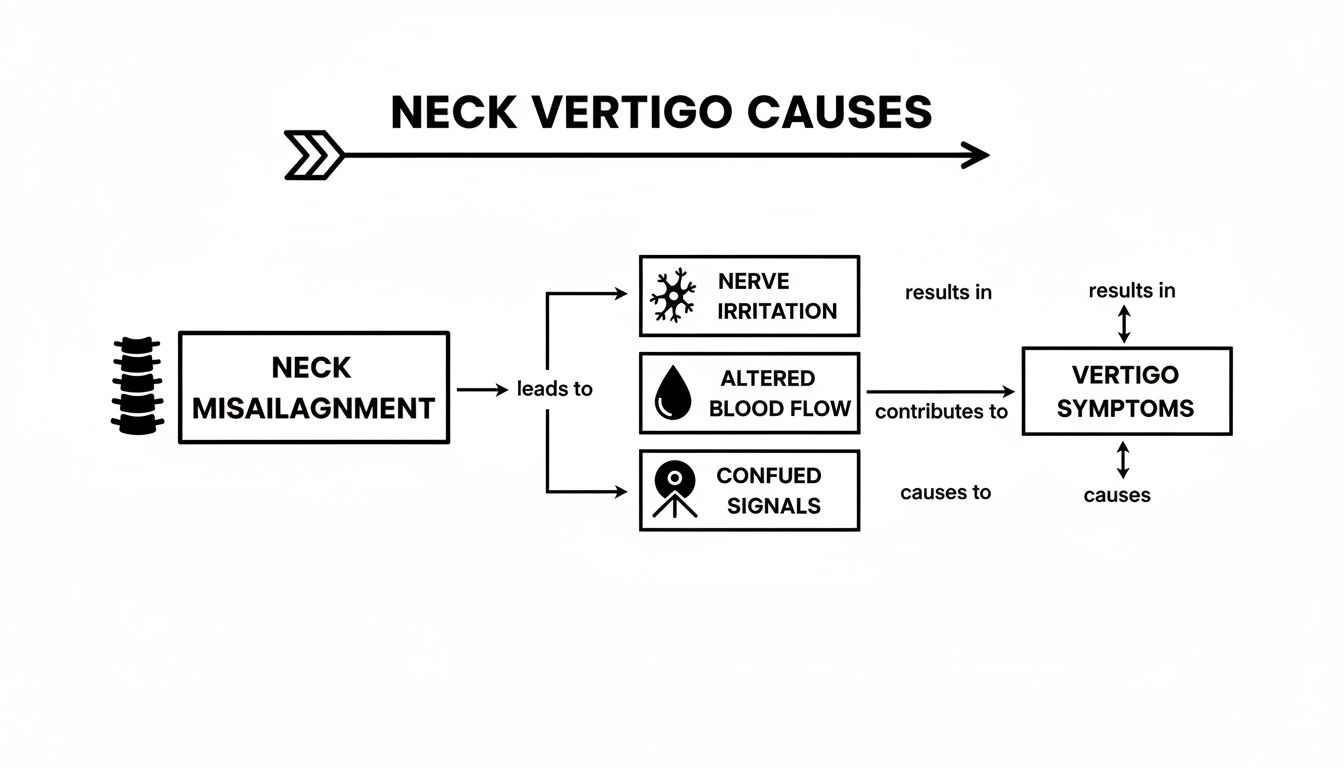
The key takeaway is that one single structural problem—a misaligned neck—can create several functional issues like nerve irritation and poor blood flow, all of which contribute to that disorienting feeling of vertigo.
The Strain of Modern Life
Not every trigger is a dramatic event. More often than not, the cause is the slow, steady pressure of our daily routines. Over time, this can be just as damaging as a sudden injury.
For many people, the cause of their vertigo isn't a single major injury but the cumulative effect of thousands of hours spent in poor posture. This constant strain gradually pulls the spine out of alignment, creating chronic nerve irritation.
This gradual slide out of alignment is often tied to a few common lifestyle factors:
- "Tech Neck" from Desk Work: Hours spent hunched over a computer or looking down at a phone puts a huge amount of strain on the cervical spine. This forward-head posture forces the muscles at the base of your skull to work overtime, eventually pulling the C1 and C2 vertebrae out of place.
- Poor Sleeping Positions: Consistently sleeping on your stomach or using pillows that don't support your neck's natural curve can cause a slow, progressive misalignment night after night.
Whether your vertigo showed up after a sudden jolt or crept in over years of daily habits, the underlying mechanical problem is the same. The first step toward lasting relief from pinched nerve in neck vertigo is identifying and correcting that specific misalignment.
How Our Charlotte Chiropractor Gets to the Root Cause: A Precise and Gentle Approach
When vertigo has turned your world upside down, the last thing you need is a harsh, jarring adjustment. That's why our approach at The Upper Cervical Spine Center is completely different. We skip the guesswork and avoid any forceful cracking, popping, or twisting of the neck. Our entire process is built on being precise, gentle, and laser-focused on correcting the specific issue causing your pinched nerve in neck vertigo.
Unlike general chiropractic that addresses the whole spine, we concentrate exclusively on the top two vertebrae: the Atlas (C1) and the Axis (C2). This tiny area is the most critical junction in your entire nervous system, where your brainstem connects to your spinal cord. A misalignment here, even a slight one, demands an incredibly careful and calculated touch.

Step 1: Seeing the Problem with Advanced 3D Imaging
Before we do anything, we need a crystal-clear picture of what's happening at the top of your neck. We use advanced 3D diagnostic imaging to see your C1 and C2 vertebrae from every conceivable angle. Think of it not as a standard X-ray, but as a detailed architectural blueprint of your unique anatomy.
This detailed imaging lets us see the exact degree and direction of the misalignment. Is the Atlas tilted 1.5 degrees to the left? Is it rotated forward on the right? We measure these tiny shifts down to a fraction of a degree. It's this level of precision that allows us to tailor a correction specifically for you—no guesswork, just objective data.
This step is crucial because it ensures the adjustment is as gentle and effective as possible. When you know the exact angle, you can use the lightest touch necessary to guide the vertebra back home.
Step 2: A Gentle, Precise Correction
With your exact measurements in hand, the correction itself is remarkably gentle. Many of our patients in Charlotte are surprised by how light the touch is. You'll be comfortably positioned while Dr. Drury applies a slight, specific pressure to just the right spot.
There is absolutely no twisting, popping, or cracking. The goal isn’t to force a bone into place. It's to give it a gentle nudge in the precise direction it needs to go, allowing your body's own muscles and ligaments to do the rest.
Our philosophy is simple: the more precise the analysis, the more gentle the correction. By mapping out the exact nature of your misalignment, we can restore balance with minimal force, ensuring your comfort and safety every step of the way.
This gentle method is safe for people of all ages. It’s particularly well-suited for a sensitive condition like vertigo, where aggressive movements could easily make your symptoms worse. The correction is designed to be so subtle that your nervous system accepts the change without putting up a fight.
Step 3: Healing and Stabilization
After the correction, the real healing begins. With the Atlas and Axis back in their proper place, the pressure comes off the delicate nerves and brainstem. Think of it as unkinking a hose—the flow of information between your brain and your body’s balance systems is restored.
The immediate effects often include:
- Reduced Nerve Irritation: The "static" that was scrambling your balance signals starts to clear up.
- Improved Blood Flow: The vertebral arteries, which run through these bones, are no longer constricted, allowing for better circulation to the brainstem and inner ear.
- Restored Proprioception: Your brain starts receiving accurate information about your head’s position in space again, resolving that confusing sensory conflict.
Our goal isn't a quick fix; it's to help your body hold the correction for as long as possible. As your spine stabilizes in its correct alignment, your body's innate ability to heal takes over. The surrounding muscles and ligaments adapt, creating lasting stability.
To dive deeper into why the Atlas bone’s position is so critical, you can learn more about Atlas bone misalignment in our detailed guide. This non-invasive, drug-free solution offers a clear path toward reclaiming your balance and getting your life back.
What to Expect at Your First Visit to Our Charlotte Clinic
Deciding to finally get help for vertigo and neck pain is a big step. We know that when you've been feeling unsteady and in pain, even making an appointment can feel overwhelming. That's why we’ve carefully designed the entire new patient experience at The Upper Cervical Spine Center in Charlotte to be straightforward, calming, and completely centered around you.
From the second you walk through our doors, our priority is to help you feel at ease and confident that you’re in the right place. Our mission is to take the guesswork out of your health and start building a real partnership.

Beginning with a Clarity Call
Your journey with us actually starts before you ever set foot in the clinic, with a complimentary clarity call. This is simply a conversation, not a sales pitch. You'll speak with a member of our team so we can listen to what you've been going through, understand your symptoms, and answer your questions about upper cervical care and its role in treating pinched nerve in neck vertigo.
This initial chat is a great way for both of us to see if you might be a good candidate for our specific type of care. If it seems like we can help, we’ll then get your first in-office visit with Dr. Drury on the calendar.
Your Comprehensive New Patient Examination
Your first appointment in our Charlotte clinic is all about investigation. Dr. Drury will perform a detailed examination focused on one thing: uncovering the root cause of your symptoms.
This in-depth initial visit includes:
- A Detailed Health History: We'll talk through your complete history—old injuries, daily habits, and the specific details of your vertigo attacks. This conversation often reveals connections between past events and your current condition.
- Neurological and Balance Testing: We run specific, non-invasive tests to evaluate your nerve function and see exactly how your body's balance system is being affected.
- Advanced 3D Imaging: This is the cornerstone of our process. We use state-of-the-art imaging to get a precise, three-dimensional view of your upper cervical spine. This lets Dr. Drury see the exact angle and direction of any misalignment in your top two vertebrae, the Atlas (C1) and Axis (C2).
We never guess when it comes to your health. The detailed data from your 3D imaging serves as the blueprint for your personalized care plan, ensuring any correction is both gentle and incredibly precise.
Reviewing Your Results and Creating a Plan
After your images have been meticulously analyzed, you’ll have a dedicated appointment to go over the results with Dr. Drury. He’ll put your scans up, show you exactly where the misalignment is, and clearly explain how it could be contributing to your vertigo and neck pain.
This is your opportunity to ask anything and everything. We believe that when you understand what’s going on in your own body, you get better results. We'll outline our recommendations for care, explain what to expect, and map out how we’ll work together to restore your body’s natural alignment and function.
As a trusted chiropractor in Charlotte, we've built our practice on transparency and partnership. Our commitment is to give you a clear path forward so you can reclaim your stability and start living without the constant worry of dizziness.
The Hidden Costs of Ignoring Neck-Related Dizziness
When you're dealing with cervicogenic vertigo, it’s not just a minor inconvenience—it's something that can quietly chip away at your quality of life. The daily struggle is real. You might find yourself living with a constant, low-level anxiety, always wondering when the next wave of dizziness or spinning might hit.
This uncertainty takes a serious toll. Simple things you once enjoyed, like driving, working out, or even just playing with your kids, can suddenly feel like a risk. Your world can start to shrink as you begin avoiding situations that might trigger an episode. This is about more than just stopping the spins; it’s about getting your life back.
How Dizziness Can Slowly Take Over
Pushing aside the warning signs of pinched nerve in neck vertigo often leads to a snowball effect. What might begin as a fleeting dizzy spell can gradually become a chronic balance problem, making it hard to focus at work or enjoy the hobbies you love.
And this isn't a rare problem. In the U.S. alone, dizziness and vertigo account for a staggering 20.6 million doctor's office visits every single year.
When you narrow it down to people already dealing with neck pain, the numbers get even more specific. One study found that about 8.1% of them eventually develop cervicogenic dizziness. The risk is even greater for older adults, with more than a quarter of those with neck pain reporting these symptoms. Most alarmingly, over 44% of them were found to be at a significant risk of falling because of their balance issues. It’s a sobering reminder of how a neck problem can spiral into a serious functional disability if it isn't addressed. You can read more in this detailed study on cervicogenic dizziness.
Ignoring neck-related dizziness is like driving with the check engine light on. At first, it's just an annoyance, but if you let it go, it can lead to bigger, more complex problems down the road.
At The Upper Cervical Spine Center, we see the real-world impact of these "hidden costs" every day. We understand the physical and emotional weight that vertigo places on our patients here in Charlotte. That’s why our goal is to get to the root of the problem—the misalignment in your upper neck—instead of just chasing the symptoms. We want to be your partner in restoring not just your balance, but your confidence to live without fear.
Common Questions About Vertigo and Upper Cervical Care
Taking that first step to figure out your vertigo can feel overwhelming, and it's natural to have a lot of questions. We find that clear, straightforward answers are the best way to help you feel confident about your health decisions. Here are some of the most common questions we hear from our Charlotte-area patients about upper cervical care and how it helps with vertigo.
Our job is to give you the clarity you need to move forward. We want you to understand exactly how our specialized approach works and why it can be so effective for tricky conditions like vertigo caused by a pinched nerve in the neck.
How Is Upper Cervical Care Different From General Chiropractic?
Think of upper cervical care as a highly specialized field within chiropractic. We focus exclusively on the relationship between the top two bones in your neck, the Atlas (C1) and the Axis (C2), and your brainstem. Before any correction is made, we use precise 3D imaging to map the exact angle and direction of any misalignment.
The correction itself is surprisingly gentle—there is absolutely no twisting, popping, or cracking involved. This focused approach gets right to the root of the nerve interference, aiming for a lasting solution instead of just temporary relief.
How Soon Can I Expect to See Results for My Vertigo?
Everyone’s healing journey is a bit different, but it’s common for patients to notice a real reduction in their vertigo episodes within just the first few corrections. The whole point is to restore proper alignment so your body can get back to healing itself.
As nerve communication improves and inflammation goes down, the symptoms tend to fade. Dr. Drury will map out a care plan tailored specifically for you, designed to get you stable, long-term results.
Is the Upper Cervical Correction Safe?
Yes, it's an extremely safe procedure. Because every adjustment is calculated from your unique diagnostic imaging, we use a minimal, gentle force to get the job done right.
The fact that we don't do any forceful twisting of the neck makes it a comfortable and safe option for people of all ages, from kids to seniors. Our philosophy is all about delivering powerful results using the most gentle approach possible.
Can You Help If I’ve Already Seen Other Specialists?
Absolutely. A lot of our patients here in the Charlotte area come to us after seeing other specialists and still not getting to the bottom of their vertigo. More often than you’d think, the upper cervical spine is the missing piece of the puzzle.
If your dizziness is coming from a misalignment at the very top of your neck, our specific care is designed to address that exact problem. We always invite people in for a complimentary consultation to see if they might be a candidate for this type of care.
Don't let vertigo run your life. At The Upper Cervical Spine Center, we're committed to helping patients in Charlotte find lasting relief by getting to the root cause of their symptoms. Schedule your complimentary consultation today and find out if our precise, gentle care is the answer you’ve been searching for.
Address
2550 W Arrowood Rd
Suite 104
Charlotte, North Carolina, 28273
United States
Hours
Monday-Friday:
9AM-12PM
&
2PM-6PM
We Align the Head and Neck So That the Nerves Can Send Brain Healing Messages to Affected Parts Of Your Body.
It's a Natural Self Healing.
