
What Is Cervical Vertigo? Your Guide to Relief in Charlotte, NC

If you've ever felt a strange, off-balance dizziness that seems to start in your neck, you are not alone. You might be experiencing cervical vertigo, a condition sometimes called cervicogenic dizziness. As your trusted chiropractor in Charlotte, NC, we want you to know there is a solution.
This disorienting feeling happens when problems in your neck start sending scrambled signals to your brain’s balance center. Think of the complex network of nerves and joints in your upper neck as a sophisticated guidance system. When that system is misaligned, your sense of stability is compromised. At The Upper Cervical Spine Center, we specialize in identifying and correcting this issue to help our Charlotte patients find lasting relief from neck pain and dizziness.
What It Feels Like to Live With Cervical Vertigo

Living with cervical vertigo can be incredibly frustrating. One minute you're fine, the next a simple turn of your head sends a wave of unsteadiness through your body. This makes everyday activities like walking, driving, or even concentrating at work in Charlotte feel like a monumental challenge.
Unlike the classic "room-spinning" sensation of other types of vertigo, this condition usually feels more like a vague sense of imbalance, lightheadedness, or being unsteady on your feet. It's a problem rooted in the upper cervical spine, and for many people in the Charlotte area, it's directly linked to neck pain. It's a surprisingly common connection—up to 40% of patients dealing with neck pain also report symptoms of cervicogenic dizziness.
To give you a clearer picture, here’s a quick summary of what this condition often looks like.
Cervical Vertigo At a Glance
This table breaks down the key characteristics of cervical vertigo to help you see if your own experiences line up.
Recognizing these patterns is the first step toward understanding what’s really going on and seeking help from an upper cervical chiropractor near you.
The Brain-Neck Connection: Why You Feel Dizzy
So, how does a neck problem make you feel dizzy? Your brain is in constant communication with your body to maintain balance, relying on three main sources of information:
- Your inner ears (the vestibular system) sense gravity and motion.
- Your eyes (the visual system) tell your brain where you are in relation to your surroundings.
- Tiny sensors in your neck’s muscles and joints, called proprioceptors, report your head’s position and movement.
When the top two bones in your neck—the atlas (C1) and axis (C2)—are out of their proper alignment, those proprioceptors start sending faulty data. This creates a "signal mismatch." Your eyes and inner ears might be telling your brain you’re perfectly still, but your neck is screaming that you’re tilted or moving. That sensory conflict is what triggers that awful, disorienting feeling of dizziness.
At The Upper Cervical Spine Center, we frequently see patients from right here in Charlotte who've been told their dizziness is a mystery. More often than not, the missing piece of the puzzle is a subtle, undiagnosed misalignment in their upper neck.
This persistent unsteadiness can seriously affect your quality of life. The fear of a sudden dizzy spell might cause you to avoid things you once loved, whether it's playing with your grandkids or just taking a walk through a local Charlotte park. It can also make your job incredibly difficult, particularly if it requires physical activity or sharp focus.
Because cervical vertigo leads to disorientation and poor balance, it also significantly increases the risk of falling. Learning about effective fall prevention strategies, balance exercises, and safety equipment is a smart step for managing daily life safely. Our ultimate goal, however, is to correct the root cause of the imbalance so you can get back to navigating your world with confidence.
The Hidden Causes Triggering Your Dizziness
If you're dealing with that disorienting, off-balance feeling, it's not just happening for no reason. Cervical vertigo is almost always a symptom—a clear signal that something is off with the intricate structure at the very top of your neck, right where your head and spine connect.
The problem usually boils down to a small but critical misalignment of the top two vertebrae in your neck: the atlas (C1) and the axis (C2). These aren't just any bones. They’re uniquely designed to handle the majority of your head's movement, and they're surrounded by a dense web of nerves that feed information directly to the balance centers in your brain.
The Atlas and Axis: Your Body’s Foundation for Balance
Imagine your atlas as the foundation holding up your head. If that foundation shifts, even just a little, it sets off a domino effect. This misalignment scrambles the crucial proprioceptive signals—the data your brain relies on to know where your body is in space. The result is a confusing sensory mismatch that we experience as dizziness or vertigo.
So, what can knock this delicate structure out of place? It’s often a specific event, sometimes one you might not even connect to your current symptoms:
- Auto Injury: The classic whiplash from a rear-end collision, even a seemingly minor fender bender in Charlotte, can easily shift the atlas and axis.
- Sports Injuries: Any significant impact to the head or a sharp twist of the neck during a game can create an upper cervical misalignment.
- Poor Posture: Think about it—years of hunching over a computer, craning your neck to look at your phone ("tech neck"), or even sleeping in an awkward position can slowly and surely pull your spine out of alignment.
- Slips and Falls: A sudden jolt from taking a tumble can have the same jarring effect as a more direct injury, shifting those top vertebrae.
Whiplash: A Common Culprit
A history of whiplash is one of the most well-documented triggers for cervical vertigo. This auto injury is so disruptive because it injures the delicate soft tissues and the proprioceptors (position-sensing nerves) in the neck. For anyone with a past neck injury, understanding whiplash recovery is a key step toward figuring out the root cause of lingering dizziness.
The link isn't new; experts have seen it for decades. Whiplash injuries affect about 0.1% of the population each year. And for those who experience one, the chances of developing vertigo are surprisingly high—some studies show it affects 20-58% of cases. We see a similar pattern in conditions like cervical spondylosis (age-related neck arthritis), where patients with vertigo were more than twice as likely to have compromised blood flow through the vertebral artery when they turned their heads. You can find more on these findings in the IOSR Journals.
How One Misalignment Causes a Cascade of Symptoms
When the atlas bone is out of position, it doesn’t just mess with your sense of balance. It can put direct pressure on the brainstem and irritate the nerves branching out from it. This is exactly why cervical vertigo rarely shows up alone.
A single, specific misalignment at the top of the neck can be the root cause of not just dizziness, but also chronic headaches, neck pain, stiffness, and even brain fog. Our focus as an upper cervical chiropractor in Charlotte is to identify and correct that one specific issue to restore proper function.
That nerve irritation can send pain signals radiating up into your head, leading to headaches that feel like they start at the base of your skull. It also forces the surrounding muscles to work overtime, trying to stabilize an unstable joint, which results in that all-too-familiar chronic neck pain and stiffness. Until that underlying structural problem is corrected, these symptoms will likely persist. For a deeper dive, check out our guide on how an atlas bone misalignment can impact your overall health.
Recognizing the Symptoms and Getting a Proper Diagnosis
How can you be sure the dizzy spells and unsteadiness you're experiencing are actually coming from your neck? Pinpointing the specific symptoms of cervical vertigo is the first, most important step toward getting the right help. Unlike other balance disorders that originate in the inner ear, this condition has a unique signature that almost always involves your neck.
The symptoms can be anything from a minor annoyance to completely overwhelming, but they tend to follow a familiar pattern. Learning to spot these signs can help you connect the dots between your neck discomfort and your dizzy spells, putting you in a better position to find a real solution here in Charlotte.
Common Signs of Cervical Vertigo
The feeling of cervical vertigo usually isn't the intense, room-spinning sensation you might see in movies. Instead, people often describe it as a more general feeling of being off-balance, foggy, or lightheaded.
Here are the key symptoms to watch for:
- General Unsteadiness: A sense of being wobbly or unsure on your feet, which can be especially noticeable when you're walking or standing still.
- Neck Pain and Stiffness: This is the big one. The dizziness is almost always accompanied by a sore, stiff, or tender neck. This is a clear indicator to see a neck pain chiropractor.
- Headaches: These headaches often start at the base of the skull and can travel up the back of your head. They're typically triggered by neck movements.
- Dizziness Provoked by Head Movement: Symptoms often flare up when you turn your head quickly, look up, or hold your head in one position for too long (like staring at a computer screen).
This infographic shows a common scenario: how a neck injury like whiplash can directly lead to the spinal misalignments that cause these dizzying symptoms.
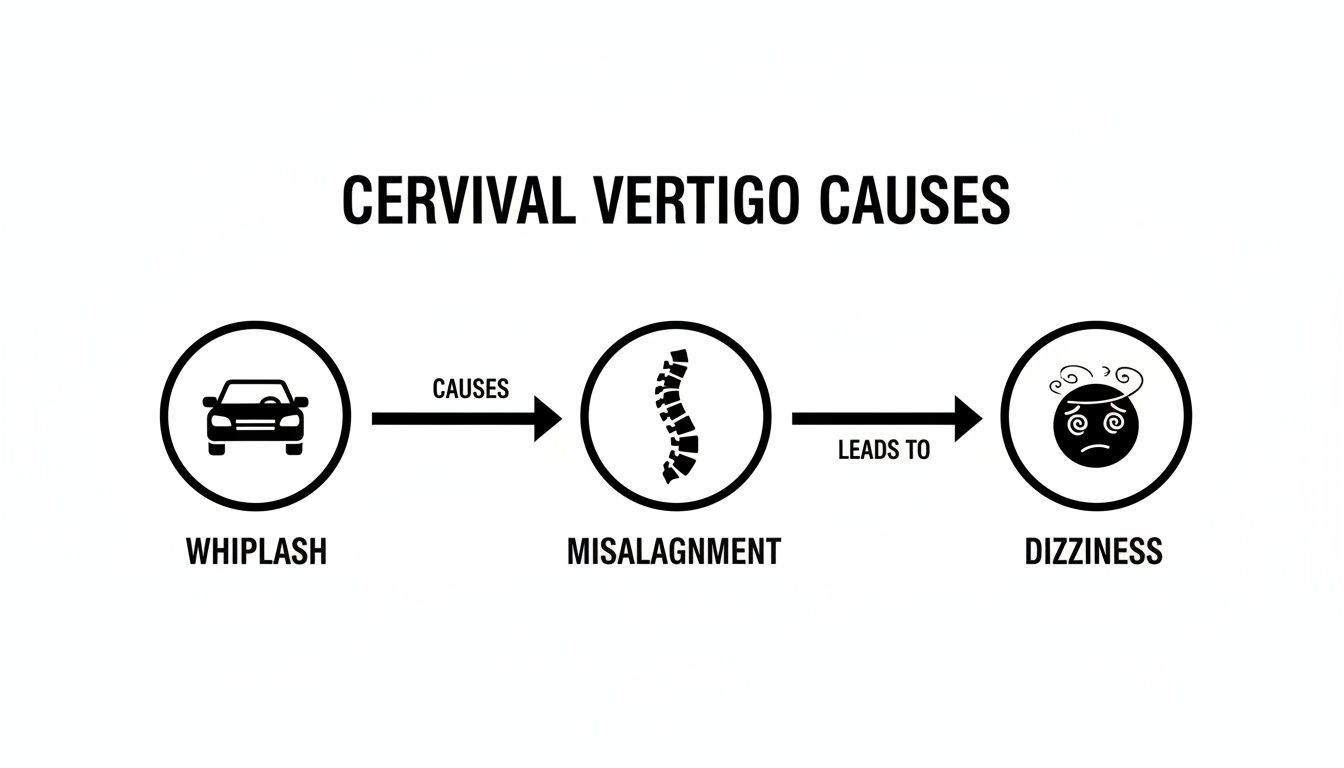
As you can see, a traumatic event often kicks off a chain reaction, creating a structural problem in the neck that results in neurological symptoms like vertigo.
Distinguishing Cervical Vertigo from Other Conditions
Dizziness can come from many places, so a critical part of any diagnosis is ruling out other conditions. This is exactly why a thorough, careful evaluation is non-negotiable. So many patients in the Charlotte area come to us after being told they have inner-ear issues like BPPV or Meniere's disease, only to discover the root of their problem was in their neck the entire time.
To help clear things up, here’s a look at how these conditions differ.
Cervical Vertigo vs. Other Dizziness Disorders
As the table shows, the presence of neck pain is the single biggest clue that points toward a cervical origin for your dizziness.
The Importance of a Precise Diagnosis
Getting an accurate diagnosis for cervical vertigo is often a process of elimination. A skilled practitioner will start with a detailed health history and a physical examination focused on your neck’s range of motion, stability, and function. The statistical connection here is incredibly strong. Globally, about one in five people experience vertigo. And when you look at referrals for dizziness, a staggering 70% of patients show restrictions in their neck mobility. For people already living with chronic neck pain, up to 40% also suffer from cervicogenic dizziness. If you'd like to explore the research, you can read the full study about these chiropractic-responsive conditions.
To truly confirm cervical vertigo, we need to see what's happening on the inside. Advanced diagnostic imaging, specifically designed for the upper cervical spine, lets us pinpoint the exact location and degree of any misalignment. This isn't a guessing game; it's a precise, data-driven approach to finding the cause.
Here at The Upper Cervical Spine Center in Charlotte, our diagnostic process is built to identify the root cause with absolute certainty. By understanding the specific structural issue, we can create a care plan to correct it and finally give you a path to lasting relief.
How Our Upper Cervical Chiropractic Care Restores Balance
When you're dealing with cervical vertigo, the goal shouldn't be to just manage the dizziness—it's to fix what's causing it in the first place. At The Upper Cervical Spine Center, our chiropractic care is very different from general chiropractic. We focus entirely on the precise, delicate alignment at the very top of your neck, where your head connects to your spine.

This area, home to the atlas (C1) and axis (C2) vertebrae, is a critical communication hub. Even a tiny misalignment here can be the root cause of the scrambled nerve signals that trigger your vertigo. Our entire focus is to gently and accurately restore proper spinal alignment so your body's internal GPS can get back online.
Precision Over Force
We understand—the thought of a neck adjustment can be nerve-wracking, especially when you’re already feeling dizzy and sore. That’s why our method is specifically designed to be incredibly gentle. There is absolutely no forceful twisting, popping, or cracking involved in our adjustments.
We start with advanced diagnostic imaging to create a detailed, three-dimensional map of your upper cervical spine. This lets us see the exact angle and direction of any misalignment. Armed with this precise data, we can deliver a controlled and gentle correction that's tailored specifically to your body.
Our care is so gentle that many patients are surprised by how light the touch is. The adjustment is calculated to use the minimum amount of force necessary to encourage the vertebrae back into their natural position, making it a comfortable and safe experience.
This focus on precision is what truly sets our chiropractic care apart. We aren't performing broad adjustments along the entire spine. We're making a specific, targeted correction to the one area that’s disrupting your body’s ability to stay balanced.
Addressing the Root Cause of Vertigo
Restoring proper alignment to the atlas vertebra does so much more than just move a bone back into place. It has a profound ripple effect on the surrounding nerves and tissues.
Once the atlas is positioned correctly, the pressure on the brainstem and the irritation to the surrounding nerves begin to ease. This calms down those overactive proprioceptors in your neck, allowing them to finally send clear, accurate signals to your brain's balance centers again. That "signal mismatch" that was causing your world to spin is finally resolved.
This process offers a cascade of benefits that go far beyond just stopping the vertigo:
- Restored Nerve Communication: Correcting the alignment allows for clear, uninterrupted communication between your brain and body, which is essential for proper balance and coordination.
- Reduced Muscle Tension: When the spine is properly aligned, your neck muscles no longer have to work overtime to compensate for an unstable joint. This often brings significant relief from chronic neck pain and stiffness.
- Headache and Migraine Relief: Many headaches, especially those that start at the base of the skull, are a direct result of irritation in the upper neck. Restoring alignment can dramatically reduce their frequency and intensity.
- Improved Brain Fog: By calming the neurological interference, many of our Charlotte patients report a noticeable improvement in mental clarity and a lifting of that persistent brain fog.
This approach is designed for lasting relief because it addresses the underlying structural problem. We don't want you to just feel better for a day or a week; we want to give your body the stability it needs to heal itself and maintain balance for the long haul. You can get more details on how an effective upper cervical treatment provides vertigo relief in our dedicated article.
Your Body’s Innate Ability to Heal
Ultimately, upper cervical chiropractic care is all about helping your body do what it does best: heal itself. The human body is designed to be a self-regulating system. But a structural misalignment at the top of the spine acts like a roadblock, disrupting the very systems meant to keep you healthy and balanced.
By making a precise correction, we're simply removing that interference. This allows your central nervous system to function as it should, restoring proper communication and giving your body the chance to heal from the inside out. For our patients in Charlotte, NC, this often means not just an end to dizziness, but a return to a more vibrant, active life.
What to Expect at Our Charlotte Chiropractic Office
Taking that first step to figure out what’s causing your vertigo can be a little daunting, especially when you don’t know what’s involved. Here at The Upper Cervical Spine Center, we’ve made our process as clear, professional, and patient-focused as possible. Everything we do is centered on one goal: finding the precise reason for your symptoms. Our approach for every patient in Charlotte is built on data and honesty, so you feel confident and in the loop from the very first day.
It all starts with a simple conversation, with no strings attached.
Your Complimentary Clarity Call
Before you even book an appointment, we kick things off with a complimentary clarity call. This is your chance to talk directly with one of our doctors about what you've been going through. We’ll take the time to listen to your health history and truly understand how vertigo is affecting your daily life.
The whole point of this call is to see if you might be a good candidate for our specialized chiropractic care. We're big on transparency—if we genuinely don't think our unique approach is the right fit for you, we’ll tell you upfront. This first step ensures we respect your time, building a relationship on trust right from the start.
The Initial Examination: A Data-Driven Approach
If it sounds like we can help, your first visit to our Charlotte office will be a comprehensive diagnostic appointment. This is where we stop talking about your symptoms and start gathering real data about what's actually happening inside your body.
This initial exam has two key parts:
A Detailed Health History Review: We'll sit down together and go over your health journey in detail. We’ll talk about any past injuries—an auto injury, sports mishaps, or even a bad fall from years ago—that could be playing a role in how you feel today.
Advanced Diagnostic Imaging: We perform a series of precise, detailed imaging tests that focus specifically on the top of your neck. These aren't your typical X-rays; they are a specialized analysis that gives us a 3D view of the alignment of your atlas (C1) and axis (C2) vertebrae.
This data-driven process is non-negotiable for us. It allows us to see the exact degree and direction of any misalignment, which removes all the guesswork from your care. We simply won't move forward with any chiropractic treatment until we have a clear, objective picture of the structural issue at the root of your vertigo.
This meticulous evaluation is what really sets our practice apart. By identifying the underlying cause with such pinpoint accuracy, we can create a gentle, precise care plan designed just for your body. We will only recommend starting care if we're confident we can help you find lasting relief.
Your Next Step to a Life Without Vertigo in Charlotte
Living with the constant threat of a dizzy spell is exhausting. It shrinks your world. You start to second-guess simple things—driving to the grocery store, bending over to tie your shoes, playing with your kids. It’s no way to live.
This guide is meant to reassure you that cervical vertigo isn't a mysterious, life-long sentence. It's a real condition with a specific, structural cause that can be addressed by a knowledgeable upper cervical chiropractor.
Lasting relief often comes from a gentle, focused approach that gets to the root of the problem: the misalignment in your upper neck. If you’re tired of bouncing from one specialist to another just to manage symptoms, and you're ready to find out what's actually causing them, then it's time to take a different path. Your journey back to a stable, balanced life can start today.
Your Path to Clarity Starts with a Conversation
You don't have to figure this all out on your own. Our first goal is to empower you with information and a clear direction. That's why our process always starts with a simple conversation to understand your story and see if our specialized care is the right fit for you.
At The Upper Cervical Spine Center, we believe that true healing begins when you understand the why behind your symptoms. We focus on making a precise correction that allows your body to get back to what it does best—healing and functioning normally. It’s all about helping you reclaim your life from dizziness and instability.
We invite you to schedule a complimentary clarity call with our team right here in Charlotte, NC. There’s no cost and absolutely no obligation. It's just a straightforward, professional conversation about your health with a chiropractor who listens. Let us help you find the answers you deserve and take the first real step toward getting your balance, and your life, back.
Your Questions About Cervical Vertigo, Answered
When you're dealing with dizziness day in and day out, it's natural to have a lot of questions. We get it. To help bring some clarity, we've put together answers to the most common questions we hear from patients here in our Charlotte chiropractic office who are exploring our approach to cervical vertigo.
How Long Until I See Results From Upper Cervical Care?
Every person's body responds differently, so there’s no one-size-fits-all timeline. That said, many of our patients begin to feel a real shift—a noticeable reduction in dizziness and neck pain—within the first few weeks of care.
Our goal isn't just a quick fix. We’re working to achieve a stable, long-term correction that gives your body the time and support it needs to truly heal and function properly again.
Is the Upper Cervical Adjustment Painful?
Absolutely not. Your comfort and safety are our top priorities. The upper cervical correction is incredibly gentle and precise. There's no forceful twisting, popping, or cracking involved.
In fact, most people are surprised by how light the touch is. The whole experience is designed to be calm and comfortable.
Our method is gentle enough for everyone, from young children to seniors. The precision of the adjustment is what allows us to get powerful results without any of the forceful manipulations you might associate with traditional chiropractic care.
Can My Vertigo Come Back After Treatment?
Our entire focus is on restoring your spine's natural, stable alignment so that the correction holds on its own for the long haul. When we achieve that stability, the chances of your vertigo symptoms returning are significantly reduced.
A crucial part of our chiropractic care involves teaching you simple habits and lifestyle adjustments to help protect your correction. This partnership is key to ensuring the lasting results you deserve.
How Is Cervical Vertigo Different From Regular Dizziness?
The main difference comes down to the source of the problem. Cervical vertigo is triggered by a structural issue in your upper neck that scrambles the balance signals being sent to your brain. This is why it almost always comes with other neck-related symptoms.
Here’s a quick way to think about it:
- Cervical Vertigo: The dizziness often feels more like unsteadiness or lightheadedness. It's directly tied to neck pain, stiffness, or headaches that seem to start right at the base of your skull.
- Other Dizziness: Conditions like BPPV or Meniere's disease are caused by problems inside the inner ear. They often produce a true room-spinning sensation (vertigo) but without the associated neck issues.
Understanding this distinction is the first real step toward getting an accurate diagnosis and the specific chiropractic care needed to address what’s actually causing your symptoms.
At The Upper Cervical Spine Center, we're here to help you find a lasting solution. If you're ready to get to the bottom of your dizziness and find a chiropractor near you who can help, let's talk.
Address
2550 W Arrowood Rd
Suite 104
Charlotte, North Carolina, 28273
United States
Hours
Monday-Friday:
9AM-12PM
&
2PM-6PM
We Align the Head and Neck So That the Nerves Can Send Brain Healing Messages to Affected Parts Of Your Body.
It's a Natural Self Healing.
