
Atlas Bone Misalignment: Your Guide to Relief in Charlotte, NC

When the very top bone in your spine—the C1 vertebra, also known as the atlas—slips out of place, it’s called an atlas bone misalignment. This tiny bone has a huge job: it supports the entire weight of your head. Even a small shift can cause big problems, interfering with the brainstem, scrambling nerve signals, and even affecting blood flow. This can trigger a cascade of issues, from chronic headaches and neck pain to vertigo.
If you're dealing with stubborn pain, dizziness, or just a constant sense that something isn't right, you’ve probably tried everything. So many of our patients in Charlotte walk through our doors feeling defeated, often told their symptoms are just something to live with. But what if the real problem—a subtle shift in your upper neck—has been missed all along? This is where our specialized upper cervical chiropractic care can help.
Imagine your atlas is the foundation of a building, and your head is the building itself. When that foundation is perfectly level, everything is stable and strong. But an injury, like whiplash from an auto accident, a slip and fall, or even just years of slouching at a desk, can cause that foundation to tilt. The rest of your spine and body are then forced to compensate for this imbalance, leading to a domino effect of seemingly unrelated health problems.
How One Small Bone Can Cause So Many Problems
An atlas misalignment isn't just a "bone out of place"; it's a neurological issue. The atlas is unique because it surrounds the brainstem, which acts as the master control panel for communication between your brain and your entire body.
When the atlas shifts, it can put direct pressure on this critical area. This can distort the vital messages that regulate everything from your balance to your blood pressure.
This is exactly why the symptoms can feel so random and widespread. Many people we see at our Charlotte chiropractic clinic experience:
- Chronic Headaches & Migraines: Especially those that seem to start right at the base of the skull.
- Nagging Neck & Shoulder Pain: A relentless ache that just won't quit.
- Dizziness, Vertigo & Balance Problems: That feeling of being unsteady or as if the room is spinning.
- TMJ & Jaw Pain: Clicking, popping, or pain when you chew or talk.
- Brain Fog & Chronic Fatigue: A frustrating inability to focus coupled with constant exhaustion.
Our specialized approach is different. We don't just treat the symptoms; we get to the root of the problem by identifying and correcting this foundational shift. By restoring proper alignment, we clear the interference, allowing your brain and body to communicate freely and your natural healing process to finally take over.
The following table offers a quick summary to help you connect your symptoms to a potential atlas issue and understand our specialized approach to care.
Quick Guide: Symptoms and Solutions
Restoring the body's natural alignment is key to achieving lasting relief.
For anyone in Charlotte, NC, or the surrounding areas, recognizing the crucial role of the atlas is the first step toward getting your life back. Instead of temporary fixes, our goal as your local chiropractor is to provide a long-term solution by addressing the problem at its source. To see exactly how this gentle and precise method works, you can find a great breakdown of how upper cervical care is explained right here on our website.
Why Your Atlas Bone Is So Incredibly Important
To really understand why an atlas misalignment can throw your whole body out of whack, you need to understand just how special this little bone is. The atlas, also known as the C1 vertebra, isn't like any other bone in your spine. It has a huge responsibility.
Imagine it's the foundation holding up a bowling ball. Your head weighs, on average, a good 10 to 12 pounds, and the atlas is the very first vertebra right at the top, supporting all of that weight.
What's really unique is that the atlas is a ring-shaped bone without the same kind of interlocking joints or discs that its neighbors have. This design is fantastic for movement—it’s what lets you nod and turn your head so freely. But there's a trade-off. That incredible mobility also makes it much more susceptible to being knocked out of place by trauma, like whiplash in an auto accident or even just a bad fall.
The Guardian of Your Brainstem
The single most important job the atlas has is protecting the brainstem. This delicate structure is basically the master control center, the communication superhighway between your brain and the rest of your body. It manages all the automatic functions you never have to think about.
Just think about what the brainstem is responsible for:
- Heart Rate and Blood Pressure: It keeps your cardiovascular system running smoothly.
- Breathing and Respiration: The automatic rhythm of your breath is managed here.
- Sleep-Wake Cycles: It governs your body’s internal clock.
- Digestion and Gut Function: Coordinates the entire digestive process.
- Balance and Postural Control: This is how your body knows where it is in space.
When the atlas gets pushed out of its proper position, it can put direct pressure on the brainstem. This can choke, irritate, or distort that vital nerve tissue, essentially creating static on the line between your brain and body. This nerve interference is often the hidden root cause of so many chronic health problems that seem completely unrelated, from sciatica to persistent back pain.
This map helps tie it all together—how a misalignment happens, the symptoms it creates, and how it can be resolved.
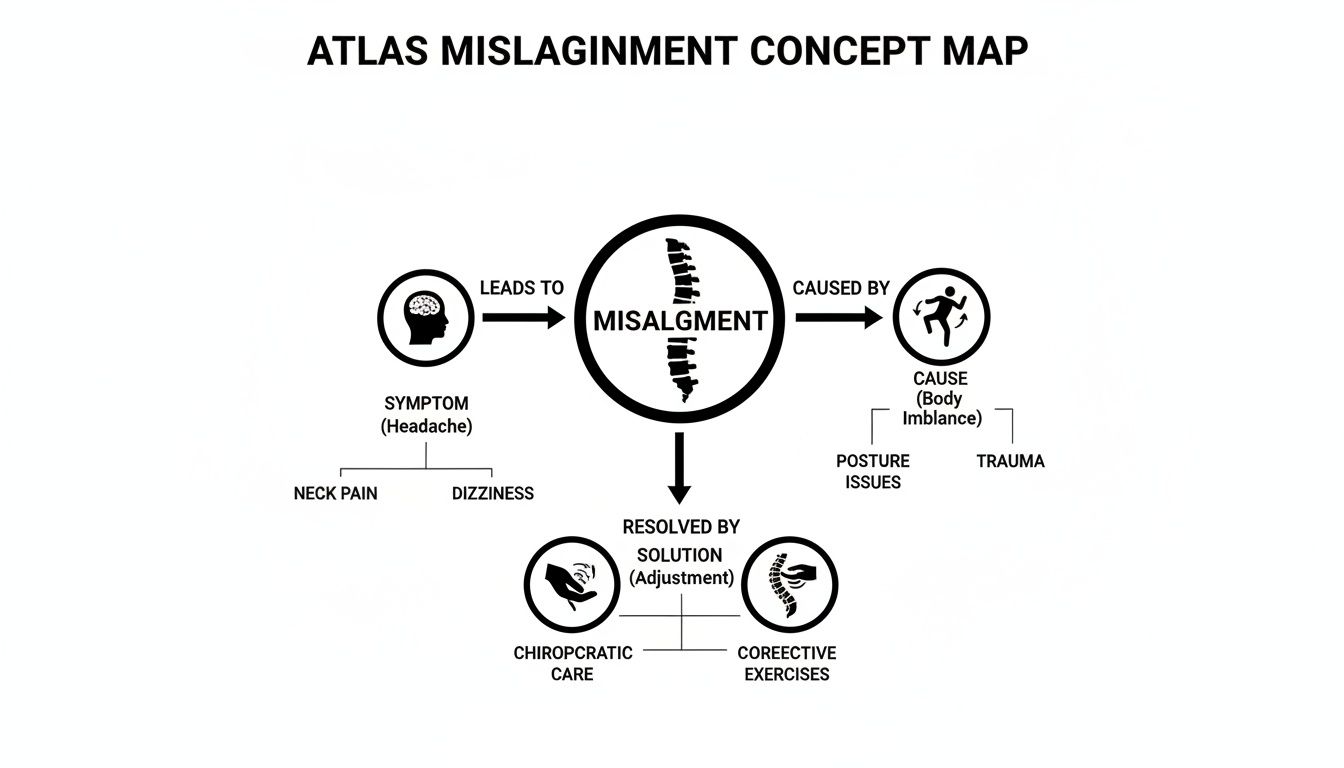
As you can see, one problem at the top can cascade into a wide range of symptoms, but correcting that one core issue can bring everything back into balance.
How Anatomy Influences Alignment
Everyone's body is a little different, and that includes the atlas. It’s actually not that uncommon for people to have slight anatomical variations in their C1 vertebra without ever knowing it. Studies show that these variations can appear in anywhere from 0.074% to 5.16% of the population, with one major study finding variations in 3% of its participants.
Knowing if you have one of these unique structural traits is important, because it could make you more prone to misalignment after an injury. If you're curious about the science, you can dive into the full research on atlas variations to learn more.
Because the atlas sits in such a critical spot, even a tiny shift—just a few millimeters—can create a massive neurological impact. It’s not about the size of the misalignment; it’s all about the location.
This powerful connection between the atlas, the skull, and the brainstem is exactly why our Charlotte chiropractic practice is so focused on this one area. By getting the atlas back into its proper position, we can restore clear brain-to-body communication and let your body’s own healing mechanisms do their job. It's the key to getting to the root cause of issues like migraines, vertigo, and chronic neck pain instead of just chasing the symptoms.
Connecting Your Symptoms to an Atlas Misalignment

It’s an incredibly frustrating experience: living with chronic symptoms that doctors can’t seem to pin down. If you’re dealing with persistent pain or just don't feel right, you've probably noticed that your complaints are often dismissed or treated one by one, as if they’re all separate problems.
But what if they aren’t? Many of these seemingly disconnected issues can often be traced back to a single root cause: an atlas bone misalignment.
Because the atlas sits at the critical junction with the brainstem, even a tiny shift can create widespread chaos. This interference is like static on a phone line, garbling the essential messages that control everything your body does. As a result, symptoms can pop up in places and ways you’d never expect, leading many people on a years-long search for a chiropractor near me who can provide answers.
Connecting your symptoms to this underlying problem is the first real step toward finding lasting relief. For our patients here in Charlotte, this shift in perspective is often the key that finally unlocks their path to recovery.
The Obvious Signs of Misalignment
Some symptoms are classic red flags for an upper cervical issue. These are the problems you’d expect—localized issues in the head and neck that are a direct result of the structural imbalance and nerve irritation.
- Chronic Headaches and Migraines: This is by far one of the most common signs. If you have headaches that seem to start at the base of your skull and wrap around your head, that’s a hallmark of atlas misalignment. It’s often a direct result of nerve compression and restricted blood flow.
- Persistent Neck Pain and Stiffness: It makes sense, right? When your head isn’t sitting properly on your spine, the muscles in your neck and shoulders are forced to work overtime just to hold it up. This leads to constant tension, nagging aches, and a frustratingly limited range of motion.
- Vertigo and Dizziness: An atlas misalignment can seriously scramble the signals your brain relies on for balance and spatial awareness. This neurological interference can leave you with a persistent feeling of being off-balance, lightheaded, or even experiencing the world-spinning sensation of vertigo.
The Less Obvious Connections
This is where things get tricky, and where so many people get lost on their healthcare journey. The ripple effects of an atlas misalignment don't stop at the neck. The neurological and circulatory disruption can trigger a whole host of symptoms throughout the body that, at first glance, seem completely unrelated.
Think of your nervous system as your body's electrical wiring. A problem at the main circuit breaker—the atlas and brainstem—can cause lights to flicker in rooms all over the house.
Here are just a few of the less obvious symptoms our Charlotte patients are often shocked to learn are connected to their atlas:
- TMJ and Jaw Pain: A tilted atlas forces your entire skull to compensate, creating an unbalanced bite. This can lead to that all-too-familiar clicking, popping, and pain in the temporomandibular joint.
- Fibromyalgia-Like Symptoms: Widespread muscle pain, tenderness, and crushing fatigue are often tied to a hypersensitive nervous system. That sensitivity can be dialed up to an 11 by the constant irritation at the brainstem.
- Brain Fog and Inability to Concentrate: Proper alignment is essential for the healthy flow of cerebrospinal fluid (CSF), which acts like a cleanup crew for your brain. When a misalignment obstructs this flow, it can contribute to cognitive sluggishness and mental fatigue.
- Changes in Blood Pressure: The brainstem is command central for regulating your cardiovascular system. It’s no surprise, then, that interference in this area can lead to unexplained spikes or drops in blood pressure.
This isn’t just theory; research is catching up. Studies have shown significant improvements in people with high blood pressure after a specialized atlas correction. Other research has found a higher prevalence of atlas misalignment in those with conditions like Multiple Sclerosis and has explored the link between atlas realignment and a dramatic reduction in migraine frequency. A common thread in these findings is the normalization of impaired fluid flow once the alignment is restored.
So, What Knocks the Atlas Out of Place?
It’s a fair question. How does a bone so important get shifted? The simple truth is that the atlas is more susceptible to moving than any other vertebra. Its unique ring shape gives it a huge range of motion, but that freedom comes at the cost of stability. An atlas bone misalignment doesn't just happen out of the blue; it’s almost always kicked off by some kind of physical force or the slow, steady grind of cumulative stress.
Many of the people we see here in Charlotte are shocked when we trace their chronic issues back to an old injury—something that happened months, or even years, ago. It often only takes one event to shift the atlas. And because the body is a master of compensation, you might not feel the real effects until much later.
High-Impact Trauma and Accidents
The most obvious culprit for an atlas shift is sudden, forceful trauma. When your head and neck whip back and forth, the stress on your upper cervical spine is immense.
Think about these high-impact scenarios:
- Auto Accidents and Whiplash: You don’t have to be in a major wreck. A fender-bender at just 5-8 mph can generate enough force to jar the atlas. Whiplash is notorious for causing subtle upper cervical damage that standard MRIs and X-rays can easily miss.
- Slips, Falls, and Concussions: Taking a hard fall on an icy sidewalk, tumbling down the stairs, or getting a head injury during a game can send a shockwave right up the spine, directly impacting the atlas.
- Sports Injuries: It's no surprise that contact sports or any activity with a high risk of collision can create the perfect storm for a misalignment.
These kinds of traumatic events are often behind a shifted atlas. If you've ever dealt with neck trauma that led to a cervical spine injury, you know how serious it can be, and it's worth exploring all your options with an experienced auto injury chiropractor.
The Slow Burn: Cumulative Stress and Repetitive Strain
Not every cause is a big, dramatic event. Sometimes, the problem creeps in slowly, the result of persistent, low-grade stress that gradually weakens the ligaments and muscles holding the atlas in place. Our modern lives are full of these kinds of stressors.
An atlas misalignment isn't always caused by one big event. Often, it's the result of thousands of small, repetitive stressors that gradually pull the bone out of its proper place.
Consider these everyday habits:
- Poor Posture ("Text Neck"): That constant downward gaze at your phone or laptop puts a huge strain on your neck. This forward head posture makes the muscles at the base of your skull work overtime, eventually pulling the atlas out of alignment.
- Awkward Sleeping Habits: Sleeping on your stomach or using a pillow that cranes your neck into an odd position puts hours of nightly stress on the atlas joint.
- Birth Trauma: The journey into the world can be physically intense for both mom and baby. The forces involved during delivery are a common, but frequently overlooked, cause of an initial atlas misalignment right from the start. We offer both prenatal and pediatric chiropractic care to address these foundational issues.
Our Patient-First Diagnostic Process in Charlotte, NC
Figuring out what's really causing your health issues shouldn't be a shot in the dark. Here in our Charlotte office, we've refined a scientific and highly specific diagnostic process to get right to the source of your symptoms. This isn't a one-size-fits-all approach; it's a partnership where we work together to understand your unique health story and map out a clear path to getting you better.
Your first visit with us doesn't start with a treatment—it starts with a conversation. We set aside dedicated time to listen, going through your health history in detail. We'll talk about any past injuries, like car accidents or even seemingly minor falls, track when your symptoms began, and review what you’ve already tried. This conversation is often where we start connecting the dots between an old injury and the problems you're facing today.
Advanced Imaging for Pinpoint Accuracy
After our initial chat, we move on to the most crucial step: advanced 3D imaging. This is a world away from the standard X-rays you might get at an urgent care, which are mainly looking for fractures or obvious dislocations. Our specialized scans create a detailed, three-dimensional model of your upper neck anatomy.
This lets us see exactly how your atlas (C1) has shifted out of place in relation to your skull and the vertebra below it. We can measure the precise angle and direction of your specific atlas bone misalignment right down to the millimeter. There's absolutely no guesswork.
We don’t guess, we test. Our entire approach is built on objective, data-driven care. By precisely measuring your misalignment, we develop a correction that is tailored specifically to your body, ensuring the adjustment is as gentle and effective as possible.
Comparing Our Diagnostic Approach
Understanding the differences in diagnostic methods is really important. So many of our patients arrive here after trying other things that didn't work, often because the real structural issue was never accurately identified in the first place.
To help clarify the key differences, the table below breaks down a general approach versus our highly specific diagnostic process. This will help you understand the unique value of our focused method.
General Chiropractic vs. Our Specialized Upper Cervical Care
By taking this meticulous approach, we ensure that when it's time for a correction, it is as accurate, gentle, and effective as it can possibly be. Your journey back to health in Charlotte begins with this foundation of clarity and precision.
Restoring Your Alignment With a Gentle Correction
When most people hear "neck adjustment," they immediately picture the forceful twisting and popping often shown in movies. It’s a common source of anxiety, and we want to put your mind at ease. Here in our Charlotte office, our approach to correcting an atlas bone misalignment is a world apart from that stereotype. The entire process is remarkably gentle, precise, and non-invasive.
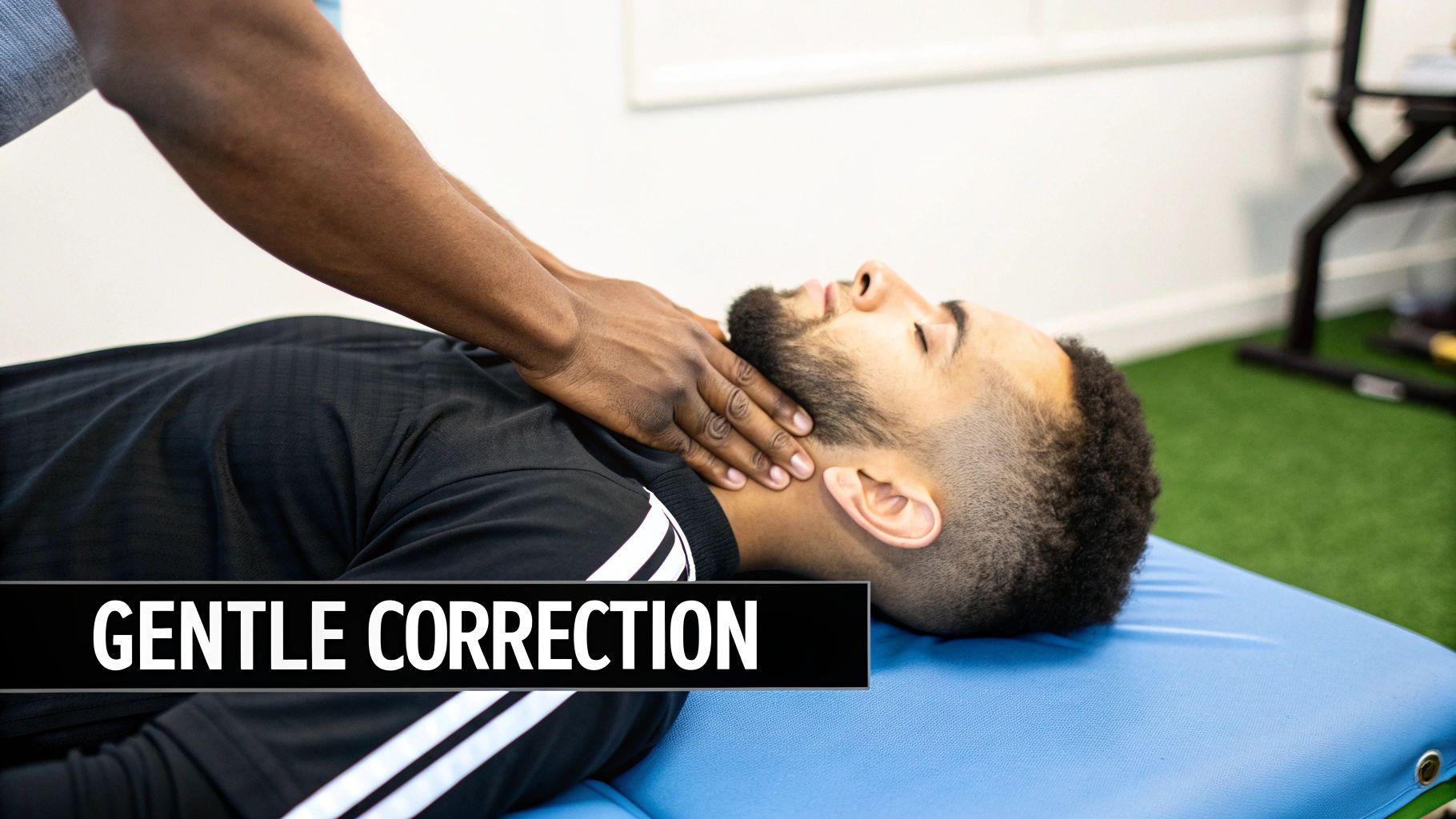
Forget any ideas about sudden movements. Our correction is meticulously planned using the exact measurements from your 3D imaging. This data allows us to calculate the precise angle needed to gently nudge the atlas back to its natural, centered position.
The correction itself is a light, controlled touch applied just below your ear. The force is minimal—many patients compare it to the gentle pressure you’d use to check if a piece of fruit is ripe. That’s it. This slight impulse is all it takes to guide the bone back into place, which immediately relieves pressure on the brainstem and unlocks your body's powerful, built-in ability to heal.
The Goal Is Holding, Not Adjusting
This might sound counterintuitive, but our primary goal isn't to adjust you over and over again. We focus on helping your body "hold" the correction. A successful adjustment is one that stays put, giving your spine and nervous system the stability they need to recover for the long haul.
Think of it like this: our job is to get the bone back where it belongs. Your body’s job is to heal and keep it there.
This simple concept is the core of our entire philosophy. When your body maintains its proper alignment, the need for frequent adjustments diminishes over time. It’s a clear sign that your nervous system is working without interference and the muscles and ligaments supporting your neck are getting stronger.
A Long-Term Solution for Lasting Health
Our method is designed to be a corrective, long-term solution, not just a quick fix for your symptoms. By getting to the root cause of the problem—that tiny structural misalignment at the top of the spine—we aim to restore proper function throughout your entire body.
The benefits of a stable correction go far beyond just pain relief:
- Restored Nerve Function: Once the pressure is off the brainstem, the communication superhighway between your brain and body becomes clear and efficient again.
- Improved Stability: As your body holds the new alignment, the supporting soft tissues adapt and strengthen, which helps prevent future misalignments.
- Reduced Need for Care: Our ultimate goal is for you to need us less and less as your body heals and stabilizes on its own.
As you think about recovery, it’s interesting to see how some practices are integrating complementary therapies. For example, some facilities are now using hyperbaric chambers in chiropractic offices to support the healing process. By focusing on a precise and lasting correction, we give your body the foundation it needs to truly heal, helping our Charlotte patients achieve a much higher quality of life.
Answering Your Questions About Atlas Alignment Care
It's only natural to have questions when you're exploring a new path to health. We believe that feeling understood and confident is the first step toward true healing. That's why we've put together some of the most common questions we hear from patients right here in Charlotte, answered simply and directly.
Think of this as our way of making sure you have everything you need to decide what’s best for your well-being.
Is Upper Cervical Care Safe for Everyone?
Yes, absolutely. The reason our approach is so safe is because it's incredibly gentle and precise. You won't find any forceful twisting, popping, or cracking of the neck in our office.
We start with advanced 3D imaging to create a detailed map of your unique anatomy. This allows us to calculate a correction that is tailored specifically for you. It’s this level of precision that makes it a safe and remarkably effective option for everyone from young children to seniors.
How Quickly Will I Feel Better?
Everyone's body heals at its own pace, so the timeline for feeling relief is different for each person. Some of our patients notice an immediate change for the better after their very first adjustment. For others, it’s a more gradual improvement as the body slowly unwinds, adapts, and restores proper nerve function over a few weeks.
When we sit down for your consultation, we'll talk through your specific case, including how long you've been dealing with the atlas bone misalignment. This helps us give you a realistic idea of what to expect. Our goal isn't a quick fix; it's a lasting correction.
True healing happens when the body achieves stability. When your alignment holds, your body gets the uninterrupted time it needs to repair itself, which is the key to long-term relief and better function.
Do I Need a Referral from My Doctor?
No, you don't need a referral to see us. In fact, most of our patients come to us directly. They're usually looking for a real solution to chronic health problems after other approaches haven't provided the relief they need.
We always invite people to schedule a consultation directly with our team. It’s the easiest way to find out if our specialized care is right for you and get all of your questions answered with no obligation.
How Is This Different from Regular Chiropractic?
The biggest difference is our singular focus. We concentrate exclusively on the critical relationship between the top two bones in your neck—the atlas and the axis—and the brainstem. While general chiropractic often involves adjusting the entire spine, our work is centered on this vital neurological area.
We use precise 3D imaging to deliver a gentle correction based on your exact measurements. Our philosophy is truly "less is more." We believe in making the right adjustment, and then letting your body’s own healing intelligence take over with as little future intervention as possible.
Your journey toward lasting relief begins with understanding the root of the problem. At The Upper Cervical Spine Center, we're committed to giving you the answers you need to reclaim your health. If you’re ready to stop chasing symptoms and start addressing the cause, we invite you to schedule a complimentary consultation with our Charlotte team today by visiting The Upper Cervical Spine Center.
Address
2550 W Arrowood Rd
Suite 104
Charlotte, North Carolina, 28273
United States
Hours
Monday-Friday:
9AM-12PM
&
2PM-6PM
We Align the Head and Neck So That the Nerves Can Send Brain Healing Messages to Affected Parts Of Your Body.
It's a Natural Self Healing.
