
Best Sleep Position for Pinched Nerve in Neck: Lasting Relief from a Charlotte Chiropractor

When you're dealing with a pinched nerve in your neck, the best way to sleep is either on your back or your side, but only with the right support. The goal is to keep your spine in its natural curve, which takes pressure off that angry nerve and gives it a chance to heal while you rest. The one position you absolutely must avoid? Stomach sleeping. It's a recipe for more pain.
Your Guide to a Pain-Free Night with a Pinched Nerve in Charlotte, NC

That sharp, radiating pain from a pinched nerve in your neck can turn bedtime into a dreaded event. Suddenly, finding a comfortable position feels like an impossible task. For our patients across the Charlotte area, we know this pain doesn't just ruin your sleep—it can derail your entire day.
This guide is designed to give you real, practical advice you can use tonight to find some relief. Here at The Upper Cervical Spine Center, our focus is always on the root cause of your pain. As your trusted chiropractor in Charlotte, NC, we believe that process often starts with foundational habits like creating a supportive sleep environment.
Understanding the Challenge: What is a Pinched Nerve?
A pinched nerve, known clinically as cervical radiculopathy, occurs when a nerve root in your neck gets compressed by surrounding tissues like bone, muscle, or a bulging disc. This pressure is like stepping on a garden hose; it disrupts the nerve's ability to work correctly and triggers a whole host of miserable symptoms that make sleep feel like a battle.
You're likely all too familiar with one or more of these:
- A sharp, burning pain shooting from your neck into your shoulder or down your arm.
- That frustrating "pins and needles" or tingling sensation in your arm or fingers.
- Noticeable weakness in your hand or arm, making it tough to even grip a coffee mug.
- Numbness that deadens sensation and makes everyday tasks difficult.
These symptoms often feel much worse at night. Why? Because the wrong sleep position can crank up the pressure on that already irritated nerve. If you spend your day with poor posture, your neck muscles are already strained, and an unsupportive sleep setup just continues that stress for another 6-8 hours. For more on this, we've put together a detailed guide on how to fix forward head posture.
The key is simple: keep your head, neck, and spine in a neutral, straight line while you sleep. This alignment takes the stress off your cervical spine, giving the pinched nerve the space and uninterrupted time it desperately needs to start healing.
By making a few strategic, simple adjustments to how you sleep, you can dramatically reduce nighttime pain and wake up feeling more mobile and refreshed. Let's walk through the best positions to achieve that all-important neutral alignment.
Sleeping On Your Back for Optimal Spinal Alignment
If you're dealing with the sharp, nagging pain of a pinched nerve in your neck, sleeping on your back is almost always the best place to start. There's a reason experts consider it the gold standard. This position—also called the supine position—lets your head, neck, and spine settle into a neutral, unstressed line. It works with gravity, not against it, to spread your weight out evenly and prevent the very twists and turns that can make that nerve compression worse overnight.
Imagine your spine as a delicate chain. Lying on your back helps keep every link in that chain properly aligned, which is exactly what you need to take the pressure off that irritated nerve. So many of our Charlotte patients tell us that this one simple switch makes a world of difference in the pain they feel when they wake up.
Fine-Tuning Your Back-Sleeping Setup
Of course, just flopping onto your back isn't the full solution. The real magic happens when you use pillows to create the right support system. Your goal here is to maintain the natural, gentle C-curve of your neck.
To get it right, you'll want to focus on two key spots:
- Support Your Neck: The trick is to slide a supportive cervical or contour pillow directly under your neck, not just your head. This fills that crucial gap between your neck and the mattress, keeping your head from tilting too far back or being propped up too high. It should feel like the pillow is cradling your neck.
- Relieve Lower Back Strain: Now, grab a second, larger pillow and tuck it under your knees. This little trick instantly softens the curve in your lower back, taking the strain off and helping your entire spine relax into a more neutral posture.
For our patients in Charlotte who are also managing chronic issues like fibromyalgia or recovering from a concussion, this setup can be a real game-changer. When you pair this kind of supportive sleep posture with the precise upper cervical adjustments we provide, you create the ideal environment for your body to heal.
The Proven Benefits of the Supine Position
Back sleeping consistently comes out on top as the healthiest option because it distributes body weight so evenly and minimizes pressure points. In fact, research shows it’s highly effective at decreasing neck pain by maintaining that neutral alignment. One study even found that back sleepers reported 40% less daily discomfort than stomach sleepers. You can read more about the best sleeping positions for pain relief from Cleveland Clinic.
By embracing this position, you give your body the best possible chance to rest and recover. It allows the inflamed nerve the space it needs to calm down, leading to less pain and more restorative sleep.
How to Master Side Sleeping to Reduce Nerve Pressure
Let's be realistic—for a lot of us, trying to become a back sleeper overnight just isn't going to happen. If you're a dedicated side sleeper, don't worry. You can absolutely make this position work for you, even with a pinched nerve in your neck. The trick is to be smart about your setup.
In fact, the Sleep Foundation points out that side sleeping is one of the best ways to tackle this kind of pain, and it makes sense when you consider that over 60% of adults sleep this way naturally. When done correctly, it helps maintain the natural curve of your neck. Research on spinal health suggests this alignment can reduce pressure on those aggravated nerves by as much as 30% compared to less-than-ideal postures. You can dive deeper into the best sleeping positions for neck pain relief from the Sleep Foundation.
Aligning Your Spine While on Your Side
When you're sleeping on your side, your one and only goal is to create a perfectly straight line from your head all the way down to your hips. Think of it like a ruler. If your head sags down or is propped up too high, you're putting a direct strain on the very nerves you're trying to soothe.
Here’s how to get that alignment right:
- Get Your Pillow Height Just Right: This is non-negotiable. Your pillow needs to be high enough and firm enough to fill the gap between your ear and the bed. Too thin, and your head drops. Too thick, and it’s pushed upward into an unnatural angle.
- Give Your Top Arm a Home: Don't let your top arm just hang there. Hugging a firm pillow to your chest gives that arm a place to rest, which is crucial for preventing your shoulder from collapsing forward and twisting your upper back.
- Keep Your Hips from Twisting: A thin but firm pillow wedged between your knees is a game-changer. It stops your top leg from sliding over, an action that rotates your hips and sends a subtle twisting force all the way up your spine.
It’s these small adjustments that make all the difference. Many of the patients we see at our Charlotte chiropractic clinic are amazed by how much less stiffness and pain they wake up with after making these simple changes.
Key Takeaway: The perfect side-sleeping pillow isn't about being fluffy or soft. It’s a tool for structural support. It needs to act like a bridge, holding your head in neutral alignment with your spine all night long.
This diagram shows you exactly how to set up your pillows to get the best possible relief while sleeping on your back.
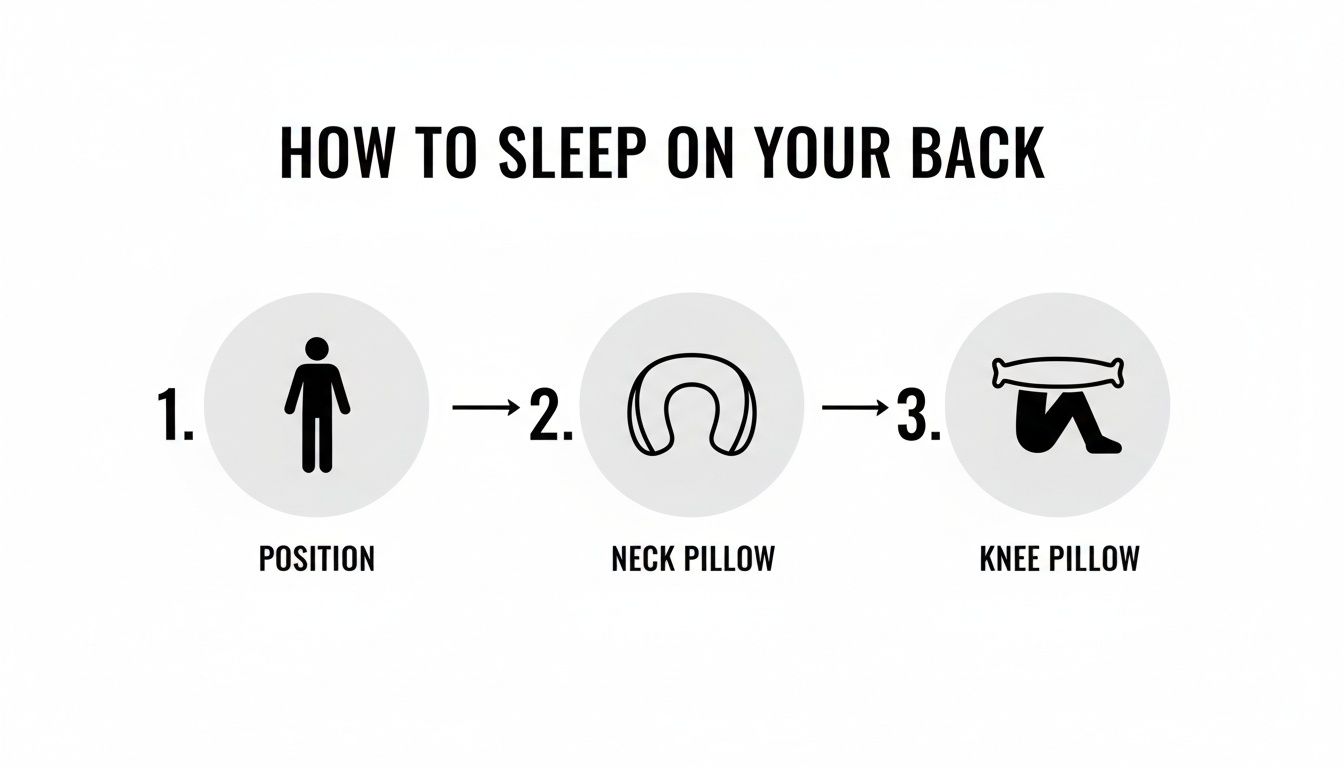
You can see how the cervical pillow and the pillow under the knees work together to keep the spine in a neutral, relaxed position. That’s the core principle for waking up without pain.
The One Position You Absolutely Must Avoid: Stomach Sleeping
When you're dealing with a pinched nerve, we can tweak back and side sleeping to help you find relief. But there's one position that’s a non-starter: sleeping on your stomach.
If you're a stomach sleeper, this habit is almost certainly a major reason your neck is in agony. At The Upper Cervical Spine Center, one of the first things we work on with our patients in Charlotte is breaking this habit for good.
Think about it—to breathe, you have to twist your head almost 90 degrees to one side and hold it there all night. This isn't just a little awkward; it's a mechanically disastrous position for your neck. It forces your cervical spine out of its natural, healthy curve, putting hours of sustained, direct pressure on the very vertebrae and nerves that are already screaming for a break.
The Problem is Pure Mechanics
When your head is cranked to the side like that, your spine is torqued into a compromising position. This not only irritates the pinched nerve you already have but can also lead to new misalignments and stubborn muscle imbalances. It's a cycle of strain and pain.
Many of the neck pain patients we see, especially those recovering from auto injuries or whiplash, are dedicated stomach sleepers. Their progress often hits a wall until they can finally switch positions.
The constant, unnatural twist on your neck's muscles and ligaments from stomach sleeping creates low-grade trauma, inflammation, and a chronic ache that follows you all day.
Sleep science backs this up completely. Research consistently shows that stomach sleepers report the most neck pain during the day. Some studies even suggest their discomfort can be up to 50% higher than people who sleep on their back or side. This constant nightly strain simply cancels out any other progress you're making to heal. You can learn more about how sleep positions directly affect neck strain and see why it’s so critical to address.
So, How Do You Stop?
We get it. If you've slept on your stomach your whole life, changing feels like an impossible task. The trick is to make it physically difficult for your body to roll into that position while you're asleep.
Here are a couple of practical strategies our patients have used successfully:
- The Body Pillow Block: Get a large body pillow and hug it. It acts as a physical barrier, making it much harder to roll fully onto your stomach.
- Build a Pillow Fort: This sounds silly, but it works. Wedge firm pillows on both sides of your body to keep yourself corralled on your back or side.
Breaking this habit won't happen overnight, but it's one of the single most powerful things you can do for the long-term health of your neck. It’s a change worth making.
Choosing the Right Pillow and Mattress for Neck Support

Perfecting your sleep position is a huge step, but it’s really only half the battle. If your pillow and mattress aren't doing their jobs, even the ideal posture won't bring you the relief you're looking for. Think of them as the essential tools you need to achieve and maintain proper alignment all night long.
Your mattress is the foundation. From our experience helping patients in Charlotte with neck and spine issues, a medium-firm mattress usually hits the sweet spot. You need something firm enough to support your spine's natural curves without letting your hips sink, but with enough give to avoid creating painful pressure points.
Selecting the Right Pillow for Your Position
The main job of your pillow is simple: keep your head and neck in a straight line with the rest of your spine. When you're dealing with a pinched nerve, getting this right is non-negotiable. For a really deep dive into this, you can check out this fantastic Guide How To Choose The Perfect Pillow.
What works best will depend entirely on your preferred sleeping position.
For Back Sleepers: A thinner pillow is your best friend. The goal is to let your head rest in a neutral position, not be pushed forward at an angle. We often recommend cervical pillows with a special contour. They have a built-in curve that supports your neck while allowing your head to rest comfortably.
For Side Sleepers: You need something thicker and firmer. The pillow has to completely fill the gap between your ear and the mattress to prevent your head from drooping. This keeps your spine level. Memory foam or latex pillows are great options here because they offer solid support that doesn't flatten out by 3 a.m.
A key piece of advice we give almost every patient is to follow the 'one-pillow rule.' Stacking pillows is one of the most common mistakes people make. It forces your neck into a sharp forward bend that can seriously aggravate a pinched nerve.
The Foundation for Long-Term Relief
Here at The Upper Cervical Spine Center, we consider your sleep setup a critical part of your overall recovery plan. A bad bed can undermine the progress you make with your adjustments. That’s why we work with our patients in Charlotte to build a foundation for lasting healing—and that foundation starts where you rest your head each night.
Our guide on choosing the best pillow for headaches also has some great tips that apply directly to neck pain. When you combine the right mattress and pillow with a healing sleep posture, you're creating the perfect environment for your body to finally start to recover.
How Chiropractic Care in Charlotte, NC, Helps Pinched Nerves
Making smart changes to how you sleep can provide serious relief for a pinched nerve in your neck. But these adjustments are often managing the symptoms, not fixing the root of the problem. If you’ve done everything right with your sleeping setup and you're still in pain, that’s a clear sign that a deeper issue needs to be addressed. Chiropractic care is designed to find and correct that underlying cause.
Pain that just won't quit, especially after a few weeks, is your body's alarm bell. A pinched nerve isn't just a simple muscle ache; it means a nerve is physically being squeezed, and letting that go can lead to bigger problems down the road.
Don't Ignore These Red Flag Symptoms
While a sore neck is the most obvious sign, a compressed nerve can trigger a whole host of other issues. It’s so important to listen to your body and recognize when it's time to see a professional who really understands the neck.
Keep an eye out for these specific warning signs:
- Lingering Numbness or Tingling: If that "pins and needles" feeling in your arm, hand, or fingers just won't go away or seems to be getting worse, the nerve is still irritated.
- Growing Weakness: Finding it tougher to hold your coffee cup, type, or lift things you used to handle easily? Muscle weakness is a serious sign that the nerve's signals are getting scrambled.
- Pain That Travels: That sharp, shooting pain that runs from your neck down into your shoulder, arm, or hand is a classic sign of nerve trouble that needs a proper diagnosis.
- Loss of Coordination: Noticing a new clumsiness in your hands or struggling with fine motor skills? This can point to significant nerve compression.
If the pain is getting in the way of your daily life—messing with your sleep, affecting your job, or keeping you from doing the things you love—it is absolutely time to get a professional evaluation. You don't have to just tough it out.
Why Your Upper Neck Might Be the Culprit
More often than not, the real source of a pinched nerve is a subtle misalignment right at the top of the spine—specifically, the atlas (C1) and axis (C2) vertebrae. These two little bones are crucial; they protect the brainstem and act as the main hub for nerve signals traveling between your brain and your body.
When they get knocked out of their proper position—from an old injury, years of poor posture, or even chronic stress—they can put direct pressure on those sensitive nerves.
This is exactly where specialized upper cervical chiropractic care shines. At our Charlotte clinic, our entire focus is on finding and correcting these precise misalignments. You won't find any of the twisting, cracking, or popping that many people associate with chiropractic care in our office.
We use advanced diagnostic tools to pinpoint the problem and then deliver gentle, specific adjustments to restore proper alignment. The goal is simple: take the pressure off the nerve so your body can finally do what it does best—heal itself. This is about finding a lasting solution, not just a temporary patch. Even with the perfect mattress and the right pillow, you can only get so far if the spine itself is out of line.
During your first visit to our Charlotte clinic, Dr. Ray Drury will conduct a comprehensive evaluation to get to the bottom of your nerve compression. We'll walk you through everything we find so you have a clear picture of what's going on and how our unique approach to chiropractic care can help you get back to living a pain-free life.
At The Upper Cervical Spine Center, we're committed to finding and fixing the root cause of your pain. If you're tired of temporary fixes and want a long-term solution for your pinched nerve, we invite you to schedule a consultation with a chiropractor near you in Charlotte, NC. Learn more about our approach and book your appointment today.
Address
2550 W Arrowood Rd
Suite 104
Charlotte, North Carolina, 28273
United States
Hours
Monday-Friday:
9AM-12PM
&
2PM-6PM
We Align the Head and Neck So That the Nerves Can Send Brain Healing Messages to Affected Parts Of Your Body.
It's a Natural Self Healing.
