
Neck Exercise for Vertigo: A Chiropractor's Guide for Charlotte, NC

When that sudden, disorienting spinning sensation hits, it's natural to think the problem is in your inner ear. But for many people in Charlotte, the real culprit is their neck. If gentle neck exercises bring even temporary relief, it often points to a deeper issue: a misalignment in your upper spine that's scrambling the vital nerve signals controlling your balance.
At Upper Cervical Spine Center, we help patients across the Charlotte, NC, area understand that this isn't just something you have to live with. As a trusted local chiropractor, our focus is on finding and addressing the root cause of your vertigo, so you can get back to feeling steady and secure.
Is Your Neck the Real Cause of Your Vertigo?
It’s a truly unsettling feeling when the world starts to tilt or spin. Most people’s first thought is vertigo, usually chalking it up to an inner-ear condition like Benign Paroxysmal Positional Vertigo (BPPV). While that's a common cause, it's far from the only one. Our chiropractic team often sees patients whose vertigo is actually coming from their neck.
This specific condition is called cervicogenic dizziness, and it stems from problems in the cervical spine that send faulty position signals to your brain. You can think of your upper neck as the command center for your body's balance and spatial awareness. It’s packed with a dense network of nerves that constantly tell your brain where your head is, and it protects the critical brainstem.
The Upper Cervical Connection
The very top of your spine is where the connection to balance begins. The first two vertebrae, the atlas (C1) and axis (C2), are shaped differently from all the others, giving your head its incredible range of motion. But this mobility comes at a cost—they're also more susceptible to being knocked out of alignment.
This can happen from a number of things we see in our Charlotte-area patients all the time:
- Whiplash from an auto injury on I-77 or I-85
- Concussions and other head injuries
- Years of poor posture (the "text neck" phenomenon is a real problem)
- Slips, falls, or jarring sports injuries
When one of these vertebrae shifts, it can put pressure on nerves and even affect blood flow. This creates a sensory mismatch. Your inner ear sends one set of signals about your position, but the irritated nerves in your neck send conflicting ones. The brain gets confused by this contradictory data, and the result is that disorienting feeling of dizziness.
The Bottom Line: Cervicogenic dizziness isn't an ear problem. It's a communication breakdown between your neck and your brain, often caused by a subtle misalignment that throws off your body's entire positioning system.
So many patients who walk into our clinic have been on a frustrating journey. They've been given medications and tried various therapies, but nothing worked because the underlying structural issue was never found. As an experienced upper cervical chiropractor in Charlotte, NC, our primary goal is to identify that root cause.
Differentiating From Inner-Ear Issues
So how can you get a clue if your vertigo is coming from your neck? Getting a proper diagnosis from a professional is crucial, but there are some tell-tale signs.
Unlike the intense, short-lived spinning spells from BPPV that are often triggered by rolling over in bed, neck-related dizziness can present differently. For a deeper look, you can learn more in our guide on what is cervical vertigo.
Often, cervicogenic dizziness comes with other symptoms like nagging neck pain, stiffness, or headaches that feel like they start at the base of your skull. The dizziness itself can feel less like a violent spin and more like a constant lightheadedness or a vague sense of unsteadiness, as if you're walking on a boat.
Here at The Upper Cervical Spine Center, our entire focus is on identifying and correcting these small but incredibly significant misalignments. We use a precise and gentle approach to restore proper alignment to the top of the neck. For many of our patients in the Charlotte area, this is the key that finally unlocks lasting headache relief and an end to their dizziness.
Getting to Know the Symptoms of Cervicogenic Dizziness
The first step toward relief is learning to recognize the signals your body is sending. While "dizziness" is a broad term, the kind that starts in your neck—what we call cervicogenic dizziness—has a unique feel to it, one that's quite different from classic inner-ear vertigo.
Cervicogenic dizziness rarely involves that intense, room-spinning sensation you might have heard about. Instead, patients often describe it as a vague feeling of unsteadiness, lightheadedness, or a sensation of floating. You might feel like you're on a boat, even when standing on solid ground in your own home.
This feeling isn't random; it's almost always provoked by specific neck movements. Do you get a wave of dizziness when you tilt your head back to grab something off a high shelf? Does turning your head quickly to back out of a parking spot in Charlotte leave you feeling disoriented for a moment? These are classic signs that the problem is rooted in your neck.
The Link Between Dizziness and Neck Discomfort
One of the biggest clues for cervicogenic dizziness is its close relationship with neck pain and stiffness. The dizziness isn't an isolated event; it often shows up with other neck-related issues. Many people we see at our chiropractic clinic tell us their dizzy spells happen right after, or at the same time as, a flare-up of neck pain.
Do any of these scenarios sound familiar?
- Morning Stiffness: You wake up with a stiff, achy neck and feel unsteady on your feet for the first hour of your day.
- Headaches: You get headaches that seem to start at the base of your skull and creep up the back of your head, often bringing a foggy or lightheaded feeling with them.
- Postural Triggers: After a few hours hunched over your computer, you stand up and feel a momentary loss of balance along with a tight, sore neck.
If you’re nodding along, that's a strong indicator that your dizziness is tied to the alignment and health of your cervical spine. The faulty signals throwing off your sense of balance are coming directly from irritation in your neck, something that chiropractic care is designed to address.
When neck pain, stiffness, and headaches are constant companions to your dizziness, it’s a major clue that the root cause is likely cervicogenic.
Cervicogenic Dizziness vs. Inner-Ear Vertigo
Figuring out whether your dizziness is coming from your neck or your inner ear is crucial for getting the right treatment. Use this quick comparison to see which profile best matches your symptoms. A professional diagnosis from a chiropractor is always the best course of action, but this can give you some initial clarity.
Recognizing your specific pattern of symptoms is powerful. It helps you have a much more productive conversation with a neck pain chiropractor and gets you closer to addressing the real source of the problem—which could very well be a misalignment in your upper cervical spine.
Gentle Neck Exercises You Can Start Today
When your world feels unsteady, the idea of moving your neck might seem counterintuitive. We understand that. But when dizziness comes from the neck—cervicogenic dizziness—gentle, controlled movement is often exactly what your body needs to find relief.
The goal here isn't to push through pain. Instead, think of these exercises as a way to gently coax your neck back into a healthier state. We're aiming to slowly improve mobility, release tight muscles, and wake up those deep, stabilizing muscles that support your head. It's all about restoring proper communication between your neck and your brain's balance centers.
Before you jump in, a quick word of advice: always start slowly and listen to your body. This is especially true if you are dealing with chronic dizziness. If you haven't been evaluated by a chiropractor near you, it's always best to consult a specialist first. Never force a movement that makes your symptoms worse.
Foundational Movements for Neck Stability
First things first, we need to build a stable foundation without adding any strain. These initial movements are subtle but incredibly powerful. They target the deep muscles responsible for holding your head up, taking the pressure off irritated nerves and joints.
Cervical Retractions (Chin Tucks)
If you do only one exercise, make it this one. Chin tucks directly combat the forward-head posture that puts so much stress on the upper part of your neck.
- Start by sitting or standing tall, with your eyes looking straight ahead.
- Gently glide your chin straight back, as if you're trying to make a double chin. You should feel a nice, gentle stretch at the base of your skull.
- Hold this position for 3-5 seconds.
- Relax and let your head return to its starting position.
- Aim to repeat this 10 times, doing 2-3 sets throughout the day.
Here’s a tip: Imagine a string is pulling the very top of your head toward the ceiling as you draw your chin back. This mental cue helps ensure you're truly retracting your head, not just looking down.
This simple flowchart shows how a seemingly normal neck movement can sometimes set off a chain reaction of dizziness and pain—a classic pattern for people dealing with cervicogenic issues.
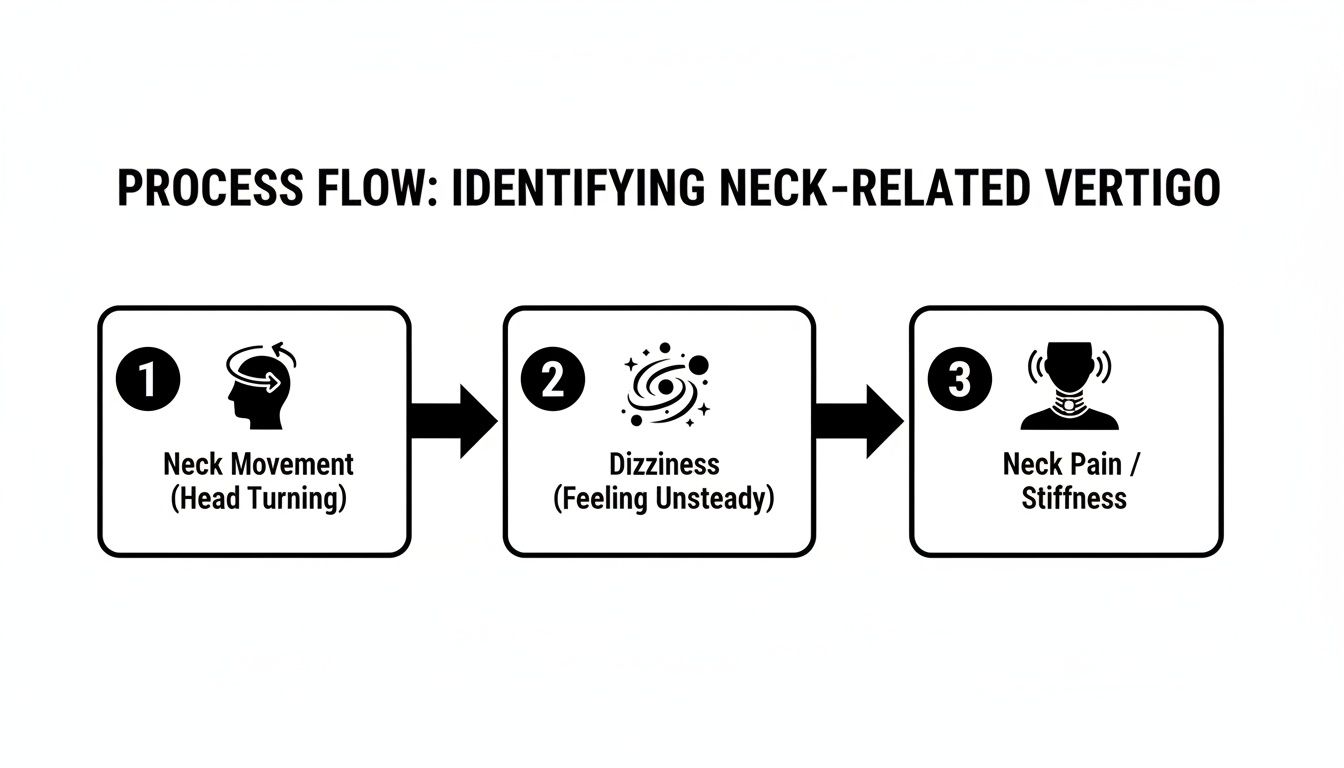
Seeing it mapped out like this really drives home why these specific, gentle exercises are so vital. They help break that frustrating cycle.
Building Strength Without Strain
Once you feel comfortable with chin tucks, you can start adding gentle strengthening. We’ll use isometric exercises, which means you’ll be tensing your muscles without actually moving your neck. This is one of the safest ways to build strength and support for the delicate structures in your upper neck.
Isometric Neck Exercises
Sit up straight in a chair for these. The idea is to gently press your head against your hand's resistance, but don't allow your head to move at all.
- Forward: Place your palm on your forehead. Gently press your head forward into your hand.
- Backward: Clasp your hands and place them on the back of your head. Gently press your head backward into your hands.
- Side-to-Side: Put your right palm on the right side of your head. Gently press into your hand. Then, switch and do the same on the left side.
Hold each gentle contraction for 5-7 seconds, then relax. Try for 5-10 repetitions for each direction. The pressure should be very light—just enough to feel the muscles fire up.
Restoring Gentle Range of Motion
Stiffness is a huge piece of the cervicogenic dizziness puzzle. These stretches are designed to carefully improve your neck's flexibility without stirring up your symptoms. Remember to move slowly and deliberately. No quick or jerky movements.
Gentle Neck Tilts and Turns
- Side Tilts: Slowly and gently tilt your right ear toward your right shoulder until you feel a light stretch on the left side of your neck. Hold for 15-20 seconds. Come back to the middle and repeat on the other side.
- Forward Tilts: Gently lower your chin toward your chest, feeling the stretch along the back of your neck. Hold this for 15-20 seconds.
- Slow Turns: Turn your head slowly to the right, as if you're looking over your shoulder. Stop as soon as you feel a gentle stretch. Hold for 15-20 seconds, then repeat to the left.
A Critical Reminder: Stop immediately if any of these movements cause sharp pain, numbness, tingling, or a noticeable spike in your dizziness. These are not "no pain, no gain" exercises. The goal is gentle, restorative movement.
The science backs this approach up. A randomized controlled trial looked at 32 patients (average age of 48) who followed a similar home exercise program. The results were fantastic—the group saw their Dizziness Handicap Inventory (DHI) scores drop by an average of 25.92 points. Their Neck Disability Index (NDI) also improved by 6.16 points, all with no significant side effects.
If you have persistent "knots" in your neck or upper back muscles, you might also find it helpful to learn how to use a trigger point foam roller for muscle knots. It can be a great way to provide targeted relief to those stubborn, tight spots.
These movements are an excellent starting point for managing your symptoms from home. For even more techniques, you might be interested in our more comprehensive guide. You can learn more about vertigo exercises in our article. Just remember, while these exercises lay a solid foundation, they work best when paired with professional chiropractic care that gets to the root structural cause of your dizziness.
Why Home Exercises Are Not the Whole Story
Don’t get us wrong, doing gentle neck exercises is a great first step. It's proactive, it can help manage the symptoms of cervicogenic dizziness, and it often provides much-needed relief from muscle tension. It gives you a sense of control, which is huge when you feel like the world is spinning.
But it’s really important to see these exercises for what they are: a tool for managing symptoms, not a fix for the underlying structural problem.
If your dizziness is coming from a misalignment in your upper neck—specifically the atlas (C1) or axis (C2) vertebrae—no amount of stretching is going to physically nudge those bones back into place.
Think of it this way: if your car's alignment is off, you can learn to steer against the pull to keep it driving straight. But that doesn't fix the crooked wheels. The tires will keep wearing down unevenly, and the car will always want to veer off course. Exercises for vertigo are a lot like that. They help you cope, but they can’t resolve the core issue that’s sending those faulty signals from your neck to your brain.
When to Suspect a Deeper Problem
So, how do you know when your vertigo is more than just a tight muscle? There are some tell-tale signs that a deeper, structural problem is the real culprit—one that needs a specialist’s eye.
If you’ve been doing these exercises consistently and the dizziness just isn't letting up, that's a major red flag. Your body is trying to tell you that the root cause is still there.
Think back to when it all started. Did the dizziness appear after a specific incident?
- Auto Accidents: Even a minor fender-bender on the streets of Charlotte can cause a whiplash injury that misaligns the upper cervical spine. An auto injury chiropractor is specially trained to find these issues.
- Concussions or Head Injuries: Any kind of blow to the head can shift the atlas vertebra. Sometimes, symptoms like dizziness don't even show up for weeks or months.
- Slips and Falls: A sudden jolt from a fall can have the same jarring effect, disrupting that delicate alignment right at the top of your neck.
And if your dizziness comes with other symptoms—like chronic headaches, migraines, or a constant feeling of pressure in your head—that points toward a more complex neurological issue that starts in the upper neck. Simple stretches just aren't built to fix that.
To get real, long-term relief, you need a precise diagnosis. The only way to restore proper communication between your brain and body is to correct the misalignment that exercises alone can't touch.
The Frustration of Only Managing Symptoms
Relying only on exercises often leads to a frustrating cycle. You feel better for a bit, but then the dizziness comes roaring back the next time you turn your head too quickly or after a long day at the computer.
Why? Because the fundamental misalignment is still there, constantly irritating the sensitive nerves and tissues in your upper neck.
Here at The Upper Cervical Spine Center, we see people from all over Charlotte who have tried everything—exercises, therapies, you name it—without lasting success. Their stories all point to the same truth: managing symptoms and correcting the cause are two completely different things.
A precise, gentle correction of the upper cervical spine addresses the problem at its source. This allows the body to finally heal, and as a bonus, it makes all those supportive exercises you're doing that much more effective for good.
How Our Charlotte, NC Chiropractor Diagnoses and Treats Vertigo
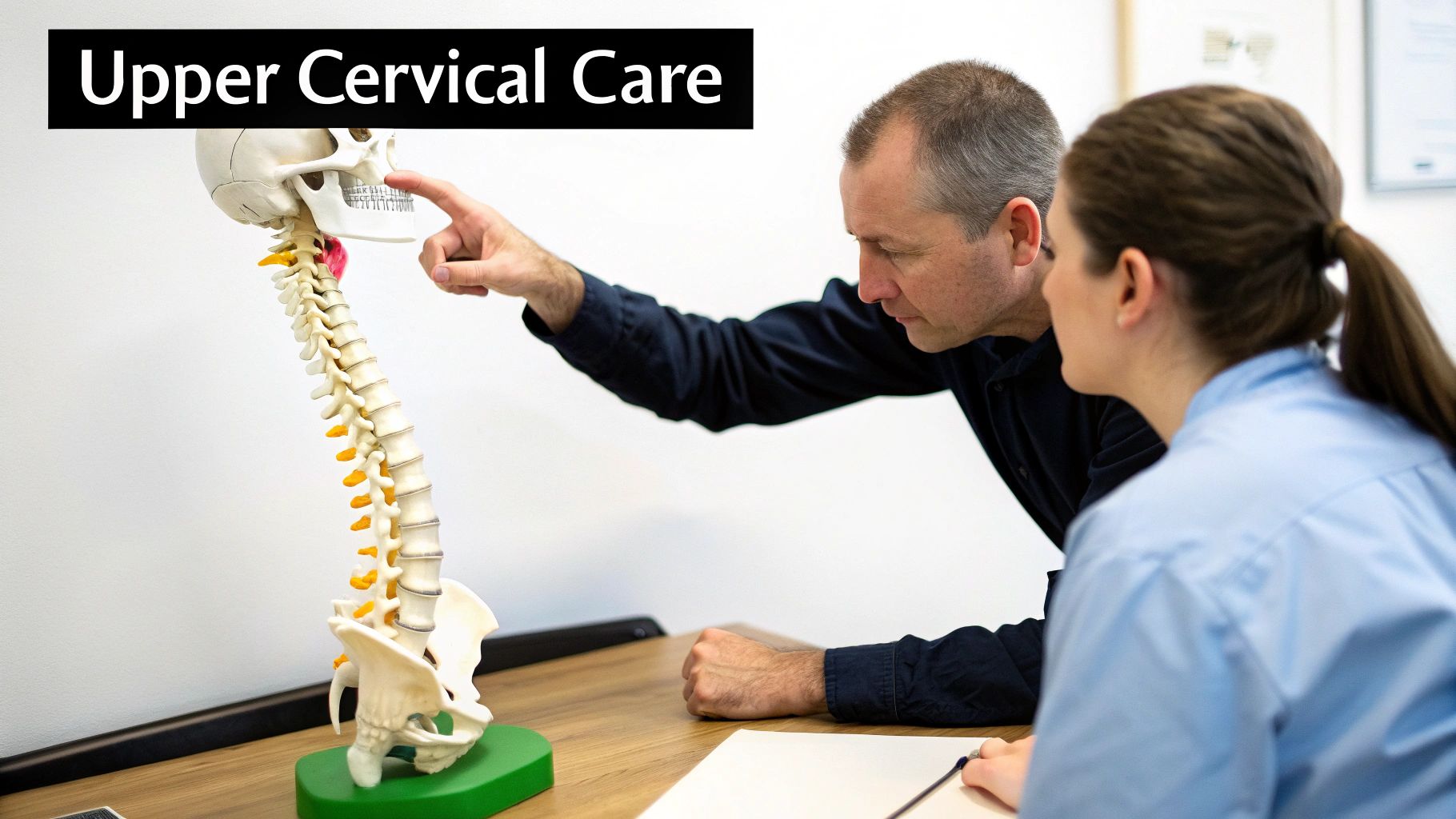
We know that visiting any new doctor can be a little unnerving, especially when you’ve been struggling with dizziness that nobody can seem to figure out. We want to walk you through exactly what you can expect when you come to The Upper Cervical Spine Center here in Charlotte. Our process is designed to be clear, gentle, and laser-focused on finding the real reason for your vertigo.
It all starts with a simple, honest conversation. We offer a complimentary consultation where you’ll sit down with Dr. Ray Drury to talk about what you've been experiencing—your symptoms, your health history, and the frustrations you've faced. This is your chance to really be heard and for us to determine if our specialized chiropractic care is the right path for you.
Our Precise Diagnostic Process
If it sounds like an upper cervical issue could be the culprit, the next step is a comprehensive examination. This isn't your typical health screening. Our diagnostics are built to pinpoint the exact degree of misalignment of your atlas (C1) vertebra. We don't guess; we measure.
Using advanced diagnostic imaging, we get a three-dimensional view of your upper cervical spine. This allows us to see the precise angle and direction of any misalignment. That level of detail is absolutely critical—it's what allows us to make a gentle, specific correction to restore proper function and calm down the faulty nerve signals causing your vertigo.
A Gentle and Specific Approach to Care
With your precise measurements in hand, we can map out a chiropractic care plan that is unique to you. This is where our approach really stands apart from general chiropractic. We focus exclusively on the atlas vertebra because of its massive influence over the entire central nervous system.
Here’s what you can expect from our corrections:
- No Popping or Cracking: Our adjustments are incredibly gentle. You won’t experience any twisting or forceful manipulation.
- Precision is Key: Every correction is calculated based on your unique imaging, ensuring we address your specific misalignment and nothing else.
- Restoring Communication: The goal is to gently guide the atlas back to its proper position. This relieves pressure on the brainstem and lets your body’s own healing mechanisms take over.
This careful, calculated approach is why so many people in Charlotte, NC, who haven't found relief anywhere else finally get their lives back. By correcting the root structural problem, we help your body rediscover its own natural balance.
Why Our Method Is So Effective
There’s a reason we’re so focused on the upper cervical spine. This area is like a critical junction box for nerve signals traveling between your brain and your body—including the systems that manage your balance. When the atlas shifts out of place, it’s like a kink in a vital communication cable. Signals get distorted, leading directly to symptoms like vertigo and migraines.
A gentle correction restores that vital communication link. By removing the interference, we allow the brain to once again receive clear, accurate information about your body's position, which is the key to resolving cervicogenic dizziness for good.
Research continues to back up this powerful connection between neck health and balance. Studies have shown that when patients combine professional care with targeted neck exercises, they see superior gains in balance, gait, and their overall dizziness handicap score. Strengthening the muscles that support your neck is a huge piece of the puzzle. You can read more about how these specific exercises enhance recovery outcomes.
Here at The Upper Cervical Spine Center, Dr. Ray Drury brings over three decades of experience to patients across Charlotte and nearby areas. We don't just chase symptoms; we correct the underlying cause to help you find lasting relief and reclaim your life from dizziness.
Got Questions About Vertigo and Upper Cervical Care? You're Not Alone.
Taking that first step to get specialized care for vertigo is a big deal, and it's only natural to have a few questions swirling around. Here at The Upper Cervical Spine Center, we find that when our Charlotte patients feel informed, they also feel more empowered on their healing journey.
So, let's dive into some of the most common questions we hear from people in our Charlotte, NC, office about vertigo and our specific approach.
How Long Until I Start Seeing Results?
This is probably the number one question we get, and the honest answer is: it’s different for everyone. Many of our patients feel a real shift—less intense or less frequent dizziness—within the first few adjustments. But how quickly you progress really depends on a few things, like how severe the misalignment is, how long it's been there, and your overall health.
Our goal isn't a quick, temporary fix. We're focused on correcting the underlying structural problem to give you lasting relief. During your first visit, we'll lay out a personalized care plan so you have a clear roadmap and know exactly what to expect. Think of it as a partnership; we're with you every step of the way.
Are These Neck Exercises Safe For Everyone?
The gentle movements we recommend—things like chin tucks and simple isometric holds—are specifically designed to be safe for most people dealing with cervicogenic dizziness. The whole point is to build stability and improve range of motion without putting any risky stress on the delicate joints at the top of your neck. That said, the most important rule is to listen to your body.
A Crucial Safety Tip: If you feel any sharp pain, numbness, tingling, or a noticeable spike in your vertigo symptoms while doing a neck exercise for vertigo, stop immediately. These are not "no pain, no gain" exercises. The only way to be certain you're doing the right movements for your specific situation is to get a professional evaluation first.
Can I Do These Exercises If I Have a Disc Injury?
If you already know you have a disc injury in your neck, it's absolutely vital that you consult with a specialist like Dr. Drury before starting any new exercise program. While gentle motion can often help the healing process, some movements might need to be modified—or avoided entirely—to keep from making the disc problem worse.
A clear diagnosis is everything. An unmanaged disc herniation or bulge can complicate vertigo recovery, so we have to see the complete picture of your spinal health first. Our detailed diagnostic process ensures we create a plan that is both safe and effective, taking any pre-existing conditions like a disc injury into account.
What Makes Upper Cervical Care Different From a Regular Chiropractor?
That's a fantastic question, and it really gets to the heart of what we do. While both fields work to improve health through the spine, our focus and our methods are worlds apart. General chiropractic often involves adjustments up and down the entire spine to restore movement.
Upper cervical care, on the other hand, is laser-focused on the critical relationship between the top two bones in your neck—the atlas (C1) and the axis (C2)—and their connection to the brainstem.
Here’s a quick rundown of what sets us apart:
- The Focus: We concentrate solely on the very top of the neck. A misalignment here can create a ripple effect throughout the entire nervous system.
- The Analysis: There is zero guesswork involved. Our care is driven by precise, three-dimensional imaging that allows us to calculate the exact angle of the misalignment down to the millimeter.
- The Adjustment: Our corrections are incredibly gentle. You will not experience any popping, twisting, or cracking. The adjustment itself is a light, controlled touch that helps guide the vertebra back to its proper alignment.
Our entire approach is built on one simple principle: restore the clear communication pathway between your brain and your body. When we correct that foundational misalignment at the top of the spine, your body’s own incredible ability to heal and regulate itself can finally take over. That's why so many of our patients find lasting freedom from chronic vertigo and other stubborn symptoms.
If you're done just managing symptoms and are ready to get to the root cause of your vertigo, we're here to help. At The Upper Cervical Spine Center, our dedicated team in Charlotte, NC, is ready to provide the gentle, precise care you need to get your life back. Schedule your complimentary consultation to find out if our approach is the answer you’ve been looking for.
Address
2550 W Arrowood Rd
Suite 104
Charlotte, North Carolina, 28273
United States
Hours
Monday-Friday:
9AM-12PM
&
2PM-6PM
We Align the Head and Neck So That the Nerves Can Send Brain Healing Messages to Affected Parts Of Your Body.
It's a Natural Self Healing.
