
Does Cervical Stenosis Cause Dizziness? Your Trusted Charlotte Chiropractor Explains

Yes, a neck problem like cervical stenosis can absolutely cause dizziness. It’s a connection that surprises many people, but for those of us serving patients here in Charlotte, NC, it's something we see and treat every day. This condition, known as cervicogenic dizziness, creates a disorienting sense of unsteadiness that doesn't originate in your inner ear, but from a structural issue right in your neck.
The Unsettling Link: How Your Neck Affects Your Balance
Feeling dizzy or off-balance can turn your world upside down. It disrupts everything, from your focus at work to your confidence just walking across a room in your Charlotte home. When the cause isn't clear, it's natural to feel frustrated and lost. What many don't realize is that the root of their instability could be cervical stenosis—a narrowing of the spinal canal in the neck.
This isn't just a theory; it's a clinical reality for many people seeking a neck pain chiropractor in Charlotte. The nerves at the very top of your neck are intricately wired into your brain's balance and spatial orientation centers. Think of it as a GPS system. When stenosis starts to irritate or compress these nerves, it scrambles the signals that tell your brain where your head is in space. The result? A confusing and unsettling sense of dizziness.

Why Neck Health is Non-Negotiable for Stability
The data backs up this connection between neck issues and dizziness. A significant study that followed thousands of patients revealed just how impactful a compromised neck can be.
Researchers discovered that individuals with cervical spondylosis—a degenerative condition that often includes stenosis—had a 10.2% chance of experiencing dizziness within a single year. That was noticeably higher than the 8.6% rate in a control group with lower back problems. This translates to a 20% higher relative risk of developing dizziness when the problem is in your neck. You can take a closer look at the full findings from the study to see the data for yourself.
Here at The Upper Cervical Spine Center, helping patients in Charlotte, NC, connect these dots is what we do. Our entire practice is built around identifying and correcting the subtle spinal misalignments that trigger symptoms like cervicogenic dizziness. We are the trusted upper cervical chiropractor for families throughout the Charlotte area.
How a Compromised Neck Can Throw You Off Balance
So, how exactly does a structural issue like stenosis create such a disorienting feeling? It's not just one thing; it’s a cascade of potential disruptions.
"When the top of the neck is misaligned, it's like having a faulty foundation for a house. The entire structure becomes unstable. Our goal is to gently and precisely correct that foundation, allowing your body’s natural sense of balance to be restored."
This table breaks down the main reasons a compromised neck can lead to dizziness, giving you a quick, easy-to-understand overview.
How a Neck Problem Can Make You Dizzy
Once you see these different mechanisms, it becomes clear that lasting relief isn't about chasing the symptoms. It’s about getting to the root of the problem in the cervical spine. By restoring proper spinal alignment and function to the neck, we help our patients in the Charlotte area find a clear path back to stability.
What Is Cervical Stenosis?
Think of the spinal canal in your neck as a protective tunnel for your nervous system's most important pathway. Now, imagine the walls of that tunnel starting to close in, leaving less and less room inside. That's the essence of cervical stenosis—a narrowing of the spinal canal in the neck region.
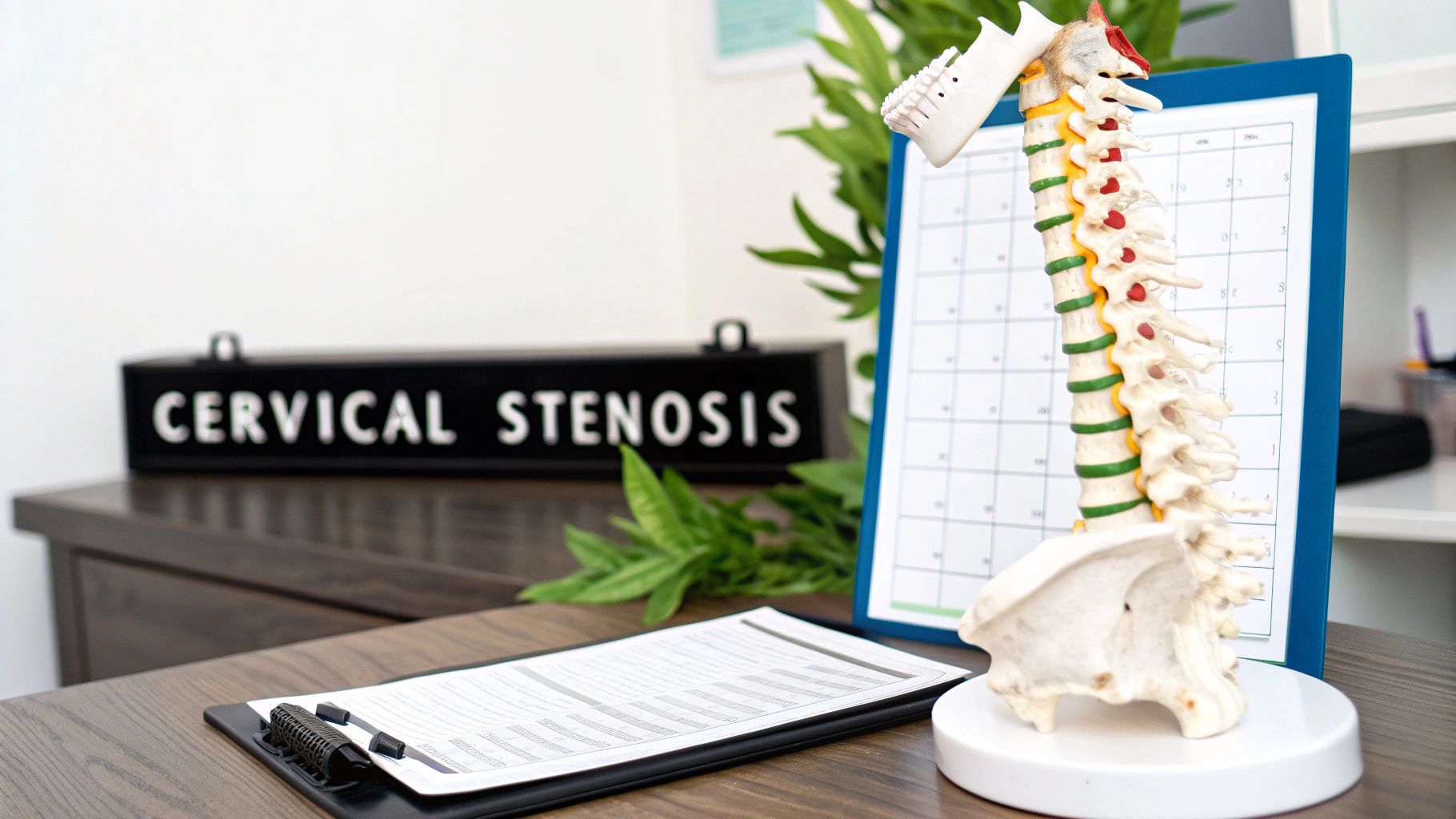
This isn't something that happens suddenly. It's usually a slow, gradual process driven by years of wear and tear, degenerative changes like bulging discs, or even old injuries like whiplash from a Charlotte auto accident. Over time, this slow-motion squeeze starts to put pressure on the spinal cord and the nerves that branch off from it.
Understanding the Structural Changes in Your Neck
Your neck, or cervical spine, is made up of seven vertebrae stacked like building blocks, labeled C1 through C7. The spinal cord passes straight through a hollow channel in the center of these bones. Stenosis is what happens when that channel starts to shrink.
So, what causes the space to get smaller? It’s usually a combination of factors:
- Degenerative Disc Disease: The gel-like discs between our vertebrae act as shock absorbers. With age, they can lose water, flatten out, and bulge into the spinal canal.
- Osteoarthritis: When the cartilage cushioning the neck joints wears down, the body sometimes responds by creating bone spurs (osteophytes). These bony growths can project directly into the canal.
- Thickened Ligaments: The tough bands of tissue holding the spine together can become stiff and thick over time, taking up precious space meant for the spinal cord.
- Past Injuries: Trauma from a serious fall or car accident can cause fractures or misalignments that narrow the canal. This is a key reason many patients seek an auto injury chiropractor in Charlotte.
This physical compression is the starting point for answering the question, "does cervical stenosis cause dizziness?" When these critical nerve pathways get irritated, the communication between your brain and body gets scrambled, which can lead to all sorts of symptoms.
Why Stenosis Is More Than Just Neck Pain
While a stiff, sore neck is a hallmark sign, the effects of stenosis often extend far beyond local pain. The nerves in your upper neck are deeply involved in your body's ability to perceive its position in space—your sense of balance.
The spinal canal is engineered to perfectly house and protect the spinal cord. When that space narrows, it can disrupt the incredibly complex signaling required to keep you feeling stable and oriented. This makes it a neurological problem, not just a mechanical one.
Here in our Charlotte clinic, we frequently meet patients who have spent years trying to figure out their dizziness, never once thinking the problem could be coming from their neck. The narrowing creates a bottleneck for nerve signals. It's like a kink in a garden hose—the flow is disrupted, and everything downstream is affected. This is exactly how a structural issue in the neck can directly cause dizziness and vertigo, making a focused upper cervical evaluation so critical for anyone looking for a chiropractor in Charlotte, NC.
How Problems in Your Neck Can Make You Dizzy
To get a real sense of how a neck issue like cervical stenosis can throw off your balance, picture your neck as Grand Central Station for your body's equilibrium system. It’s doing far more than just holding up your head; it’s a non-stop communication highway, feeding critical data to your brain about where you are in space. When stenosis starts to narrow the spinal canal, it’s like a major track closure—it can seriously disrupt this vital communication, creating that frustrating, disorienting feeling of dizziness.
The most common way this happens is by scrambling your proprioception. Your neck is packed with tiny nerve receptors that act like an incredibly precise internal GPS, constantly telling your brain about your head's position and movement. When stenosis irritates these sensitive nerves, that GPS starts sending out glitchy or delayed signals. Suddenly, your brain is getting conflicting reports from your eyes, your inner ears, and your neck, and this sensory confusion is what we feel as dizziness.
This specific type of dizziness, the kind that starts in the neck, has a name: cervicogenic dizziness. If you'd like to dive deeper into this particular condition, we've put together a comprehensive guide on what is cervical vertigo. It's a diagnosis that our upper cervical chiropractors in Charlotte have extensive experience in accurately identifying.
The Brain-Neck Connection Explained
The link between cervical stenosis and dizziness goes beyond just jumbled nerve signals. The narrowing of that spinal canal can also directly interfere with the other delicate structures that keep you feeling stable and upright.
There are really two main ways this goes wrong:
- Proprioceptive Interference: Like we just touched on, this is the big one. When the nerves in your upper neck get pinched or irritated by stenosis, they simply can't do their job of reporting your head's position correctly. Think of it like trying to walk a straight line while wearing glasses with the wrong prescription—that's the kind of sensory mismatch your brain is trying to sort out.
- Vascular Compromise: This is another important piece of the puzzle. The vertebral arteries, which supply essential blood to the brain's balance centers, actually run up through small channels within your neck bones. In cases of severe stenosis or with a significant spinal misalignment, certain head movements can temporarily pinch or reduce this blood flow. This can leave you feeling lightheaded or woozy.
Getting a handle on these pathways is the first real step toward finding a solution that gets to the root cause of the dizziness, instead of just chasing the symptoms.
The Evidence for Cervicogenic Dizziness is Overwhelming
For a long time, if a patient’s dizziness wasn't coming from their inner ear, they were often told it was "just stress" or "all in their head." Thankfully, modern research is finally catching up to what upper cervical chiropractors have observed for decades: the neck is a massive contributor to balance problems.
The connection is undeniable. A clinical analysis that looked at 1,000 patients who came in complaining of dizziness found that a remarkable 89% were ultimately diagnosed with cervicogenic dizziness. For most of them, cervical spinal canal stenosis was the primary underlying cause.
When researchers dug deeper and performed MRI scans on 600 of these patients, they found stenosis in 91% of them. The average spinal canal diameter was a tight 9.0 mm. What’s really telling is that the research noted even slight narrowing could set off symptoms, especially when combined with the chronic stress of a spinal misalignment. You can read more about these compelling findings in the published research. This kind of data solidifies the answer to "does cervical stenosis cause dizziness" with a resounding yes, making a thorough evaluation of the neck an absolute must for anyone dealing with unexplained instability.
Our Diagnostic Process for Dizziness in Charlotte
Getting to the bottom of dizziness isn't about guesswork; it requires a systematic, investigative approach. Here in our Charlotte clinic, the first thing we do is simply sit down and listen. We need to understand your complete health picture and, just as importantly, what "dizziness" actually feels like for you.
Is the room spinning around you (true vertigo)? Or is it more of a lightheaded, unsteady feeling, like you’re walking on a boat? These details are the first breadcrumbs on the trail to figuring out the root cause.
After our talk, we'll move on to a detailed physical and neurological exam. This is where we get hands-on, checking your neck's range of motion, muscle function, and reflexes. We'll also run specific tests designed to rule out other common culprits for dizziness, like problems with your inner ear or other neurological issues.
Precision Imaging: The Key to an Accurate Diagnosis
The most critical piece of our diagnostic puzzle is advanced imaging. To get a crystal-clear picture of what's happening where your head meets your neck, we rely on specialized Cone Beam CT (CBCT) scans.
This technology is a true game-changer. Standard X-rays and even many MRIs just don't give us the level of detail we need. CBCT, on the other hand, provides a precise, three-dimensional model of the alignment between your top two vertebrae—the atlas (C1) and the axis (C2). This lets us see exactly how your head is sitting on your neck, right down to a fraction of a degree.
By visualizing the exact misalignment, we move from speculation to certainty. We can pinpoint the source of nerve and vascular interference, which is the key to creating a care plan that’s built for your specific anatomy.
A Data-Driven Path to Relief
This careful, step-by-step process ensures we aren't just chasing symptoms. We’re identifying the structural problem at the source.
Our entire diagnostic system is designed to answer three simple but crucial questions:
- Is there a misalignment in your upper cervical spine?
- Is this misalignment the real reason for your dizziness and other symptoms?
- Can we correct it safely and effectively with our upper cervical approach?
By the time you leave your initial evaluation at our Charlotte clinic, you’ll have clear answers. We believe in showing you your images, explaining what we see, and making sure you feel confident and informed. From there, we can build a plan to restore your stability and help you get back to feeling like yourself again.
This decision tree illustrates how a problem in the neck can lead to different outcomes, with dizziness being a major potential symptom.
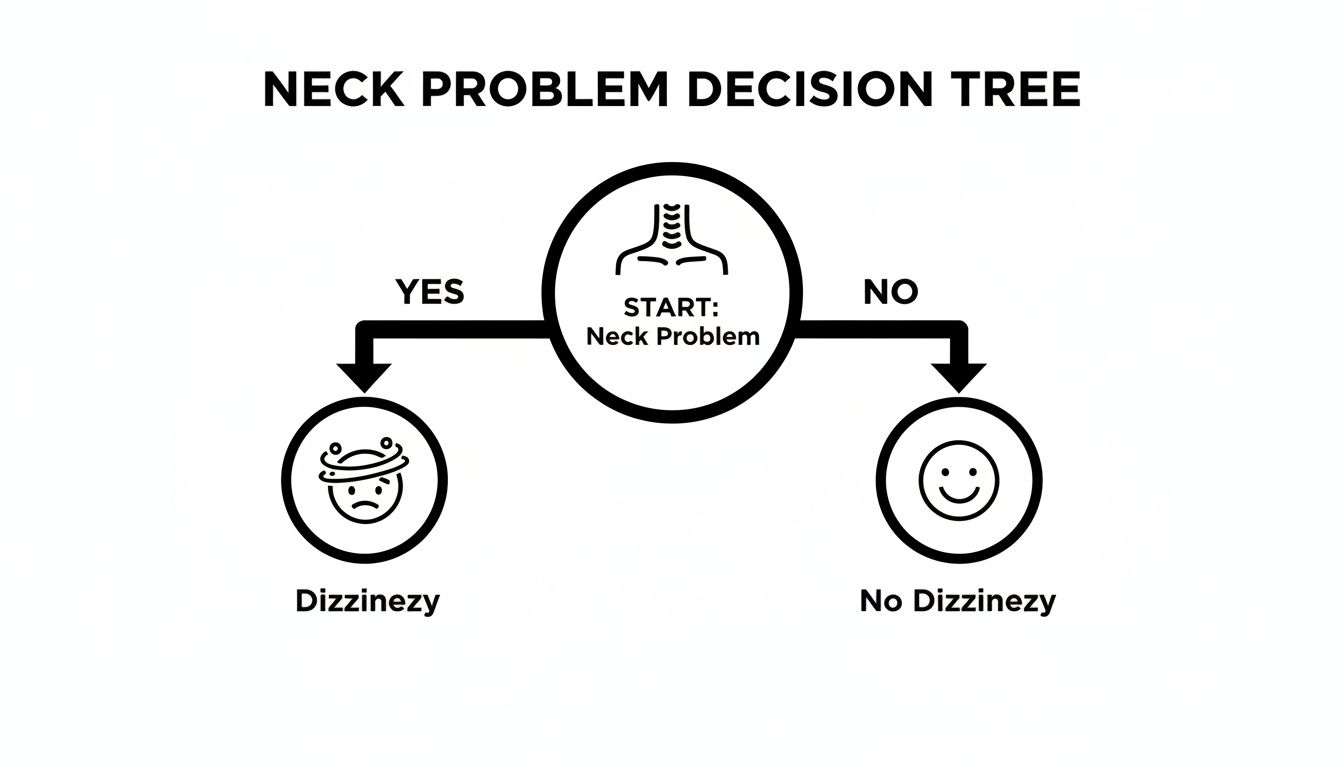
As the graphic shows, while not every neck issue causes dizziness, it’s a significant possibility that needs to be properly investigated.
How Upper Cervical Care Restores Your Balance
Once our comprehensive diagnostic workup points to a misalignment at the top of your neck, the road back to stability is surprisingly gentle. Our specific focus is a discipline known as Upper Cervical Care, which zeroes in on correcting the alignment of your atlas (C1) and axis (C2) vertebrae. This is the critical spot where your head connects to your spine, and where so much can go wrong.
If you're one of our patients in Charlotte, you should know that this is a world away from what most people think of as chiropractic. There is absolutely no twisting, popping, or cracking. Instead, we use a very light, controlled, and precisely calculated touch to guide the vertebrae back into their natural position.

A good way to picture it is like leveling the foundation of a house. When the foundation is off, everything above it is strained. Similarly, when your head is properly balanced atop your neck, the positive effects can ripple through your entire body. This single, precise correction can take the pressure off delicate nerves, help improve blood flow through the vertebral arteries, and essentially reset the faulty "GPS" signal being sent to your brain.
The Gentle Correction That Makes a Big Difference
We know that neck problems and dizziness are connected, but the numbers might still surprise you. Dizziness impacts up to 20% of adults every year, and a huge chunk of those cases trace back to a problem in the neck. In fact, studies show that neck pain is present in a staggering 37.5-46.7% of people who experience dizziness.
At The Upper Cervical Spine Center, Dr. Ray Drury brings over 30 years of experience to this very issue. We’ve consistently seen firsthand how these precise upper cervical corrections can lead to 70-90% improvement rates for conditions like vertigo and cervicogenic dizziness for our patients across Charlotte, Wilmington, and Nashville.
Focusing on the upper neck isn't about chasing symptoms; it's about correcting the underlying structural problem. This allows your body’s own natural healing ability to kick in and provides the potential for lasting relief from cervicogenic dizziness.
Restoring Communication Between Your Brain and Body
Our entire process is built on precision. By restoring the proper alignment at the top of the spine, we’re aiming to accomplish a few key things that directly impact your sense of balance:
- Decompressing Nerves: The adjustment takes the pressure off the nerves responsible for telling your brain where your head is in space. This helps clear up the scrambled signals that cause that dizzy, off-kilter feeling.
- Improving Blood Flow: A correctly aligned atlas can help restore normal blood flow through the vertebral arteries, which supply the brain's balance centers with the oxygen they need to function correctly.
- Reducing Muscle Strain: When your head is balanced properly, the surrounding neck muscles don't have to work overtime just to hold it up. This reduces the chronic tension that often contributes to both dizziness and headaches.
By correcting the foundational alignment of the spine, we are essentially rebooting the body's internal balance system. This allows for clear communication and function to be restored, naturally and without invasive procedures.
For any clinic specializing in complex neck and balance disorders, a smooth patient experience is key from the start. Tools like an AI receptionist for chiropractic clinics can help manage this process, allowing us to focus on patient care. Our careful approach is designed to provide a lasting solution, not just a temporary fix. You might also be interested in our guide on cervicogenic dizziness treatment, which dives deeper into our methods.
What to Expect on Your First Visit to Our Charlotte Clinic
Walking into a new doctor's office can be nerve-wracking, especially when you've been dealing with persistent dizziness and don't know why. We get it. That’s why we’ve made the whole process here at The Upper Cervical Spine Center in Charlotte as straightforward and comfortable as possible, right from the very beginning.
Your first step with us is a complimentary consultation. Think of this less as an appointment and more as a simple conversation. It’s a chance for you to sit down with Dr. Ray Drury, share what you've been going through, and talk about your health history. Just as importantly, it's our chance to listen carefully and see if our specific upper cervical approach is truly the right fit for your situation.
A Data-Driven Approach to Your Health
If we both agree that you’re a good candidate for our care, your first official visit is all about gathering the hard data we need to get to the bottom of your problem. This isn't about guesswork; it's about precision.
This visit has two main parts:
- A Comprehensive Examination: We'll perform a detailed physical and neurological exam. This lets us check your neck's range of motion, identify potential nerve interference, and start ruling out other things that could be causing your symptoms.
- Advanced Imaging: This is where we take the specialized Cone Beam CT scans mentioned earlier. These scans give us a crystal-clear, three-dimensional map of your upper cervical spine, showing us the exact angle and degree of any misalignment.
For anyone asking, "can cervical stenosis cause dizziness?" this thorough, data-first process is non-negotiable. We rely on objective information to find real answers for your health.
Your Report of Findings and Personalized Care Plan
After your exam and imaging are complete, you'll sit down one-on-one with Dr. Drury for a report of findings. He’ll pull up your results and walk you through everything in simple, clear terms.
"Our goal is to empower you with knowledge. We show you your images, explain exactly what’s happening in your neck, and connect it directly to the symptoms you’re experiencing. A clear understanding is the first step toward true healing."
Dr. Drury will then lay out a specific plan of care designed just for you, based entirely on your unique anatomy and findings. You'll know exactly what to expect at every turn—from how the gentle, precise adjustments work to the timeline we anticipate for your recovery. Our commitment is to make sure you feel confident, supported, and optimistic about getting your life back on solid ground right here in Charlotte.
Your Questions, Answered
When you're dealing with dizziness, you're bound to have questions. Here are some of the most common ones we hear from patients here in Charlotte who are curious about how upper cervical care might help. We want to give you clear, honest answers so you can feel confident about your next steps. If your question isn't here, just give us a call—we're happy to chat.
Does the Upper Cervical Adjustment Hurt?
Absolutely not. That’s a big worry for many people, especially when they're already in pain, and it’s one we take very seriously. Our adjustments are incredibly gentle and precise.
Forget any ideas you might have about forceful twisting, popping, or cracking. We use a very light, controlled touch to guide the misaligned vertebra back where it belongs. The goal is to let your body’s own healing processes do the real work. Most people are genuinely surprised at how gentle it is.
How Quickly Can I Expect Relief from Dizziness?
Everyone's journey is a little different. How fast you feel better depends on a few things, like how severe the misalignment is, how long it's been there, and your overall health. That said, a lot of our patients in Charlotte start to see their dizziness become less frequent and less intense within the first few weeks of care.
Our focus isn't on a quick fix that wears off. We're aiming for lasting stability so your body has the time it needs to heal and hold the correction on its own. This is how we get to the root of why cervical issues can cause dizziness in the first place.
We focus on correcting the underlying problem so your body can heal itself, rather than just chasing symptoms. True, lasting stability is what allows you to get your life back.
What's the Difference Between This and General Chiropractic?
The main difference is our specific focus. We concentrate exclusively on the top two bones in the neck: the atlas (C1) and the axis (C2). While a general chiropractor might adjust various parts of the spine, our entire process—from analysis to correction—is dedicated to this crucial area where your head connects to your neck.
To do this, we use advanced 3D imaging to map out the exact, unique angle of your misalignment. This allows for a correction that is tailored specifically to your anatomy, which is essential when addressing complex issues like cervicogenic dizziness.
Can This Help Even If a Doctor Recommended Surgery for My Stenosis?
While there are no guarantees for any single case, we've worked with many patients who were told surgery was their only option and found tremendous relief with us. By restoring the proper alignment at the very top of the neck, we can often take significant mechanical stress and nerve pressure off the area. This can ease stenosis-related symptoms without needing an invasive procedure.
The best way to know for sure is to come in for a complimentary consultation. We can review your case and see if our approach is a good fit for you.
At The Upper Cervical Spine Center, our mission is to help you find a lasting solution to your dizziness so you can get back to living your life. If you're in the Charlotte area and looking for a gentle, precise, and effective approach, we invite you to book a complimentary consultation today. You can schedule by visiting us at https://www.uppercervicalspinecenter.com.
Address
2550 W Arrowood Rd
Suite 104
Charlotte, North Carolina, 28273
United States
Hours
Monday-Friday:
9AM-12PM
&
2PM-6PM
We Align the Head and Neck So That the Nerves Can Send Brain Healing Messages to Affected Parts Of Your Body.
It's a Natural Self Healing.
