
Your Guide to Lasting Lower Back Pain Treatment in Charlotte

If you're caught in a frustrating cycle of lower back pain, you've likely tried everything—stretches, pain relievers, and endless advice. But when the relief is always temporary, the search for a real solution can feel hopeless. For many of our neighbors here in Charlotte, this is a daily reality.
The key to an effective treatment for back pain in the lower back isn't just about masking the ache. It's about understanding why it's happening in the first place. At The Upper Cervical Spine Center, we help our Charlotte-area patients find answers and lasting relief. This guide will walk you through the common causes of lower back pain, what you can do at home, and how our specialized chiropractic care offers a different path forward.
Finding a Real Solution for Lower Back Pain in Charlotte
That nagging, persistent ache in your lower back can feel isolating, but it's a battle countless people are fighting every day. The sheer scale of the problem is staggering.

A recent study revealed that low back pain affected a staggering 619 million people globally in 2020, making it the number one cause of disability worldwide. For our neighbors in Charlotte, Wilmington, and the surrounding areas struggling with chronic pain or sciatica, this isn't just a statistic; it's a daily disruption to their lives.
The conventional path often involves pain-masking drugs or invasive procedures. As a trusted local chiropractor, we believe there’s a better way—one that works with your body to resolve the root cause.
Looking Beyond the Obvious for Lasting Relief
Many people searching for a "chiropractor near me" in Charlotte have already been down the usual roads. You try some generic stretches or pop a pain reliever, hoping this time will be different, but the pain always seems to return. It’s an exhausting cycle.
Here's where we take a different turn. We introduce patients to upper cervical chiropractic, a specialized field of care focused on the connection between the top of the neck and the rest of the spine. A tiny misalignment in your upper neck can be the hidden driver behind your lower back problems. For many, correcting this imbalance is the missing piece of the puzzle for headache relief, sciatica treatment, and more.
Your body has a powerful, innate ability to heal. Our entire focus is on finding and removing the interference that’s holding it back, allowing your lower back to finally stabilize and function the way it was designed to.
At The Upper Cervical Spine Center, our first job is to help you understand what's really going on. When you know the "why" behind your pain, you can finally make informed, confident decisions about your health. For some immediate tips, this is an excellent guide on how to alleviate lower back pain and get through your day with more comfort.
A Clear Path Forward
This guide is designed to give you clarity and a concrete plan. We'll start by breaking down the common causes of lower back pain, from posture and lifestyle habits to more complex issues like disc injuries. From there, we'll give you practical self-care steps for immediate pain management.
We’ll also walk through the pros and cons of different professional treatments, putting a spotlight on the unique, targeted approach of upper cervical care. You'll even get a look inside our Charlotte chiropractic clinic, so you know exactly what to expect when you visit us for your consultation.
We want to be your trusted partner on this journey. To see how our specific methods work, you can explore our detailed guide on effective back pain treatment. Let's get started on leaving that pain behind for good.
What Your Lower Back Pain Is Trying To Tell You
That nagging ache in your lower back isn't just a random annoyance. It's a message from your body, a signal that something is out of balance. While it's easy to dismiss it as a simple "muscle strain," our experience shows that this often misses the root cause, especially when the pain becomes chronic. Finding a lasting treatment for back pain in the lower back starts with understanding what’s really going on.

For so many of us here in Charlotte, our daily routines are the biggest culprits. The long hours spent slouched at a desk, that one awkward twist while playing with the kids at Freedom Park, or even small, repetitive movements can all add up. These aches are often signs of specific structural problems that need a targeted approach from a local back pain chiropractor.
Decoding Your Lower Back Pain Symptoms
To start figuring out what your body is trying to say, use this table to better understand your symptoms and what your next steps should be for seeking care from a chiropractor in Charlotte, NC.
This table is a great starting point, but it's not a substitute for a professional diagnosis from a qualified chiropractor. Its real power is in helping you describe your pain more accurately when you do seek help.
Common Culprits Behind Your Lower Back Pain
While a fall or auto injury is an obvious cause, most lower back problems we see have been developing for months or even years. Here are a few of the most frequent underlying conditions we encounter in patients looking for a back pain chiropractor in Charlotte:
- Herniated or Bulging Discs: The soft cushions between your vertebrae can get squeezed and push out, pressing on nearby nerves. This is a classic cause of intense, sharp pain and radiating symptoms. A proper disc injury treatment plan is essential.
- Sciatica: This isn't a condition itself, but a tell-tale symptom. It's that signature sharp pain, numbness, or tingling that runs down your leg, caused by something—like a herniated disc or a spinal misalignment—irritating the sciatic nerve.
- Spinal Stenosis: More common as we age, this condition involves a narrowing of the spinal canal itself. It puts pressure on the spinal cord and nerves, often causing pain that gets worse when you walk but feels better when you sit or lean forward.
- Myofascial Pain Syndrome: This chronic pain condition comes from "trigger points"—tight, painful knots in your muscles. These knots can cause localized pain or refer it to other parts of your back, leading to a frustrating, deep ache.
Sometimes, the root cause is something you'd never suspect. When chronic pain persists despite typical treatments, we have to consider factors like underlying inflammatory conditions or even old injuries. A thorough evaluation by a qualified professional is non-negotiable.
When To See a Chiropractor in Charlotte
Most minor back tweaks get better on their own within a couple of weeks. But there are definite "red flags" that mean you should stop waiting and get professional help.
If you're just saying "my back hurts," you're missing key details. Describing how it hurts—sharp, dull, radiating, constant—is the most valuable information you can bring to your chiropractor.
It’s time to schedule a consultation with a chiropractor in Charlotte if you experience any of these:
- Pain that lasts for more than 2-4 weeks without improving.
- Pain that shoots down one or both of your legs, especially with numbness, tingling, or weakness.
- Back pain that starts after a serious fall, car accident, or other injury.
- Pain accompanied by fever or unexplained weight loss.
- Any loss of bladder or bowel control. This is a medical emergency and requires immediate attention.
Ignoring these signals is like ignoring the check engine light in your car. You risk a small, fixable issue turning into a chronic, life-altering problem. If you're in the Charlotte area and your back is sending these signals, it's time to listen.
At-Home Strategies for Immediate Pain Management
When that first twinge of lower back pain hits, your immediate goal is simple: make it stop. While identifying the root cause is crucial for long-term recovery, you need relief now. The good news is there are several effective things you can do at home to manage a flare-up and regain some control while you plan your next steps with a chiropractor near you.
A common reflex is to freeze up and head for the couch, but complete bed rest often backfires, leading to more stiffness and weakness. A smarter approach is activity modification. This simply means listening to your body and avoiding specific movements that trigger sharp pain.
If bending over to empty the dishwasher sends a jolt down your spine, try kneeling on one knee to keep your back straight. The key is gentle movement, not a total shutdown.
Heat or Ice: Which Is Best for Your Back?
This is one of the most frequent questions we get from our Charlotte patients, and the answer depends on what your pain feels like and when it started.
Ice for New Injuries: If your pain just started (within the last 48 hours) or feels sharp and inflamed, reach for an ice pack. Ice constricts blood vessels, which helps numb the area and reduce swelling. Wrap it in a thin towel and apply it for only 15-20 minutes at a time.
Heat for Lingering Aches: For that dull, persistent ache or chronic muscle stiffness, heat is your friend. It boosts blood flow, helping to relax tight, knotted muscles. A heating pad or a warm bath can provide incredible comfort, especially first thing in the morning.
Many people find that a combination works best—using ice after an activity that stirred things up and heat later to soothe residual soreness.
Gentle Stretches for Immediate Relief
Light stretching can do wonders for releasing tension, but the keyword here is gentle. Pushing into a stretch and causing more pain is counterproductive. Start with two of the safest and most effective stretches for an angry lower back: the Knee-to-Chest hug and the Pelvic Tilt.
Knee-to-Chest Stretch:
Lie on your back with your knees bent and feet flat on the floor. Gently bring one knee toward your chest, using your hands to pull it in until you feel a light stretch in your lower back. Hold for 20-30 seconds, then slowly return to the start and switch legs.
Pelvic Tilt:
In the same starting position, focus on tightening your core muscles to press the small of your back flat against the floor. It’s a very small, subtle movement. Hold it for about 10 seconds, then relax. Aim for 5-10 repetitions.
The goal of these movements isn't to push through pain. It's to gently coax your muscles into letting go. If any stretch causes a sharp or shooting pain, stop immediately. You can explore more safe options in our detailed guide to lower back pain stretches.
These at-home strategies are a critical first line of defense. However, it's important to see them as part of a bigger picture. With global cases of lower back pain projected to hit 843 million by 2030 and high recurrence rates even with standard treatments, we have to look deeper.
These troubling back pain prevalence forecasts highlight why it’s so important to find a true treatment for back pain in the lower back that addresses the source—not just the symptoms.
When Self-Care Is Not Enough
At-home care is a fantastic first step, but it's often a temporary fix, not a permanent solution. If your lower back pain has been lingering for weeks, interfering with your life, and no longer responds to ice, heat, or gentle stretches, that's your body's signal to bring in a professional, like a back pain chiropractor in Charlotte.
Pushing through persistent pain is a risk. What feels like a manageable ache today can easily become a chronic problem that disrupts your work, hobbies, and sleep. Knowing when to pivot from self-care to professional help is key to finding a lasting treatment for back pain in the lower back.
The Conventional Treatment Path
When you visit a medical doctor for back pain, the approach is typically a ladder of options, starting with the most conservative and moving toward more invasive treatments.
The first suggestion is almost always over-the-counter anti-inflammatories (NSAIDs). If those don't work, your doctor might prescribe stronger muscle relaxants or painkillers. While these can provide temporary relief, they only muffle pain signals—they don't fix the underlying mechanical or structural problem.
From there, the conversation often turns to physical therapy. A great physical therapist can be a game-changer, guiding you through exercises to build core strength and improve flexibility. This is incredibly helpful for muscle-related pain, but if the real issue is structural—like a spinal misalignment or a pinched nerve—the relief may not last.
When More Invasive Options Are on the Table
If the pain persists, especially with nerve symptoms like sciatica, your doctor might suggest more direct interventions.
- Epidural Steroid Injections: A powerful anti-inflammatory medicine is injected near the irritated nerve in your spine. This can bring dramatic, quick relief, but the effects aren't always permanent, and there's a limit to how many you can receive.
- Surgery: Procedures like a discectomy or spinal fusion are typically a last resort. Surgery comes with significant risks and recovery time, so it’s usually reserved for severe cases of nerve compression or spinal instability that haven't improved with other treatments.
This flowchart gives you a simple visual for deciding between at-home care and seeing a doctor.
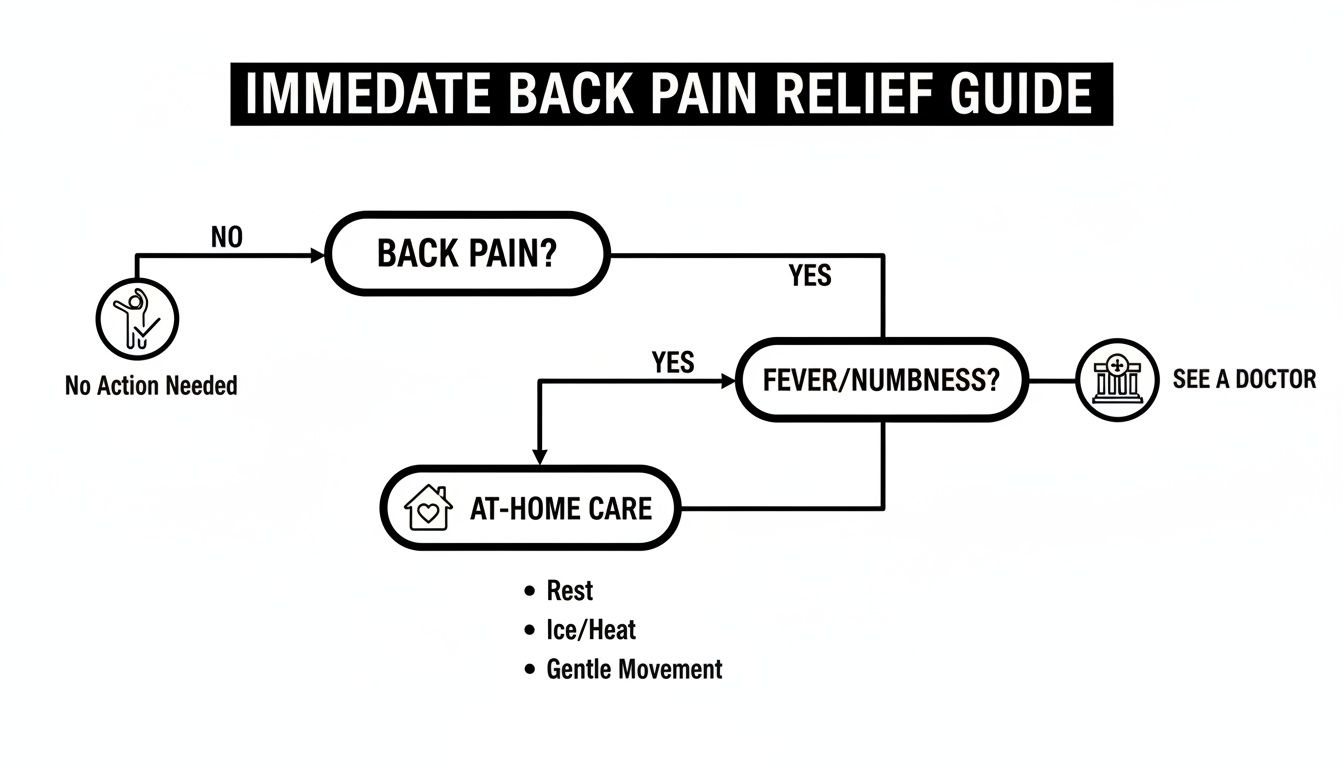
While you can manage new back pain at home, certain red flags like a fever or numbness are clear signs to get professional medical help right away.
A Different Approach: Getting to the Root of the Problem
Here’s the issue with many conventional treatments: they all focus on the site of the pain—your lower back. But what if that’s just where the symptoms are showing up, and not where the problem started? This is where upper cervical chiropractic care offers a completely different perspective for our patients here in Charlotte.
Lower back pain is a massive global issue. In 2021 alone, it was responsible for 19.25 million new cases among working adults. You can read more about this global health issue from Frontiers in Public Health. For too many people, this becomes a frustrating cycle of treatments that just don't stick.
Our approach is built on a powerful idea: your head sits on top of your spine. If the very top bone, the atlas (C1), is even slightly out of alignment, your entire body must compensate to keep your head level. This kicks off a chain reaction of muscle tension and spinal imbalance that travels all the way down to your lower back.
Think of your body like a house. If the foundation is cracked, you'll eventually see problems in the walls upstairs. Instead of just patching the drywall, a skilled contractor goes straight to the source and fixes the foundation. As an upper cervical chiropractor, that's exactly what we do for your spine.
By making a precise and gentle correction to the upper neck, we can remove the root cause of the imbalance. This allows your lower back to gradually return to a natural, stable position. It's a non-invasive way to restore proper function and find lasting relief by addressing the problem at its origin.
What to Expect at Our Charlotte Chiropractic Clinic
Deciding to finally do something about your lower back pain is a big step. We understand that. That’s why our entire process is built around giving you clarity and confidence, starting from our very first conversation. As your local chiropractor in Charlotte, we want you to feel certain that you’re in the right place to get the effective treatment for back pain in the lower back you’ve been searching for.

Before you even schedule an appointment, we start with a simple conversation. Our first goal is to make sure our unique upper cervical approach is the right fit for your specific condition.
Your Complimentary Clarity Call
It all starts with a complimentary 15-minute clarity call. This isn’t a sales pitch; it’s a no-obligation phone call where you can speak directly with a member of our team.
You’ll have a chance to explain what you're experiencing with your back pain, and we can explain exactly how our method works. It's the perfect time to ask all your questions about our chiropractic care and see if our approach resonates with you. If it sounds like we can help, we can then discuss scheduling your first in-office consultation.
Your Comprehensive Consultation and Exam
Your first visit to our Charlotte clinic is all about digging deep to find the root cause of your pain. Dr. Drury will sit down with you, review your health history, and—most importantly—listen to your story. From there, he will conduct a thorough examination.
A key part of this visit is our advanced diagnostic imaging. We use a specialized, low-dose 3D Cone Beam CT (CBCT) scan to get a precise, three-dimensional picture of your upper cervical spine. This is far more advanced than a standard X-ray. It allows us to see the exact angle and direction of any misalignment down to a fraction of a degree.
This precise imaging is the blueprint for your care. It removes all guesswork and allows us to create a chiropractic care plan that is 100% unique to your body’s needs.
This diagnostic step is non-negotiable because it answers the most important question: is an upper cervical misalignment the root cause of your lower back pain? If the answer is yes, we are confident we can help. If not, we’ll tell you upfront and help point you toward a provider who may be a better fit.
Your First Gentle Adjustment
If the diagnostics confirm you are a good candidate for our care, you’ll receive your first adjustment. The first thing most patients notice is how gentle the process is. There is absolutely no twisting, popping, or cracking involved.
Using the precise measurements from your 3D imaging, Dr. Drury applies a light, controlled touch to the side of your neck. The entire adjustment is calculated to correct the specific misalignment of your atlas vertebra. The goal isn't just to move a bone, but to restore clear communication between your brain and body, allowing your spine to begin healing and realigning itself. This gentle correction kicks off the healing process, unwinding the chain reaction of compensation that has been causing strain and pain in your lower back.
Common Questions About Lower Back Pain Treatment
It’s completely normal to have questions when considering a new approach to your health. We find that people in our Charlotte office feel much more confident about their care when they get clear, straightforward answers. Here are some of the most common questions we hear about our unique chiropractic care for treating lower back pain.
How Is Upper Cervical Chiropractic Different for Lower Back Pain?
This is the most important question we get, as it gets to the core of what we do. While most therapies focus on where it hurts—your lower back—we start by looking at the entire body as a single, connected system. The stability of your entire spine begins right at the top, where your head meets your neck.
A tiny misalignment in the atlas, the very first vertebra, can be a huge problem. It can disrupt nerve signals from the brainstem and force your entire body to compensate to keep your head level. This creates a chain reaction of muscle tension and postural imbalances that travels all the way down to your pelvis and lower back.
Understanding the specific nature of your condition, like a herniated disc injury, is crucial. Our comprehensive exam is designed to pinpoint these underlying causes. Our advanced imaging in the Charlotte office will show us if this is the true source of your problem.
We don't just chase symptoms in the lower back. By correcting the foundational misalignment at the top of the neck, we remove the interference that started the problem, letting your body’s own healing ability take over.
Are the Adjustments Painful or Forceful?
Absolutely not. This is a huge relief for most of our new patients and a key difference in our practice. The forceful twisting, popping, or cracking that many people associate with general chiropractic is completely absent from our upper cervical care.
Our adjustments are incredibly gentle and precise. We use the exact measurements from your 3D diagnostic images to deliver a light, controlled touch. Most people are surprised by how subtle the entire process feels. The goal is to work with your body, not against it.
How Quickly Can I Expect Relief for My Lower Back Pain?
Everyone’s healing journey is unique. How quickly you feel relief from your lower back pain depends on a few personal factors:
- How long you've had the problem: Chronic issues that have been present for years often take more time to unwind than a recent injury.
- The severity of the misalignment: A more significant structural shift can require more time for your body to stabilize.
- Your overall health and lifestyle: Factors like your daily activity, nutrition, and stress levels all play a role in how well your body heals.
Some of our patients feel immediate improvement right after their first adjustment. For others, the relief is more gradual as the body adapts, inflammation decreases, and tight muscles finally begin to relax over a few weeks. Our focus is always on creating a long-term, stable correction, not just a quick fix. During your consultation, Dr. Drury will lay out a realistic timeline based on your specific case.
Do I Need a Doctor's Referral to Visit Your Charlotte Clinic?
No, you do not need a referral from a medical doctor to schedule an appointment with us. In North Carolina, chiropractors are primary contact healthcare providers. This means you can call our office and book a visit directly whenever you’re ready for a different kind of treatment for back pain in the lower back.
If you're tired of temporary fixes and are looking for a chiropractor in Charlotte, NC, who gets to the root cause of your pain, the first step is easy. Call our office to set up your complimentary clarity call. We're here to listen, answer your questions, and help you start on the path to lasting recovery.
Ready to find out if your lower back pain is connected to a problem in your upper neck? The team at The Upper Cervical Spine Center is here to provide clarity and a potential path to lasting relief for patients in Charlotte and the surrounding communities. Schedule your complimentary, no-obligation clarity call today to discuss your case and see if our approach is the right fit for you.
Address
2550 W Arrowood Rd
Suite 104
Charlotte, North Carolina, 28273
United States
Hours
Monday-Friday:
9AM-12PM
&
2PM-6PM
We Align the Head and Neck So That the Nerves Can Send Brain Healing Messages to Affected Parts Of Your Body.
It's a Natural Self Healing.
