
Sciatica Chiropractor in Charlotte, NC: Your Guide to Natural Relief

When that sharp, shooting sciatic pain hits, it can feel like your whole life is put on hold. But getting lasting, natural relief is absolutely possible, right here in Charlotte, NC. Many people searching for a "sciatica chiropractor near me" are dealing with pain that makes simple tasks like sitting or walking feel impossible. If you're experiencing back pain, neck pain, or radiating leg pain, our team is here to help.
The secret isn't just about masking the pain. It’s about calming that irritated nerve with the right movements and anti-inflammatory habits while, most importantly, getting to the root cause of what’s pinching it in the first place. This guide will introduce you to our patient-focused approach and walk you through proven, drug-free strategies to help your body heal itself.
Your Path to Relief Starts With Understanding Sciatica

First things first: sciatica isn't a diagnosis. It's actually a symptom—a sign that something is putting pressure on the sciatic nerve. This nerve is the longest in your body, running from your lower back, through your hips and glutes, and all the way down each leg. As your trusted chiropractor in Charlotte, NC, we help patients understand the source of their pain.
For many of our patients, the pain is a sharp, burning, or electric-like jolt that makes simple things like sitting at a desk or getting out of a car feel impossible.
This happens when the sciatic nerve gets compressed. The most common culprits are a herniated disc (a common disc injury), a bone spur, or a narrowing of the spine called spinal stenosis. Sometimes, even a tight muscle deep in your glutes (the piriformis) can be the offender. Figuring out what’s causing the compression is the key to unlocking real relief.
What Does Sciatica Actually Feel Like?
While that radiating leg pain is the classic sign, sciatica can show up in a few different ways. See if any of these sound familiar:
- A sharp, shooting pain that makes it tough to stand up straight or walk.
- Numbness, tingling, or a "pins-and-needles" feeling in your leg, foot, or toes.
- Noticeable weakness in the muscles of your affected leg or foot.
- Pain that gets worse after sitting for a while, or when you cough or sneeze.
The great news? Most cases of sciatica get better with conservative, natural chiropractic care. Let's dive into how to treat sciatica naturally, using strategies that put you back in the driver's seat of your own recovery.
At The Upper Cervical Spine Center, we find that many people searching for a "sciatica chiropractor in Charlotte" are surprised to discover that the root of their lower back problem often starts with a tiny misalignment at the top of their neck.
It sounds unrelated, but this misalignment can trigger a chain reaction. It shifts your head's position, forcing your entire spine and pelvis to compensate. This postural imbalance can eventually lead to pressure right on the sciatic nerve.
Our approach is different because we focus on correcting that foundational issue. By restoring proper spinal alignment from the top down, we allow the body to rebalance itself and heal naturally. We know you're looking for real solutions, not just a quick fix. Our mission is to empower you with the tools and knowledge to find lasting comfort by addressing the underlying problem.
Immediate Relief: At-Home Strategies for a Sciatica Flare-Up
When a sciatica flare-up hits, the pain is all-consuming. It doesn’t just ache; it shoots, burns, and demands your full attention. Forget long-term plans for a moment—when you can't sit or stand without that electric jolt down your leg, you need relief now.
The good news is, you can take control. There are simple, effective things you can do at home to calm that angry nerve and turn the volume down on the pain. Think of these strategies as your first-aid kit for sciatica. They’re designed to tackle the immediate crisis while you work on solving the underlying problem with professional chiropractic care.
The Ice vs. Heat Debate for Nerve Pain
One of the oldest tricks in the book is using temperature to manage pain, but for sciatica, timing is everything. Getting it right can make a world of difference.
For the first 24 to 48 hours of a really bad flare-up, ice is your go-to. Grab a cold pack, wrap it in a thin towel, and place it right on your lower back. The cold helps constrict blood vessels, which is fantastic for bringing down the inflammation and swelling that’s putting the squeeze on your nerve. It also provides a welcome numbing sensation.
After that initial two-day window, it’s time to switch over to gentle heat. A heating pad or a warm compress can feel like a miracle for the tight, spasming muscles in your back and glutes that have been clenching in protest. The warmth boosts blood flow, eases stiffness, and helps your muscles finally relax.
- Ice It Down: For the first two days of a flare-up, use a cold pack for 15-20 minutes at a time, several times a day. This is your anti-inflammatory phase.
- Warm It Up: After 48 hours, switch to heat for 15-20 minutes to soothe tight muscles. A word of caution: never fall asleep with a heating pad on.
Gentle Moves That Give Your Sciatic Nerve Some Breathing Room
I know, moving is probably the last thing on your mind when you're in excruciating pain. But staying completely still can often make things worse. The right kind of gentle movement can actually create space around that pinched nerve and offer some real relief.
The golden rule here is to move slowly and deliberately. If anything you do causes a sharp or worsening pain, stop immediately. Your body will tell you what it can handle.
Here are two incredibly safe and effective movements to try:
- Knee-to-Chest Stretch: Lie on your back, maybe with a small pillow for your head. Gently bring one knee up towards your chest until you feel a comfortable stretch in your lower back and buttock. Hold it there for about 20-30 seconds. Slowly lower it and switch legs. Aim for 2-3 reps on each side.
- Pelvic Tilts: Still on your back, bend your knees and place your feet flat on the floor. Now, gently press the small of your back into the floor by tightening your core muscles and slightly tilting your pelvis up. It's a small, subtle movement. Hold for a couple of seconds and then relax. Try for about 8-12 repetitions.
Often, what feels like a back problem is connected to stiffness elsewhere. Learning how to improve hip mobility is a game-changer for many people, as it can take a huge amount of strain off the lower back.
A Quick Word of Advice: The whole point of these movements is to gently coax your body into a better state, not to force it. Listen carefully to what your body is telling you.
Smart Positioning: How to Sit, Stand, and Sleep Without Angering Your Nerve
Sometimes the simplest changes make the biggest impact. The way you position your body throughout the day can either constantly poke at that irritated sciatic nerve or give it the space it needs to calm down.
When you're sitting, slide a small rolled-up towel or a lumbar support pillow into the curve of your lower back. This tiny adjustment helps you maintain your natural spinal curve. Also, try to keep your feet flat on the floor with your hips just a bit higher than your knees.
Have to stand for a while? Find a low stool or even a thick book and prop one foot up on it. Every 10-15 minutes, switch feet. This simple maneuver changes the tilt of your pelvis and can provide instant relief to a tired lower back.
At night, avoid sleeping in a way that twists your spine. The best bets are lying on your back with a pillow tucked under your knees, or on your side with a pillow squeezed between your knees. Both positions help keep your spine neutral and happy.
The most encouraging thing to remember is that you can get through this. In fact, an overwhelming 80-90% of sciatica cases get better without ever needing surgery. Conservative approaches like chiropractic care, physical therapy, and the right exercises are incredibly effective, with many people feeling significant relief in just a few weeks.
Building Long-Term Strength to Prevent Future Pain
Getting through a painful sciatica flare-up is one thing, but the real win is making sure it doesn't happen again. Lasting recovery isn't just about temporary relief; it's about building a stronger, more resilient back. The best way to do this is by creating a natural "corset" of muscle around your spine to support it and protect that sensitive sciatic nerve from future trouble.
This isn’t about hitting the gym for heavy, intense lifting. It’s about being consistent with specific, targeted exercises that strengthen the core and glute muscles—the true foundation of your spinal health. For many of our patients here in Charlotte, strengthening these key areas is what finally breaks the cycle of recurring pain.
Foundational Movements for a Stronger Back
To build this protective muscular support, you have to start with the basics. These foundational movements are designed to wake up the right muscles without putting any extra strain on your lower back. They might feel gentle, but they're incredibly effective at activating dormant glutes and core muscles.
Here are two of our go-to exercises to start with:
- Glute Bridges: Lie on your back with your knees bent and feet flat on the floor. Squeeze your glutes and gently lift your hips until your body forms a straight line from your shoulders to your knees. Hold for a couple of seconds at the top, really focusing on that squeeze, before slowly lowering back down. This move is fantastic for isolating the gluteal muscles, which are critical for stabilizing your pelvis.
- Bird-Dog: Get on all fours, making sure your hands are directly under your shoulders and your knees are under your hips. Brace your core to keep your back perfectly flat, then slowly extend your right arm forward and your left leg straight back. The goal is to hold this position for a moment, focusing on balance and stability, then return to the start and switch sides.
With these movements, control and consistency trump speed or reps every time. Perfect form is everything, as it ensures you're building strength exactly where you need it most.
Think of your core and glutes as the support beams for your spine. When they're weak, the whole structure becomes vulnerable and unstable, leaving you open to problems like disc herniation or nerve compression. Strengthening them is like reinforcing the very foundation of your house.
This simple visual shows the first-response sequence for an acute flare-up, which is the phase that comes right before you start focusing on building strength.
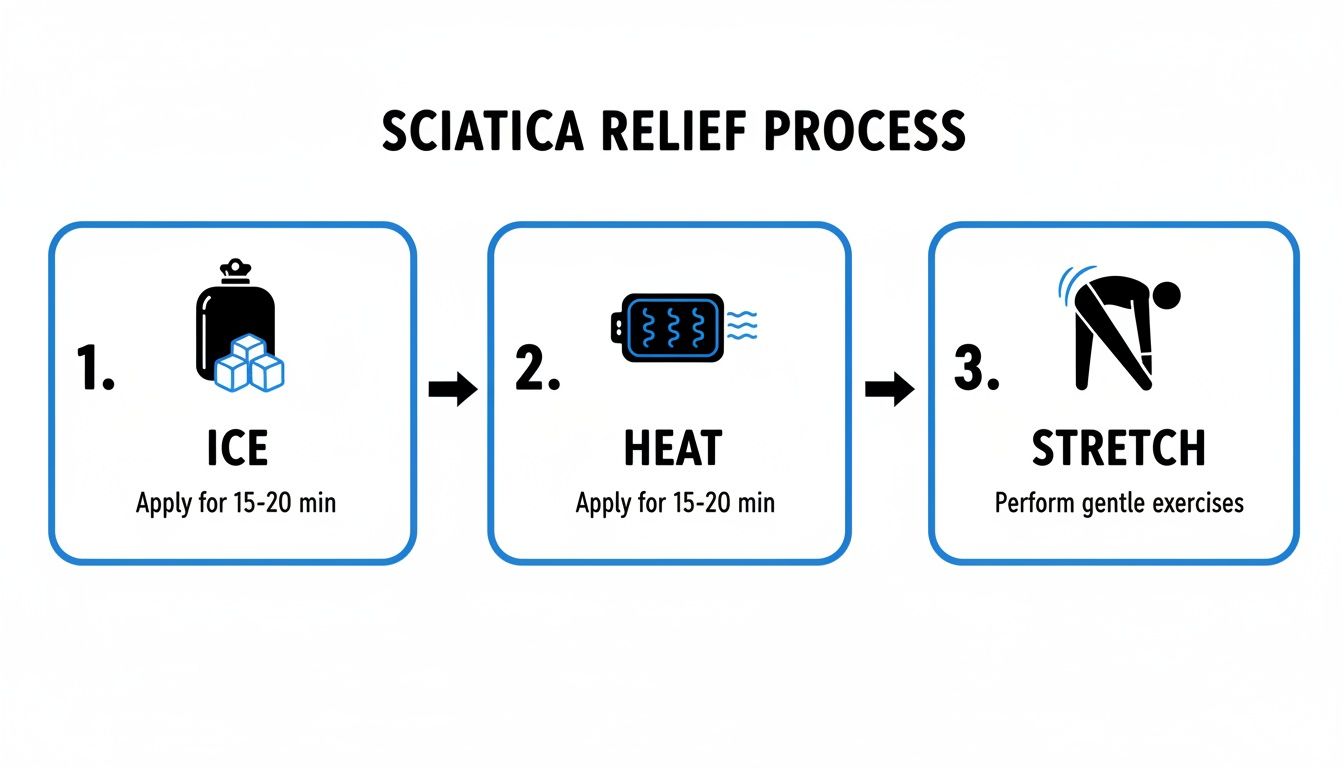
The flow from ice to heat and then gentle stretching gives you a clear roadmap for getting that initial pain under control, which paves the way for the more active recovery and strengthening work to come.
Progressing to Dynamic Strength and Mobility
Once you've got the foundational movements down and the worst of the pain has calmed down, it's time to add more dynamic exercises. This next phase is all about teaching your body to stay stable while in motion—a crucial skill for preventing re-injury during everyday activities like walking, bending over, or picking something up.
At the same time, you absolutely have to work on mobility, especially in your hips and hamstrings. When these areas are tight, they can pull your pelvis out of alignment, messing with your spinal mechanics and directly irritating the sciatic nerve. This is a very common problem we see in patients looking for a sciatica chiropractor in Charlotte.
Here’s a safe way to progress:
- Add Stability Challenges: Try more advanced variations of the bird-dog or add a light resistance band to your glute bridges.
- Bring in Standing Exercises: Things like bodyweight squats—done with perfect form—are excellent for building functional, real-world strength.
- Make Mobility a Priority: Gentle hamstring stretches and hip-opening poses like the pigeon pose can release the deep-seated tension that contributes to nerve compression.
Building a strong, mobile lower body is one of the most powerful ways to treat sciatica naturally and for good. For more ideas that fit this approach, check out our complete guide on back pain relief exercises. This kind of progressive plan helps you build a body that’s not just free from pain but is also far less likely to suffer another sciatica flare-up down the road.
How Your Diet Can Help Soothe Sciatic Nerve Pain
While gentle movements and proper spinal alignment are the bedrock of sciatica relief, what you eat plays a surprisingly powerful role. The food on your plate can either pour gasoline on the fire of inflammation, making your nerve pain worse, or it can give your body the tools to calm that inflammation down.
Think of your diet as another way to create a healing environment, but from the inside out. For many of our patients right here in Charlotte, shifting their nutritional focus becomes a game-changer on their journey toward lasting relief.
Systemic inflammation makes your entire body more sensitive to pain, and an already-irritated sciatic nerve is no exception. By making a few strategic food choices, you can directly influence your body's inflammatory response and give your nervous system the support it needs to heal.
Choosing Foods That Fight Inflammation
The core idea is pretty simple: eat more whole, unprocessed foods. These are packed with the natural anti-inflammatory compounds your body is craving. You don't have to follow a crazy-strict "diet"; it's more of a lifestyle shift focused on nutrient-dense choices.
Try to bring more of these healing foods into your daily routine:
- Foods Rich in Omega-3s: Think fatty fish like salmon and mackerel, along with walnuts and chia seeds. These are absolutely loaded with omega-3 fatty acids, which are true champions at knocking down inflammatory markers in the body.
- Antioxidant-Packed Fruits & Veggies: Berries, cherries, and leafy greens like spinach and kale are bursting with antioxidants. These compounds are like bodyguards, protecting your cells from the damage caused by inflammation and stress.
- Healing Spices: Turmeric contains a powerhouse compound called curcumin, a potent natural anti-inflammatory. Just adding it to your meals or sipping on some golden milk can be a simple, effective way to support your body's healing process.
Making these small, consistent changes can have a massive cumulative effect on how you feel. It's all about nourishing your body so it's better equipped to manage pain and repair itself.
The Importance of Hydration and Stress Management
Beyond what you eat, two other pieces of the puzzle are absolutely critical: hydration and stress.
Your spinal discs—the soft cushions between your vertebrae—are mostly water. When you're dehydrated, these discs can literally shrink and lose height, which can easily contribute to nerve compression. The fix is simple: aim to drink plenty of water throughout the day. This keeps your spinal discs plump and healthy, helping them do their job of absorbing shock and maintaining proper spacing for nerves.
Stress also has a very real, very physical impact. It triggers the release of cortisol, a stress hormone that drives up inflammation when it’s chronically high. Finding ways to manage that stress—whether it’s through deep breathing, a quiet walk in a Charlotte park, or mindfulness—helps calm your entire nervous system. And a calmer nervous system is a less painful one.
This holistic approach—addressing diet, hydration, and stress—is at the very heart of what we do at The Upper Cervical Spine Center. We believe in treating the whole person, not just the symptom, to create the conditions for genuine, lasting healing.
To help you get started, I've put together a simple guide to choosing foods that heal versus foods that can harm.
An Anti-Inflammatory Eating Plan for Sciatica Relief
This table offers a straightforward comparison to help you make smarter choices at the grocery store and in your kitchen. It’s a simple guide to choosing foods that help reduce inflammation and support nerve health versus those that can make it worse.
For those looking to take a fully holistic approach to nutrition, it can also be helpful to explore how certain nutrient-rich beef organ supplements can contribute to your overall wellness and support bodily functions important for natural pain management.
Combining a clean diet with targeted nutritional support can significantly enhance your body's ability to recover.
The Upper Cervical Connection: How We Treat Sciatica in Charlotte

It seems counterintuitive, doesn't it? The key to solving that searing pain in your lower back and leg might actually be at the very top of your neck. But your body isn't a collection of separate parts; it's a single, interconnected system. A small problem up top can absolutely create a cascade of issues all the way down.
Here at The Upper Cervical Spine Center in Charlotte, we see this connection play out every day. We often find that a subtle misalignment in the top two bones of the neck—the atlas (C1) and axis (C2)—is the hidden root cause of stubborn sciatica that just won't go away with other treatments.
When these vertebrae are out of place, your head tilts, even if it's imperceptible. Your brain's brilliant survival mechanism kicks in to keep your eyes level with the horizon, forcing the rest of your body to compensate. This creates a chain reaction: your shoulders become uneven, your spine twists, and eventually, your pelvis is thrown off-balance. That pelvic tilt is often the final straw that compresses the sciatic nerve.
A Gentle, Precise Approach to Sciatica
When people look for a "sciatica chiropractor in Charlotte," they're usually picturing the twisting and popping of the lower back common in traditional adjustments. Our approach is completely different. Upper cervical chiropractic care is a highly specialized field focused solely on that critical junction where your head meets your neck.
We don't guess. We use advanced 3D imaging to get an exact blueprint of your upper cervical spine, revealing the precise angle and direction of any misalignment. This allows us to perform an incredibly gentle and specific correction. There is no popping, cracking, or forceful twisting—ever.
The goal is to restore the clear communication pathway between your brain and your body. Once the atlas is back in its proper place, the body’s innate ability to heal and self-regulate takes over. The postural compensations start to unwind, the pelvis levels out naturally, and the pressure finally comes off the sciatic nerve for good.
For a deeper dive into this unique method, you can learn more about how our upper cervical explained process works to restore the body’s natural alignment and function from the top down.
What to Expect When Visiting Our Charlotte Chiropractic Clinic
Your first visit is purely about discovery. We’ll sit down and have a detailed conversation about your health history and what you've been experiencing. From there, we'll perform our advanced diagnostic imaging. This gives us the exact measurements we need to understand your body's unique alignment.
If we find that you're a candidate for care, we map out a correction plan just for you. The adjustment itself is just a light touch behind your ear, carefully calculated to guide the atlas back home. Our patient-focused process ensures you feel comfortable and informed every step of the way.
It's encouraging to know that this approach is backed by impressive results. Chiropractic care is a powerful natural treatment for sciatica, with studies showing a whopping 72% effectiveness rate for relief, according to recent 2025 statistics. This means the vast majority of patients find real, significant pain reduction without drugs or surgery—which is exactly what we focus on in our Charlotte, Wilmington, and Nashville clinics.
Addressing the Root Cause for Lasting Relief
So many treatments focus on quieting the symptoms in your low back or leg. While that might offer some temporary comfort, the problem almost always returns because the underlying cause was never fixed.
By focusing on the upper cervical spine, we aim to correct the foundational imbalance that triggered the sciatic nerve compression in the first place.
Our patients are consistently amazed that a gentle correction in their neck can bring such profound and lasting relief to their lower back and leg. That's because we're not just chasing the pain; we're restoring the body's proper structure and nervous system function. We solve the problem felt in the leg by addressing its true origin in the neck.
Answering Your Questions About Natural Sciatica Treatment
When you start looking into natural ways to treat sciatica, you're going to have questions. That's a good thing. You should feel confident and clear about the path you're taking for your health.
Here are some of the most common questions we hear from patients at our Charlotte clinic. We hope these answers give you the clarity you're looking for.
How Long Does Natural Sciatica Relief Usually Take?
Honestly, everyone's timeline is a bit different. For a flare-up of acute pain, many people start to feel a real difference within a few days or a couple of weeks, especially if they're consistent with at-home care like gentle movements and ice or heat.
But for more chronic, stubborn sciatica, lasting relief can take several weeks of dedicated work. In our Charlotte clinic, we often see patients report significant changes very soon after their first upper cervical adjustments. Why? Because we're getting right to the root cause, which frees up the body to start healing itself more effectively. Our goal isn't just a quick fix; it's to create long-term stability, and that's a journey we map out specifically for you.
When Should I See a Chiropractor for Sciatica?
If your sciatica pain is severe, just won't quit, or isn't getting any better after a week of trying things at home, it's time to see a professional. You should absolutely seek immediate care if you notice the numbness getting worse, significant weakness in your leg, or a constant "pins and needles" feeling in your leg or foot.
At The Upper Cervical Spine Center, we always suggest coming in for a consultation so we can figure out exactly what's causing your sciatica. Getting a precise diagnosis and starting care early is the fastest way to stop the problem from becoming a chronic battle and get you back to your life.
Is Upper Cervical Chiropractic Safe for Sciatica?
Yes, absolutely. Upper cervical chiropractic is incredibly gentle and precise. We don't do any of the forceful twisting, popping, or cracking that often comes to mind when people think about general chiropractic adjustments.
Our entire process is built on precision. We use advanced imaging to get exact measurements of your spinal alignment, which lets us deliver a calculated, specific correction right at the top of the neck. It's a gentle method designed to restore proper nervous system communication so your body can heal itself, and it's safe for people of all ages.
Can I Combine Chiropractic with Massage or Acupuncture?
Yes, and we often encourage it! Other therapies can work hand-in-hand with upper cervical care to support your recovery. They often provide fantastic symptom relief while we focus on correcting the foundational spinal issue that's causing the problem in the first place.
Here’s how they can complement each other:
- Massage Therapy is great for releasing tight muscles that can press on the sciatic nerve, especially that deep piriformis muscle in your glutes.
- Acupuncture has also become a go-to for natural pain management. A growing body of research shows it can be a game-changer. Systematic reviews have found it often outperforms medications, with one analysis showing acupuncture was 21% more effective than drugs for symptom improvement. You can read the full research about acupuncture's effectiveness for more details.
Once we correct the core misalignment here in our Charlotte office, you'll likely find that these other therapies become even more effective, helping to speed up the healing process.
Are you ready to find out if a gentle, precise upper cervical correction is the key to finally getting rid of your sciatica? At The Upper Cervical Spine Center, we're here to help you get to the root cause of your pain and build a recovery plan that doesn't involve drugs or surgery.
Schedule your complimentary consultation with our Charlotte team today by visiting https://www.uppercervicalspinecenter.com.
Address
2550 W Arrowood Rd
Suite 104
Charlotte, North Carolina, 28273
United States
Hours
Monday-Friday:
9AM-12PM
&
2PM-6PM
We Align the Head and Neck So That the Nerves Can Send Brain Healing Messages to Affected Parts Of Your Body.
It's a Natural Self Healing.
