
How Long Does Whiplash Last: A Guide for Charlotte Residents

After the shock of a car accident, one of the biggest questions on your mind is probably, "How long is this going to take?" If you're dealing with neck pain here in Charlotte, the uncertainty around whiplash recovery can be almost as frustrating as the pain itself. While every person’s healing journey is unique, we can look at typical timelines based on the severity of the injury.
For most people, whiplash symptoms clear up within a few weeks to three months. But for some, the pain and stiffness can linger for months or even years, turning into a chronic condition called Whiplash-Associated Disorder (WAD). Getting the right care from a local auto injury chiropractor quickly makes all the difference in a faster, more complete recovery. At The Upper Cervical Spine Center, we specialize in helping Charlotte residents find lasting relief.
What to Expect From Your Whiplash Recovery Timeline
The road to recovery isn't the same for everyone, but we can map it out by looking at the specific grade of the injury. Understanding where you fall on this spectrum can give you a much clearer idea of what to expect, from a minor strain to a more complex case involving neck and back pain.
This visual breakdown shows how the timeline can change depending on the severity.

As you can see, the expected recovery period gets significantly longer as the injury grade goes up. This really drives home why an early and accurate diagnosis from a chiropractor in Charlotte is so important for issues like neck pain, back pain, and sciatica after an accident.
Understanding Whiplash Grades
To give patients a clearer picture, healthcare providers classify whiplash injuries into different grades. This system helps estimate healing time and guide treatment.
Here’s a quick overview of the different grades of Whiplash-Associated Disorders (WAD) and their estimated recovery periods.
Whiplash Recovery Timelines by Injury Grade
These timelines are solid estimates, but remember, they can be influenced by your age, overall health, and how quickly you start treatment with a chiropractor near you.
Key Factors That Can Change Your Timeline
While the WAD grades provide a good baseline, they aren't the whole story. Several other factors can speed up or slow down your healing process.
- Injury Severity: A low-speed fender-bender is very different from a high-impact collision. More force usually means more damage and a longer recovery.
- Age and Overall Health: Younger individuals and those in good physical condition tend to heal faster. Pre-existing health issues can sometimes complicate recovery.
- Previous Injuries: If you've had neck or back injuries before, the new trauma can aggravate old problems, potentially extending your timeline.
It's crucial to remember that these are just general guidelines. Your personal recovery path might look different, which is why a professional evaluation is the best way to understand your specific situation.
Why You Shouldn't Wait to Get Checked
Putting off an evaluation is one of the biggest mistakes you can make after an accident. Delaying care can significantly lengthen your recovery and raise the risk of developing chronic pain.
Even if you feel "fine" or your symptoms seem minor, an underlying misalignment in your upper cervical spine could be preventing your body from healing correctly. This is why we always encourage anyone involved in a car accident in the Charlotte area to get a specialist’s opinion right away.
For a deeper dive from a car accident victim's perspective, this guide offers more details on the common question: how long does whiplash last. Understanding what’s possible empowers you to be proactive. Our goal is always to find the root cause of your pain and create a precise plan to help you heal as efficiently and completely as possible.
How Does a Whiplash Injury Actually Happen?
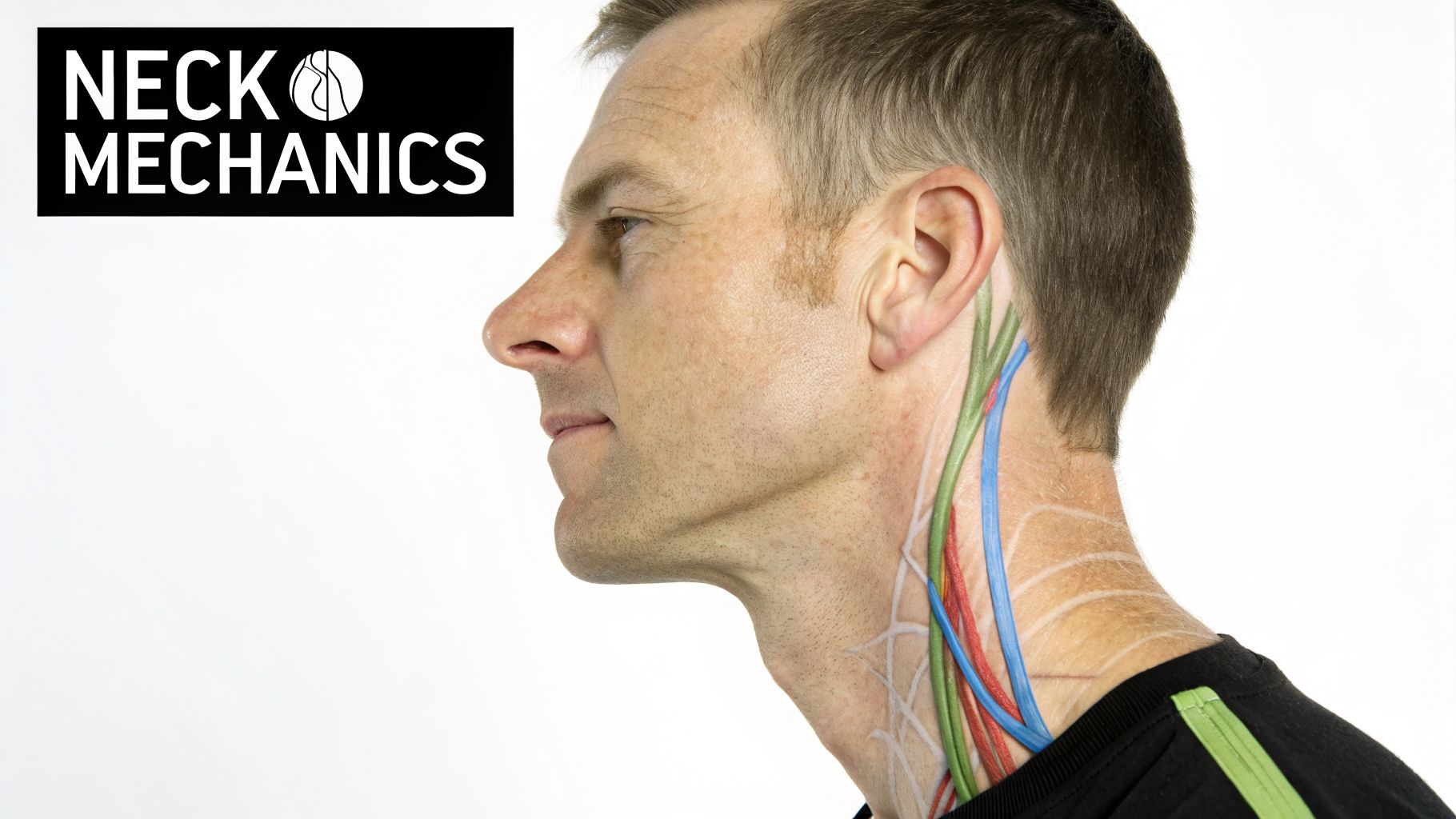
To get a real handle on how long whiplash can last, you first have to understand what’s physically happening inside your neck during that split-second impact. Think about snapping a rubber band—that sudden, violent overstretching is a pretty good analogy for what the muscles, ligaments, and tendons in your neck go through. This isn't just a simple muscle pull; it’s a complex trauma that affects some of the most delicate and important structures in your entire body.

The entire injury sequence is over in the blink of an eye. When a car is hit, your body lurches forward, but for a critical moment, your head stays put. This lag forces your cervical spine into an unnatural S-shape it was never built to withstand.
Right after that, your head is whipped forward, violently flexing your neck. This rapid back-and-forth motion can easily overstretch, and in some cases, even tear the soft tissues that hold your head up. Recognizing that whiplash is a common outcome in rear-end accidents helps patients in Charlotte connect their symptoms back to a specific event, even if the crash seemed minor at the time.
Why the Upper Neck Is So Critical
The area that takes the biggest hit during this jolt is the upper cervical spine. We're talking about the top two vertebrae, the atlas (C1) and the axis (C2). These bones are special. They’re designed for mobility, giving you most of your head's ability to turn and nod, but they don't have the same interlocking joints that provide stability to the rest of the spine.
This trade-off for mobility makes them incredibly vulnerable to being knocked out of alignment during an accident. When a misalignment happens here, it's a big deal. Why? Because it can:
- Irritate or pinch the brainstem and the nerves branching off it.
- Interfere with the circulation of cerebrospinal fluid, which is vital for brain function.
- Restrict proper blood flow to and from your brain.
Even a tiny misalignment in the upper neck—just a few millimeters—can create a massive amount of neurological interference. This can set off a chain reaction of symptoms that might not seem connected to your neck at all, like dizziness, brain fog, and relentless headaches.
This is exactly why so many Charlotte residents come to our clinic after a car accident with more than just a sore neck. They're often dealing with a whole host of issues that trace right back to a problem at the top of their spine.
From Injury to Symptoms: What's Happening Inside
After the soft tissues are damaged and the spine is knocked out of place, your body's natural defense system goes on high alert. This is when you start to feel the classic signs of whiplash, which can take hours or even a few days to fully show up.
- Inflammation and Swelling: Your body rushes inflammatory cells to the site of the injury to start the repair process. This brings on pain and swelling.
- Muscle Spasms: The muscles in your neck and shoulders clamp down to guard the injured area. This is what causes that rock-solid stiffness and makes it hard to turn your head.
- Nerve Irritation: The combination of swelling and misalignment can put direct pressure on sensitive nerves, leading to pain that shoots down into your shoulders and arms, or that pins-and-needles feeling.
- Headaches: Headaches are one of the most common complaints, often caused by tension from the tight muscles and pressure on nerves at the base of the skull.
All those things you feel—the ache, the stiffness, the headaches—are your body’s alarm bells. They are direct, logical results of the physical trauma, and they're telling you that something is wrong and needs to be fixed at the source. As an auto injury chiropractor in Charlotte, finding and correcting that source is always our first priority.
Why Your Whiplash Recovery Timeline Might Be Different
There's no single, predictable timeline for healing from whiplash, and it’s important to understand why. While the official injury grades give us a starting point, your personal recovery journey is just that—personal. Several key factors can dramatically change how long your whiplash lasts, which is why a one-size-fits-all approach just doesn't work.
Knowing what these variables are is the first step toward taking control of your recovery. It also highlights why a personalized evaluation from an auto injury chiropractor in Charlotte is so critical. A thorough assessment allows us to build a care plan that’s built for your body and the specific details of your accident.
The Physics of the Crash
The severity and direction of the collision play a massive role. A minor tap in a parking lot is a world away from a high-speed wreck on the highway. The more force your body absorbs, the more damage you can expect to the muscles, ligaments, and the delicate joints of the upper cervical spine. More damage almost always means a longer recovery.
The angle of impact matters, too. We all think of rear-end collisions when we hear "whiplash," but side-impact (T-bone) crashes are often worse. They add a violent twisting motion to the mix, which can complicate the injury and drag out the healing process.
Your Age and Pre-Existing Health
Simply put, your body's ability to repair itself changes over time. Younger people generally bounce back from soft tissue injuries more quickly. As we get older, natural changes in tissue elasticity and joint health can slow things down.
Your health before the accident is another big factor. If you were already dealing with something like neck arthritis or a previous spinal injury, a new whiplash injury can pour fuel on the fire, making the road to recovery much more complex.
When the Pain Shows Up
It sounds strange, but feeling okay right after a crash isn't always a good thing. The adrenaline surging through your system is a powerful painkiller that can mask serious injuries for hours or even a full day.
A delayed onset of severe pain can be a red flag. It sometimes points to a more subtle but significant problem, like a critical misalignment in the upper neck that wasn't immediately obvious. Ignoring it allows the problem to get worse, which only prolongs recovery.
This is exactly why we recommend getting checked out by a specialist, even if you don't feel much pain at first.
What the Research Tells Us About Recovery
Studies show that whiplash recovery tends to follow one of three paths. Most of the healing and improvement you'll experience happens within the first three months. Research that follows whiplash patients over time has found that about 50% recover completely. The other half, unfortunately, may deal with lingering symptoms that level off after that initial 12-week window.
How much pain and stiffness you have right at the beginning is a strong clue as to which path you'll follow. This really highlights how important it is to get the right care during the acute phase (the first two weeks) and the subacute phase (up to 12 weeks). If you want to dig into the data yourself, you can explore the research on whiplash recovery trajectories and see just how much early intervention matters.
All these variables point to one simple truth: your injury is unique. A successful recovery hinges on a plan that accounts for your health history, the accident details, and the precise nature of the damage. At The Upper Cervical Spine Center, our focus is always on digging deep to find the root cause of your pain so we can provide targeted, effective relief.
The Risk of Chronic Pain When Whiplash Lingers
One of the biggest worries after a car accident is the nagging thought: what if this pain never goes away? While most people with a minor whiplash injury start to feel better within a few weeks, that’s not everyone’s story. When the pain, stiffness, and other symptoms drag on for months, it’s no longer a simple sprain—it's become chronic whiplash.
This happens when the symptoms stick around for more than three months. It's not because you're doing something wrong; it's a clear signal that something is preventing your body from healing properly. Often, the initial injury was more complex than it seemed, and a core problem hasn't been addressed. For many, that hidden problem is a subtle but significant misalignment in the upper neck that happened during the impact.
How an Atlas Misalignment Stalls Your Recovery
The jolt of a whiplash injury is brutal on the neck, and the most delicate part is the very top—the atlas, or C1 vertebra. This is the ring-like bone your skull rests on. Unlike the rest of your spine, it doesn’t have interlocking joints, making it far less stable and incredibly easy to knock out of place during a sudden back-and-forth motion.
When the atlas gets shifted, even by a tiny amount, it can throw a wrench into your body’s entire operating system. This misalignment can:
- Put constant, irritating pressure on the brainstem and surrounding nerves.
- Interfere with the normal circulation of blood to and from your brain.
- Force your neck muscles into a state of permanent tension as they struggle to compensate for the imbalance.
This one unresolved issue can bring your recovery to a screeching halt, trapping your body in a vicious cycle of pain and inflammation. The original injury simply can't heal because the very foundation of your neck is out of alignment.
An unresolved atlas misalignment is like trying to build a house on a crooked foundation. You can keep patching the cracks in the walls, but the structure will never be truly stable until you fix the foundation itself.
The Long-Term Consequences of Unresolved Whiplash
When whiplash shifts from a short-term injury to a chronic condition, the symptoms can become a daily reality that chips away at your quality of life. What began as a sore neck can slowly morph into a whole host of persistent problems.
Common long-term issues tied to unresolved whiplash include:
- Persistent Neck Pain: A constant, nagging ache that just won't quit.
- Chronic Headaches or Migraines: Head pain that often starts at the base of the skull and becomes more frequent and intense over time.
- Brain Fog and Dizziness: Trouble with concentration, feeling mentally "slow," or a lingering sense of being off-balance.
- Radiating Pain or Numbness: Symptoms that travel down from the neck into the shoulders, arms, or even the hands.
These aren't random symptoms; they are often the direct result of the ongoing irritation to your nervous system caused by that upper cervical misalignment. If the root cause isn't corrected, these problems are likely to stick around.
The statistics on long-term whiplash outcomes are sobering. Research that followed whiplash patients for over seven years revealed that a full recovery isn't guaranteed. In one study, only 29% of patients were completely symptom-free years later. The rest—a staggering 71%—still had lingering issues, and 21% reported their symptoms were intrusive enough to require ongoing medical care. You can read more about these long-term whiplash findings to see just how serious it can be.
This data really drives home the need for specialized care that gets to the root of the injury, giving you the best chance at a complete recovery instead of a lifetime of managing chronic pain.
How Our Charlotte Chiropractor Helps You Heal
When you're dealing with whiplash, the goal isn't just masking the pain—it's about getting to the root of the problem so your body can actually heal. This is precisely where our specialized upper cervical chiropractic care comes in. It's a world away from general chiropractic that might involve twisting or popping the whole spine. Our focus at The Upper Cervical Spine Center is laser-sharp, gentle, and precise, zeroing in on the one area that takes the biggest hit in a car accident: the upper neck.
The sheer force from a collision, even a seemingly minor one, can easily shove the top two bones in your spine—the atlas (C1) and axis (C2)—out of their natural alignment. Imagine this misalignment as a major traffic jam at the base of your skull. It chokes off the vital communication between your brain and your body, creating a domino effect of issues that stalls your recovery.
Our entire approach is built around clearing that traffic jam, gently and effectively, so your body's own healing intelligence can finally get to work.
The Gentle Power of a Precise Correction
The first thing people notice about our care is how non-invasive it is. There is absolutely no forceful manipulation, cracking, or popping involved. Instead, we start with a series of incredibly accurate, objective measurements and detailed imaging to pinpoint the exact direction and degree of the misalignment.
This data allows us to perform a correction that is:
- Calculated and Specific: It's tailored to your exact spinal structure, not a one-size-fits-all approach.
- Incredibly Gentle: Patients often describe it as a light, quick touch behind the ear.
- Highly Effective: It’s designed to restore proper alignment without irritating an already sensitive and injured area.
This gentle precision is a game-changer for auto injury patients in Charlotte. When your neck muscles and ligaments are already inflamed and guarded, the last thing you need is more stress. Our method corrects the underlying structural problem without adding to it.
Restoring Your Body's Master Control System
Your brainstem, which is housed and protected by that top atlas vertebra, acts as the master control center for countless functions we never think about—from breathing and heart rate to managing pain signals and inflammation. When the atlas is knocked out of place, it can put direct pressure on this vital area, disrupting its ability to send and receive clear signals.
An upper cervical misalignment is like having static on the line between your brain and your body. The signals get distorted, leading to persistent symptoms like chronic pain, headaches, dizziness, and brain fog that just don't seem to respond to anything else.
By gently correcting the misalignment, we take that pressure off the nervous system. Think of it as restoring a clear connection. This allows your body to start regulating itself properly again. It can finally begin the healing process, naturally calming inflammation and dialing down overactive pain signals.
Empowering Your Body to Fix Itself
Ultimately, the goal of upper cervical chiropractic care is to create the ideal conditions for your body to heal from the inside out. It's not about providing a temporary fix. Once the atlas is stable and in its proper position, the benefits ripple out far beyond just your neck.
Proper spinal alignment improves blood flow to the brain, allows for better drainage of inflammatory waste products, and helps restore balanced muscle tone. This foundational stability gives the damaged soft tissues in your neck the break they need to finally repair themselves without the constant strain of a structural problem. For so many of our Charlotte patients, this means a faster, more complete, and more lasting recovery from their whiplash injury.
If you're interested in the science behind this unique approach, you can get a closer look at what makes our care so different by exploring how upper cervical treatment works. This focused method is often the key to breaking the cycle of chronic pain and helping you truly move forward after an accident.
What to Expect on Your First Visit to Our Charlotte Clinic
We know that taking that first step toward dealing with an injury, especially when you're in pain, can feel overwhelming. That’s why we’ve designed the entire process here at The Upper Cervical Spine Center in Charlotte to be as straightforward and reassuring as possible, right from the very first phone call.
Your journey starts with a complimentary phone consultation. This isn't a sales pitch; it's a simple conversation to see if we're the right place for you.

During this call, you can tell us what's been going on. It gives us a chance to listen and see if the symptoms you're describing—whether from whiplash, neck pain, or sciatica—point toward a problem our specific type of care can solve.
Your Comprehensive Initial Examination
If it sounds like a good fit, we'll schedule your first visit. This appointment is all about one thing: a deep-dive, comprehensive examination. We aren't interested in guesswork; our goal is to pinpoint the exact root cause of your problem.
This thorough evaluation always includes:
- A Detailed Health History: We’ll talk through everything—the details of your car accident, when your symptoms started, and your overall health picture.
- Precision Imaging: We rely on advanced 3D imaging to get an incredibly precise view of your upper cervical spine. This isn't a standard X-ray; it shows us the exact angle and direction of any misalignment.
- Objective Neurological Tests: These tests give us a clear baseline of how your nervous system is functioning and help us spot any interference a spinal misalignment might be causing.
This in-depth diagnostic process is what sets our care apart. It provides the hard data we need to confirm if an upper cervical misalignment exists and, just as importantly, if we're confident we can truly help you.
A Clear Path Forward
After your exam, we'll book a follow-up to go over everything together. We’ll pull up your images, point out exactly what we see happening at the top of your neck, and lay out a personalized care plan designed to correct it.
We have a simple, transparent promise: We will only accept you as a patient if we genuinely believe our care can lead to significant, lasting improvement. It's a patient-first approach that ensures you feel informed and in control from day one.
To get a more detailed look at the process before you call, you can read a complete overview of your first visit on our website.
Your Whiplash Recovery Questions, Answered
If you've been in a car accident in Charlotte, you’re bound to have questions. Feeling uncertain is completely normal, but getting clear, expert answers can make all the difference in your healing journey. Let's walk through some of the most common concerns we hear from our patients dealing with whiplash.
Should I Get Checked by a Chiropractor Right After an Accident?
Yes, and the sooner, the better. One of the trickiest things about whiplash is that the symptoms often don't show up right away. You might feel fine for a few days, or even a week, before the neck pain, stiffness, and headaches really set in.
Getting a specialized evaluation at The Upper Cervical Spine Center as soon as possible allows us to spot any subtle misalignments in your atlas—the top bone in your neck—before they escalate into bigger, more chronic issues. Think of it as getting ahead of the problem, which can lead to a much smoother and faster recovery.
Is Upper Cervical Chiropractic Safe for a Whiplash Injury?
Absolutely. In fact, its gentle nature is precisely why it's so well-suited for a sensitive injury like whiplash. We avoid any of the forceful twisting or popping you might associate with general chiropractic.
Instead, our approach is based on precise, advanced 3D imaging that shows us exactly what needs to be corrected. The adjustment itself is incredibly gentle, designed to restore proper alignment without causing further stress to your injured neck. It’s all about working with your body’s natural healing process, not against it.
What Makes Your Approach Different from a Regular Chiropractor?
The main difference is our hyper-focused specialty: the upper cervical spine. This is the critical junction where your head meets your neck, specifically the atlas (C1) vertebra. This area is the gateway for your entire nervous system, protecting the delicate brainstem.
While general chiropractic addresses the entire spine, we concentrate on correcting misalignments at this foundational point. A problem here can create a ripple effect of dysfunction throughout the rest of your body.
By restoring balance at the very top of the spine, we empower the rest of the body to function and heal as it was designed to. It’s about correcting the cause, not just chasing symptoms.
Can This Actually Help with My Headaches and Dizziness?
Yes, it’s one of the most common reasons people seek our care. Those classic whiplash symptoms—headaches, dizziness, even brain fog—are frequently traced back to an atlas misalignment that’s irritating nerves and restricting proper blood flow to the brain.
Our specialized adjustments are incredibly effective at resolving this core issue. By gently guiding the atlas back into its proper position, we take the pressure off your nervous system. For our Charlotte patients, this often means significant, natural relief from these debilitating symptoms without a reliance on medication.
If you're tired of wondering "how long does whiplash last" and you're ready to address the root cause of your pain, we're here to help. At The Upper Cervical Spine Center, our team is dedicated to providing the precise, gentle care you need to recover fully.
Take the first step toward lasting relief. Schedule your complimentary clarity call today and discover how upper cervical care can change your recovery.
Address
2550 W Arrowood Rd
Suite 104
Charlotte, North Carolina, 28273
United States
Hours
Monday-Friday:
9AM-12PM
&
2PM-6PM
We Align the Head and Neck So That the Nerves Can Send Brain Healing Messages to Affected Parts Of Your Body.
It's a Natural Self Healing.
