
Atlas Misalignment Symptoms: A Guide for Charlotte, Wilmington & Nashville Residents

If you've been searching for answers to nagging headaches, dizziness, or neck pain that just won't quit, the problem might be hiding in a place most people never think to look: an atlas misalignment. As a trusted upper cervical chiropractor serving Charlotte, Wilmington, and Nashville, we see patients every day who are frustrated and looking for real solutions.
Your atlas, or C1 vertebra, is the very first bone in your spine, sitting right where your head meets your neck. It’s a crucial connection point, and when it shifts out of place, it can disrupt nerve signals and blood flow. This can trigger a host of symptoms that seem completely random and disconnected, leaving you wondering if you'll ever feel normal again.
Your Guide to Understanding Atlas Misalignment
When the atlas is misaligned, the pain isn't always just in your neck. This tiny bone has a huge job—it protects the brainstem, which is the body's master control panel. Even a tiny shift can create system-wide chaos. We created this guide for our community in Charlotte, Wilmington, and Nashville who are tired of guessing and ready for real answers from a local chiropractor who understands.
Think of your atlas like the foundation of a house. If that foundation is even slightly crooked, it doesn't just create a problem in the basement. It puts stress on the walls, the roof, and the plumbing—the whole structure becomes unstable. An atlas misalignment does the same thing, forcing your body into a state of constant compensation and sparking a chain reaction of symptoms.
The Widespread Impact of a Small Misalignment
You might be surprised to learn how common this is. Some studies suggest that as many as 85% of people could have some degree of atlas misalignment and not even realize it. That number helps explain why so many people are walking around with chronic issues they can't pin down.
For example, one sleep study of 200 patients with a confirmed atlas misalignment found that 82% of participants had trouble finding a comfortable sleeping position, while 65% consistently woke up with neck pain. You can read more about how this condition affects sleep and overall wellness.
So, how does this happen? It's usually the result of physical stress or trauma, sometimes from an event you've long since forgotten about.
- Car accidents and whiplash, even a minor fender-bender from years ago.
- Sports injuries, especially from contact sports or anything involving a sudden jolt to the head.
- Slips and falls that send a jarring impact up the spine.
- Poor posture built up over years, like the "tech neck" we all get from staring down at our phones.
At The Upper Cervical Spine Center, we’ve seen time and time again how these seemingly unrelated symptoms all trace back to one single origin point. Our entire practice is built around finding and correcting this foundational problem to restore the vital communication link between your brain and your body.
Instead of just chasing symptoms, our upper cervical chiropractic care focuses on addressing the root cause. By correcting the misalignment, we allow your body to do what it does best: heal itself. This guide will walk you through the common signs of an atlas issue and explain how our precise, gentle upper cervical care can help you find lasting relief.
Headaches, Migraines, and Chronic Neck Pain
If there's one set of symptoms that sends people searching for a "neck pain chiropractor near me," it's the trifecta of persistent headaches, debilitating migraines, and relentless neck pain. If you're constantly dealing with a nagging ache at the base of your skull or migraines that completely shut down your life, the problem might not be in your head at all—it could be starting in your neck.
The atlas cradles your skull. When it shifts even slightly out of place, it can directly irritate the incredibly sensitive nerves and blood vessels that travel through that tight space. Imagine a kink in a garden hose; the water flow is immediately disrupted. A misaligned atlas does something similar, creating a bottleneck for nerve signals and blood flow between your brain and the rest of your body.
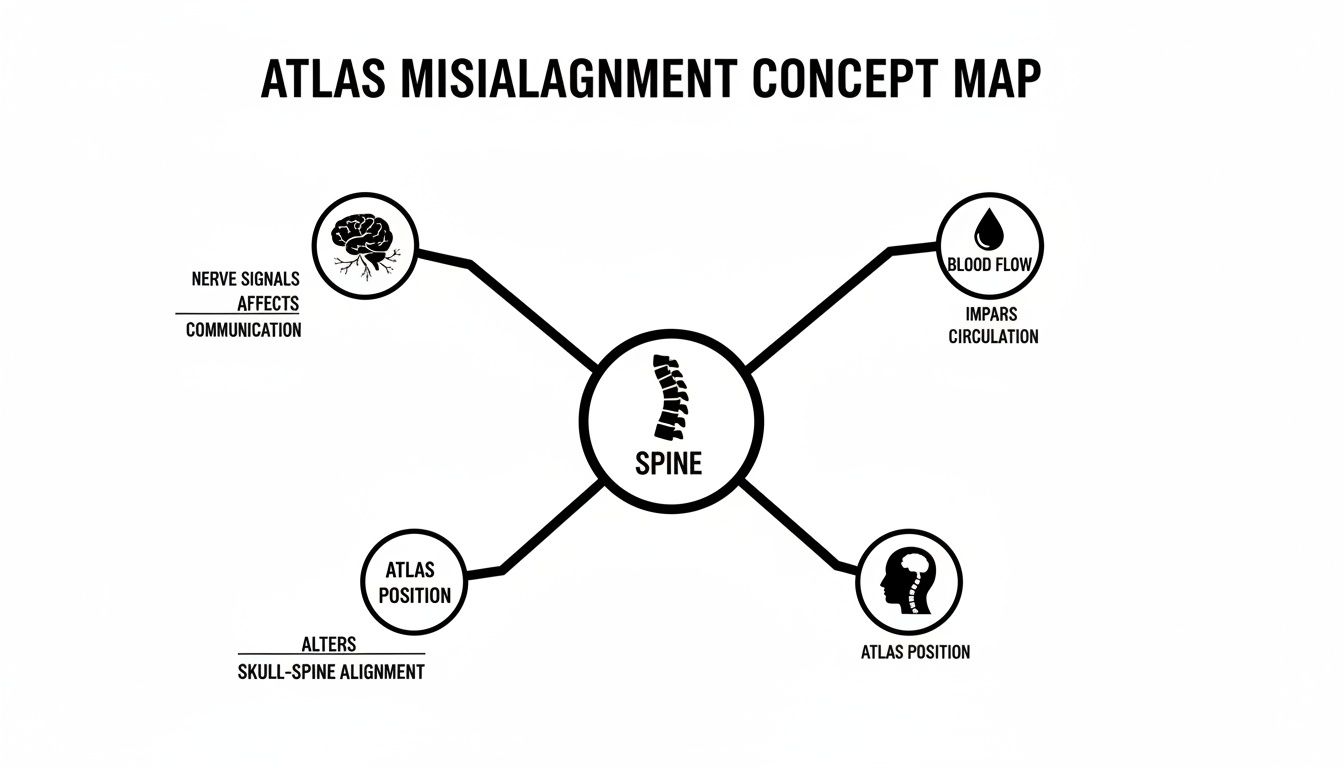
This isn't just a theory; it's a direct cause-and-effect relationship our patients experience. This is why pain medications often feel like a temporary fix—they're masking the pain signal, but they aren't addressing the structural issue causing the signal in the first place.
The Clear Link Between Your Atlas and Head Pain
When we look at the research, the connection becomes undeniable. Some studies suggest that up to 90% of all headaches can be traced back to an issue in the neck.
When the atlas is out of alignment, it can either physically pinch a nerve or restrict blood flow in the vessels that supply the brain. These are two of the biggest known triggers for both tension headaches and full-blown migraines. This is why you can have a "clean" MRI of your head but still suffer from debilitating pain; the problem isn't where the pain is felt, but where it originates.
To help you see if your symptoms fit the pattern, we've put together a quick comparison of the well-known signs versus the ones that often get missed.
Common vs. Less Obvious Symptoms of Atlas Misalignment
Recognizing that a cluster of seemingly unrelated symptoms—like jaw pain, dizziness, and migraines—could all point back to one root cause is often the first step toward finding real relief with chiropractic care.
Are All Headaches the Same?
The specific type of head pain you experience can give us important clues about what’s happening in your upper neck. An atlas misalignment can trigger a few distinct headache patterns:
- Tension Headaches: This feels like a constant, dull pressure or a tight band wrapped around your head. It’s often caused by the neck and shoulder muscles working overtime to compensate for a head that's not sitting correctly on the spine.
- Migraines: Far more than just a bad headache, a migraine is a severe, throbbing pain, usually on one side of the head. It's often accompanied by nausea and light sensitivity. The connection here is often vascular—that "kinked hose" effect on blood flow we mentioned earlier.
- Cervicogenic Headaches: The name says it all: "cervicogenic" literally means "originating from the neck." The pain is referred from a problem in the upper spine into the head. It typically starts at the base of the skull and can radiate up over your scalp or behind your eyes.
For so many of our patients, understanding their chronic migraines aren't just a random neurological event but a direct result of a fixable structural problem changes everything. It’s a massive shift from simply managing pain to actually correcting the cause.
Dizziness, Vertigo, and Unexplained Balance Issues

Feeling unsteady, dizzy, or as if the room is spinning can be incredibly disruptive. For so many of our patients in Nashville, Charlotte, and Wilmington, these balance problems seem to appear out of the blue, causing a great deal of anxiety and confusion. While there are many potential causes for these sensations, a misalignment of the atlas vertebra is one of the most frequently overlooked.
Your sense of balance relies on a sophisticated system, with the brainstem acting as the central command post. This vital structure constantly interprets signals from your eyes, inner ears, and the nerves in your joints to figure out your body's position in space. The atlas (C1) sits right next to the brainstem, so when it shifts, it can send a steady stream of distorted signals. Your brain gets bad information, creating a mismatch between what your body is actually doing and what your brain thinks it's doing.
The Brainstem Connection to Balance
Think of it like trying to pilot a boat with a compass that's permanently stuck a few degrees off. Even if you're an expert navigator, you'll constantly drift off course because your main tool is giving you faulty data. That’s a pretty good analogy for what happens when the atlas is misaligned.
The brain is flooded with incorrect information about where your head is, which makes it misjudge your body's true orientation. This neurological static is what sparks the unsettling—and sometimes frightening—symptoms of dizziness and vertigo. Realigning the atlas is like recalibrating that compass, allowing your brain to receive clear and accurate signals once again.
We often hear patients say things like, "I've had my ears checked and my vision is fine, but I still feel off-balance." This is a classic sign that the issue might not be the sensors (your eyes and ears) but the processor—the brainstem—which is directly affected by your atlas alignment.
How Atlas Misalignment Distorts Your Sense of Position
This built-in sense of where your body is in space is called proprioception. It’s the "sixth sense" that lets you touch your finger to your nose with your eyes closed or walk down a hallway without staring at your feet. An atlas misalignment creates a proprioceptive deficit.
The tiny muscles at the base of your skull have the highest concentration of nerve receptors in your entire body, and they are constantly feeding your brain positioning data. When the atlas shifts, these muscles get pulled into an imbalance, firing off chaotic signals. This can manifest as:
- Vertigo: The distinct and powerful sensation that you or the room around you is spinning.
- Dizziness: A more generalized feeling of being lightheaded, woozy, or unsteady.
- Disequilibrium: A constant feeling of being off-balance, almost as if you're about to fall.
When dealing with the chronic neck tension that often comes with this, learning about targeted techniques like myofascial release and trigger point therapy can be beneficial. However, by correcting the foundational structural problem with an upper cervical adjustment, we can help restore your body's natural sense of balance from the inside out. To explore this further, you can read our detailed guide on the reasons for vertigo and effective relief options.
How Does Trauma Cause an Atlas Misalignment?
While things like poor posture can definitely add stress to your spine over the years, a true atlas misalignment—where that top vertebra gets knocked out of place—almost always comes down to a single, significant physical trauma. Think about it: the very design that gives your head such an incredible range of motion also makes the upper neck uniquely susceptible to injury from sudden, jarring forces.
For so many of our patients here in Charlotte, Wilmington, and Nashville, the story starts with an event they barely remember. A fender bender from a decade ago, a nasty slip on an icy sidewalk, or even a hard hit in a high school football game can be enough to shift the C1 vertebra off its proper alignment.
The Classic Example: A Whiplash Injury
Whiplash is the textbook case of how this happens. When you're in a rear-end collision, your head gets thrown backward and then snapped forward in a violent acceleration-deceleration motion. This puts an incredible amount of strain on the delicate ligaments and muscles responsible for holding the atlas steady.
Those supportive tissues can get stretched or sprained, losing their grip on the C1 vertebra. When that stability is gone, the atlas can get stuck in a misaligned position—perhaps tilted or rotated by just a few millimeters. It sounds tiny, but that small shift is more than enough to throw the central nervous system into chaos.
The link between a past trauma and a current atlas misalignment isn't just a theory; it's something we see in our chiropractic clinic every single day. Once you grasp that a single event can kick off a chain reaction of symptoms that lasts for decades, it becomes obvious why correcting that original injury is the key to lasting health.
Why Symptoms Show Up Years Later
One of the most confusing things for patients is the delayed onset of symptoms. You might walk away from a car accident feeling a bit sore but assuming you're fine. Then, months or even years later, you start struggling with chronic migraines, vertigo, or fatigue that you just can't shake.
This delay is a testament to how resilient your body is. It will twist and contort the rest of the spine, tighten up muscles, and alter your posture—anything to compensate for that misplaced atlas. For a while, that strategy works. But eventually, the constant strain of compensation wears the body down, and that's when the persistent atlas misalignment symptoms finally break through.
This is a crucial concept for anyone in the Charlotte, Nashville, or Wilmington area who has a history of head or neck trauma. That old injury could very well be the hidden root cause of the health issues you're facing today.
The Overwhelming Connection to Trauma
The evidence linking trauma to these misalignments is impossible to ignore. A detailed analysis of atlas misalignment cases revealed that a staggering 100% of patients had a history of whiplash or a similar injury to their neck. This statistic really drives home just how impactful these events are on the upper cervical spine. In one specific case study, a patient's pain levels plummeted from severe to nearly zero over a few years of care, proving how powerful it is to correct the initial trauma. You can discover more about these findings on cervical trauma and recovery.
This is precisely why our intake process at The Upper Cervical Spine Center is so in-depth. We don't just focus on your current symptoms. We dig deep into your health history to uncover any past traumas, no matter how minor they seemed at the time. Getting an evaluation from an auto injury chiropractor is so important because it helps connect the dots between a past event and your present-day struggles, creating a clear path toward care that finally targets the source of the problem.
Our Approach to Diagnosis and Treatment

Realizing that your symptoms might be coming from an atlas misalignment is a huge first step. The next, of course, is finding out for sure. At The Upper Cervical Spine Center, we’ve built a diagnostic process that’s as precise as it is reassuring, designed to move from problem to solution without any guesswork.
Our entire philosophy is built on one simple idea: measure, don't guess. When you come to see us in Charlotte, Wilmington, or Nashville, our first job is to map the exact three-dimensional position of your atlas. We do this using a series of specialized, low-dose digital images taken from very specific angles.
This detailed imaging becomes the blueprint for your care. It shows us the exact degree of tilt, shift, or rotation of your C1 vertebra—a pattern that is completely unique to you. With that information, we can calculate the precise, gentle correction needed to restore proper alignment.
Your First Visit: What to Expect
We understand. Seeing a new doctor can be stressful, especially when you've been living with chronic symptoms. Our team is here to make your experience comfortable, informative, and empowering from the moment you step into our clinic.
Your initial consultation is really just a conversation. We’ll sit down and listen. We want to hear your health history, learn about past traumas like car accidents or falls, and understand the specific symptoms you're facing. This conversation helps us start connecting the dots between your past and your present.
We believe the most effective care is a partnership. Our commitment is to give you a clear understanding of what’s happening in your body and a logical plan for how we can help correct it, so you can feel confident and in control of your health journey.
After we talk and complete a thorough examination, we'll determine if you're a good candidate for our care. If you are, we'll proceed with the necessary diagnostic imaging to get the full picture before any correction is made.
Gentle and Precise Adjustments
Probably the biggest question we get from new patients revolves around the adjustment itself. Many people picture the kind of forceful twisting or cracking often associated with general chiropractic care.
That is not what we do.
Our upper cervical corrections are incredibly gentle and controlled. There is absolutely no popping or twisting of the neck. The adjustment is just a light, specific contact applied to the upper neck, guided by the precise measurements from your images. It’s just enough to nudge the atlas back toward its natural, stable position.
This non-invasive approach is safe, comfortable, and highly effective because it’s tailored specifically to you. The entire goal is to restore that critical communication line between your brain and body, allowing your nervous system to finally function without interference.
Of course, a big part of recovery is addressing the ripple effects of the misalignment, like muscle imbalances. This guide on how to correct muscle imbalances offers a great overview of self-assessment and exercises that support our holistic approach. By fixing the root cause, we help your body’s supporting structures find their balance again.
Whether you're looking for a neck pain chiropractor in Charlotte or an auto injury chiropractor in Nashville, our process is always the same: precise diagnosis followed by gentle, specific care.
Ready to Find Lasting Relief?
If you've been nodding along while reading this guide—recognizing your own battle with chronic headaches, dizzy spells, or that stubborn neck pain—it’s time for a new perspective. These aren't just random aches you have to live with. They're signals that something is out of sync at the very top of your spine.
Real healing isn't about chasing symptoms with temporary fixes. It starts by correcting the underlying problem. For many people, that problem is a subtle misalignment of the atlas (C1) vertebra, which can throw the entire nervous system off balance. This is where your journey back to feeling like yourself truly begins.
Your Next Step in Charlotte, Wilmington, or Nashville
If you're in the Charlotte, Wilmington, or Nashville areas and you're tired of the runaround, we want to make it easy for you to find answers. You don't have to wonder if upper cervical care is the right path. We believe in providing clarity without any pressure.
It all starts with a simple conversation. We offer a complimentary clarity call with a member of Dr. Ray Drury's team to help you understand your options. This call is a chance for you to:
- Talk about the specific symptoms and health issues you're facing.
- Get straight answers to all your questions about upper cervical care.
- Learn what makes our gentle, precise approach different.
- Find out if you might be a good candidate for care at The Upper Cervical Spine Center.
Your health is your greatest asset. Investing a few minutes to explore a solution that gets to the root cause of your suffering—instead of just managing the pain—is an investment in your future.
There's absolutely no cost or obligation for this call. Our mission is simply to give you the information you need to make the best decision for your health. If you’re ready to break free from the cycle of pain and medication, we’re here to guide you.
Stop letting pain dictate your life. Schedule your complimentary clarity call today and discover if our specialized care holds the key to the relief you've been searching for. It’s time to take back your health.
Frequently Asked Questions
It's completely normal to have questions when you're exploring a new approach to your health. We hear many of the same concerns from people who visit our chiropractic clinics in Charlotte, Wilmington, and Nashville. Below, we've answered some of the most common ones to help you find clarity.
How Do I Know If an Atlas Misalignment Is Causing My Symptoms?
That's the key question, isn't it? While only a specialized exam with precise imaging can give a definitive answer, there are strong clues.
A major one is dealing with chronic symptoms that haven't improved with other treatments. If you've tried everything for persistent headaches, stubborn vertigo, or neck pain that never really goes away, it's a good sign something deeper is at play. This is especially true if you can trace your issues back to a specific head or neck injury, even if it happened years ago.
Is an Upper Cervical Adjustment Safe?
Yes, absolutely. The first thing to know is that this is not a typical chiropractic adjustment. We specialize in an extremely gentle and precise technique with no twisting, popping, or cracking of the neck.
The correction itself is a light, controlled touch applied to the first bone in your neck. It’s carefully calculated based on your own diagnostic images to nudge the C1 vertebra back into its proper place. Because it's so specific and gentle, the procedure is safe for everyone, from children to seniors.
One of the most common things we hear right after a patient's first correction is, "Is that it?" The gentleness is surprising, but the power is in the precision, not the force.
How Long Does It Take to Feel Better?
Everyone's body responds differently. Your healing timeline really depends on the severity of your misalignment and how long your body has been compensating for it. Many of our patients in Charlotte, Nashville, and Wilmington feel some immediate changes—less pain, clearer thinking, or just a feeling of lightness in their head and neck.
But the real, lasting improvement happens over the following weeks and months. As the alignment holds, your nervous system can finally start functioning without interference, which kickstarts the body's natural healing process. We map out a personalized care plan to guide you through this stabilization phase.
Will I Need Treatment Forever?
No, our goal is the exact opposite. We focus on corrective care, which means we want to fix the underlying problem so your body can hold the alignment on its own.
In the beginning, visits are more frequent because we need to check that the correction is stabilizing. As your body gets stronger and holds the alignment for longer periods, we drastically reduce the frequency of your visits. The ultimate goal is for you to only need periodic check-ups to protect your investment in your health and ensure everything stays where it should be.
At The Upper Cervical Spine Center, we want you to have clear answers and a clear path forward. If you still have questions, we invite you to schedule a complimentary clarity call to talk about your specific health concerns.
Address
2550 W Arrowood Rd
Suite 104
Charlotte, North Carolina, 28273
United States
Hours
Monday-Friday:
9AM-12PM
&
2PM-6PM
We Align the Head and Neck So That the Nerves Can Send Brain Healing Messages to Affected Parts Of Your Body.
It's a Natural Self Healing.
